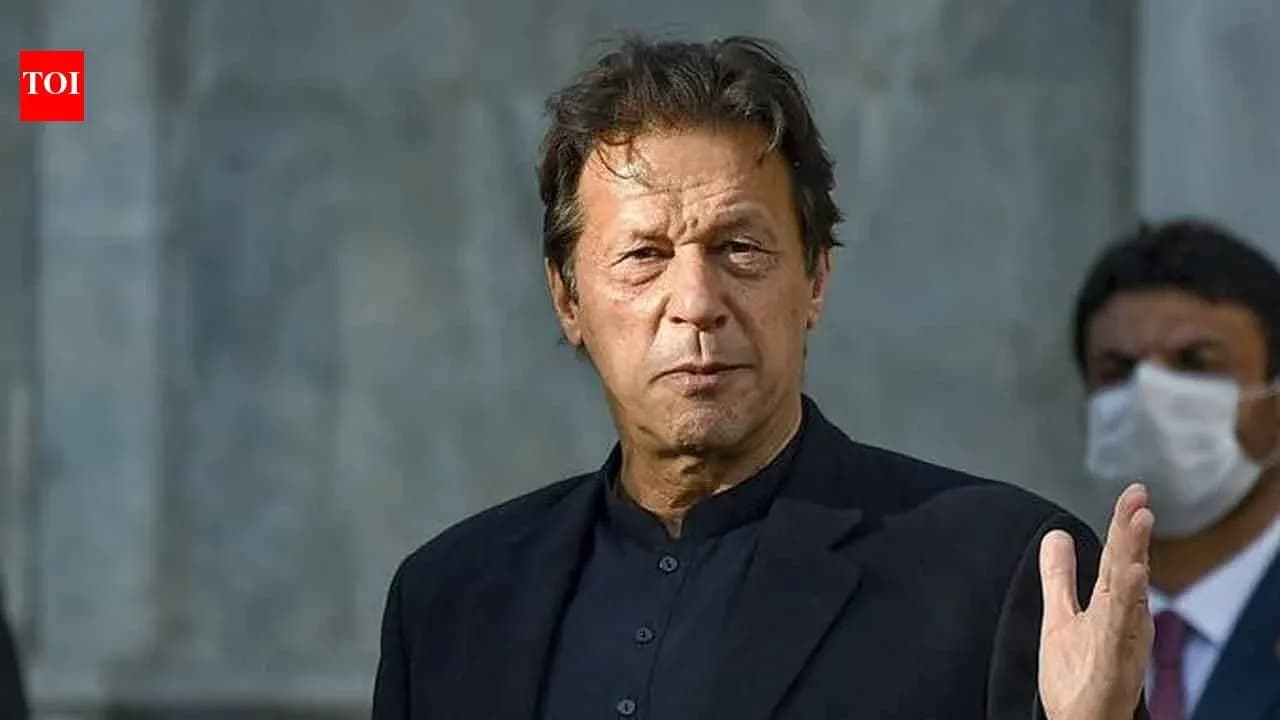
At Lord’s, where cricket usually drowns out the noise of politics, a storm has broken over what happened off the field rather than on it.
The sons of former Pakistan captain and Prime Minister Imran Khan have launched a fierce attack on Pakistan Cricket Board (PCB) chairman Mohsin Naqvi, after reports that the board threatened to pull Pakistan’s players from the field during the second Test against England unless a television interview about their father was taken off air.
The flashpoint came on day one at Lord’s, when Sky Sports broadcast an interview conducted by Michael Atherton with Sulaiman and Kasim Khan. In calm tones but stark detail, they described their father’s health and conditions in prison.
What followed has dragged the PCB into an international row.
Threat to walk off at Lord’s
According to subsequent reports, PCB officials were so angered by the interview that they warned Pakistan would not return for the post-lunch session if the segment remained on air. For a board that often speaks of protecting the “spirit of cricket”, the alleged ultimatum cut straight across the image it tries to project on the world stage.
From the Khan family’s side, the reaction was seen as both heavy-handed and revealing.
“They made absolute fools of themselves,” Kasim told The Telegraph, accusing the PCB of damaging its own reputation by attempting to strong-arm a broadcaster over an interview about an ex-Pakistan captain who spent more than two decades living in England.
Sulaiman admitted he expected some backlash. Not this.
“I was expecting some sort of response. But I didn't think they would be so tactless as to threaten not to take to the field,” he said, arguing that the PCB had no business trying to suppress a discussion framed around his father’s health and humanitarian concerns rather than party politics.
“It shouldn't be in the remit of the Pakistan Cricket Board to ask for an interview about an ex-Pakistan player, somebody who lived in England for 22 years, to be taken down. This wasn't about politics, but about the humanitarian situation and his health.”
For a few tense moments at Lord’s, the talk in the press box was not about swing, seam, or session scores, but whether a Test match might be held hostage to a political and personal dispute.
‘They're clearly hoping to kill him in there’
Away from the drama over broadcast rights and walk-off threats lies the darker core of the story: the condition of Imran Khan in prison.
Kasim did not soften his words.
“They're clearly hoping to kill him in there. They want to silence him as secretly as possible and just slowly make him fade into nothing,” he said, painting a picture of a deliberate attempt to erase the man who once led Pakistan to a World Cup and later to political power.
He described a pattern he believes has emerged around his father’s treatment.
“That's a very difficult thing to do with the most popular person in Pakistan right now. Their strategy, whenever we speak, is to let everything fizzle out and then impose more brutal restrictions that make it even harder for him to survive.”
Solitary confinement, limited contact, and tightly controlled information have all fuelled the family’s fears. From their perspective, every time they raise concerns, the response is not transparency but tighter control.
PCB and politics collide
For the PCB, the optics are grim. A board entrusted with safeguarding Pakistan’s cricketing interests is now accused of trying to muzzle a conversation about one of the country’s greatest sporting icons, at the very venue where his name still carries weight.
To the Khan family, the alleged attempt to interfere with a live broadcast was not just clumsy but revealing of a wider desire to silence dissenting voices, even when those voices speak about health and basic conditions rather than political strategy.
“They made absolute fools of themselves,” Kasim repeated in his interview, underlining the sense that the board had overreached in spectacular fashion.
The incident has also reopened an old question: where should the line sit between cricket and politics in Pakistan, a country where the two have always been uncomfortably close?
Authorities deny mistreatment
Pakistani authorities have consistently rejected claims that Imran Khan is being mistreated. Officials insist he is receiving proper medical care and that his rights are being respected.
Sulaiman is far from convinced.
He says the family is being kept in the dark about key details of his father’s condition and treatment, and he believes the narrative of concern from authorities masks something more sinister.
“The worrying theory we're hearing is that they're drip-feeding these reports of his ailing health and pretending that they're trying to help him, just to lay the ground for something worse to happen. Then they can wash their hands and say: 'He's just an old man who died, and we had nothing to do with it.’”
It is a chilling scenario, built on suspicion and the absence of hard information.
“They haven't given us proof of any of this. It's all just hearsay from government sources – there's no transparency, they don't want to give anyone access, so how are we supposed to believe any of it?” he asked.
The last reliable update, Sulaiman says, came not from officials but from Imran himself, half a year ago.
“The last verifiable piece of information we had was from him, six months ago, when he spoke about his eye and how it had been neglected.”
Lord’s left with more questions than answers
So a Test match at Lord’s, a stage usually reserved for cover drives and swing bowling, has become the backdrop to a much larger fight: over a former captain’s health, over the reach of the state, and over how far a cricket board will go to avoid uncomfortable conversations.
The scoreboard will record only runs and wickets from that second Test. The more enduring numbers, though, may be the days since Imran Khan last spoke freely about his condition, and the minutes during which a historic ground held its breath, wondering if a national team really would refuse to walk back out onto the field.