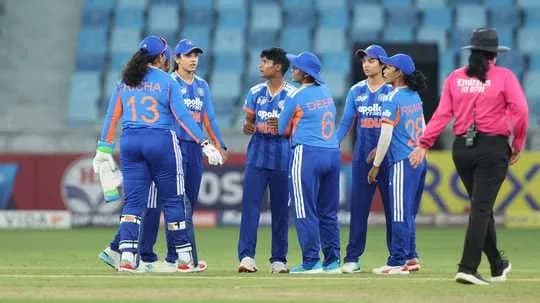
India opened their Asia Cup 2026 campaign with a statement win in Dubai, but not without a jolt that will keep the team management alert. A 94‑run hammering of Thailand, built on Shafali Verma’s blazing fifty and a ruthless bowling display led by Nandni Sharma and Deepti Sharma, underlined their superiority. The stutter in the middle overs, though, told its own story.
Shafali ignites a flying start
Asked to bat first, India did not bother easing into the tournament. Shafali walked out with intent and stayed there, tearing into Thailand’s new-ball attack with the kind of freedom that can end contests inside a powerplay.
Her 64 off just 36 balls was all timing and audacity. She drove on the up, carved through point, and went aerial without hesitation. At the other end, Smriti Mandhana played the perfect foil, racing to 24 off 10 balls with four crisp boundaries before departing, but not before helping India rocket to 38 in just three overs.
The early charge set the tone. Debutant Pratika Rawal joined Shafali, and the pair kept the board ticking smartly. Pratika was more circumspect, picking gaps, rotating strike, letting Shafali continue the assault. India surged to 65 in the powerplay, a platform most sides would dream of in a tournament opener.
From cruise control to collapse
Just as Thailand looked bereft of answers, the surface – and Suleeporn Laomi – dragged them back into the contest.
After the partnership moved past fifty, Pratika fell to a delivery from Laomi that stayed low and snuck under her bat. It was the kind of ball that can change the mood of an innings. It did.
From 91 for 1, India imploded to 137 for 9 in the space of just 50 balls. Wickets fell in clumps, the middle order misreading length and trajectory, failing to adjust to the slower surface as Laomi found rhythm and confidence. She added two more scalps, her figures suddenly shaping the narrative of the innings.
India, who had looked set for something well beyond par, were now scrapping for every run. Kranti Gaud’s late blows in the final overs dragged 22 more onto the total and pushed India to 159, but the finish lacked the authority promised by that electric start.
The scoreboard still looked imposing for a side like Thailand. The manner of getting there, though, will stick in India’s dressing room conversations.
Bowlers slam the door shut
Any lingering doubts about the total vanished almost immediately once Thailand began the chase.
Nattakam Chantam, one of their more experienced batters, was cleaned up in the opening over by Kranti Gaud, and with that early strike the tone was set. Thailand never recovered their footing.
Sree Charani struck twice to keep the top order pinned down, and the chase never resembled a pursuit. It looked like survival practice against a sharper, more relentless attack.
The real damage came through the middle and lower order. Nandni Sharma and Deepti Sharma took charge, hitting hard lengths, attacking the stumps, and refusing to offer release. Each of them picked up three wickets, ripping through Thailand’s resistance with clinical efficiency.
Only Nannapat Koncharoenkai offered any meaningful defiance. Her 41 off 48 balls stood in stark contrast to the chaos around her, a lone, composed effort amid a collapsing scorecard. No other batter reached double figures; Laomi’s 6 was the joint second-best contribution in an innings that never truly got going.
Bowled out for 65, Thailand finished miles adrift of India’s 159. The margin – 94 runs – told the story of a mismatch. The passages within the game told a subtler one.
Statement made, warning received
On paper, India’s campaign has begun exactly as expected: a thumping win, net run rate boosted, key bowlers in the wickets, Shafali in ominous touch.
On the field, the sudden slide from 91 for 1 to 137 for 9 will nag. Better attacks than Thailand’s will not let them off so lightly. In a tournament where pressure will only rise, can this Indian batting line-up turn a blazing start into a complete, ruthless performance when it truly matters?