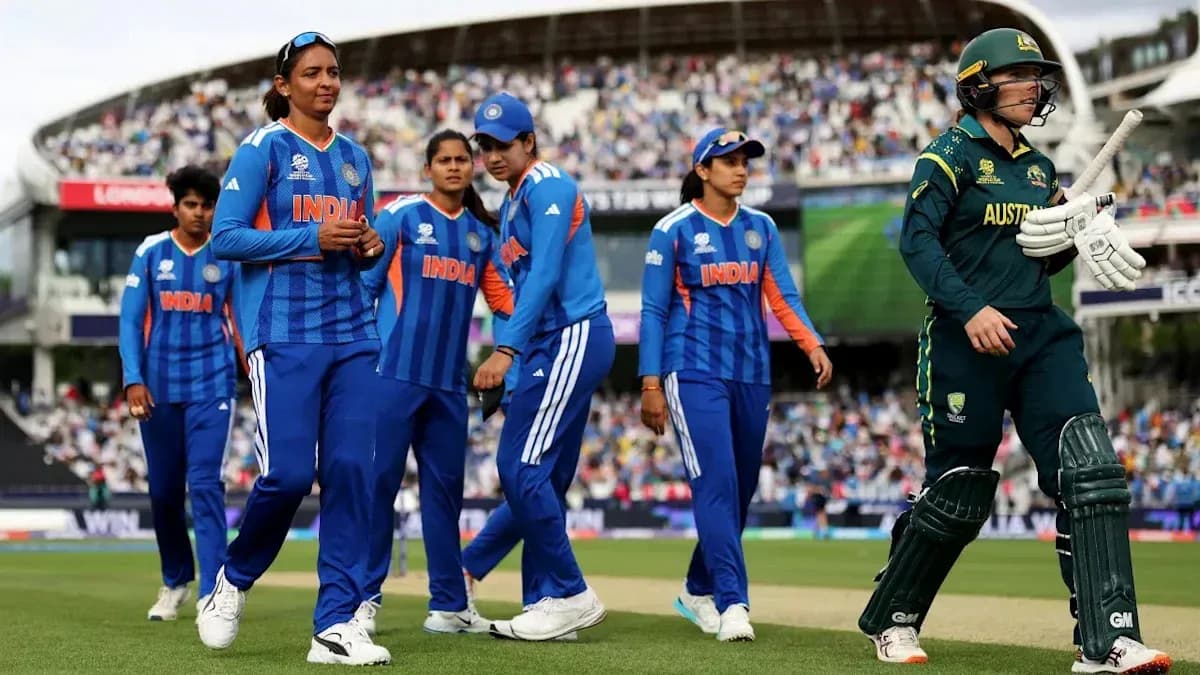
India and Pakistan will walk out into a familiar cauldron on September 5, when the Women's Asia Cup 2026 serves up its marquee group-stage clash at the Dubai International Cricket Stadium.
The venue has become the centre of the women’s game in this part of the world. It staged the entire 2024 Women's T20 World Cup and now hosts all 15 matches of this Asia Cup. By now, the players know every blade of grass, every patch of rough, every darkening shade of twilight under the lights.
India know it a little better than most.
They beat Pakistan here in October 2024, chasing calmly to win by six wickets in the T20 World Cup. That result underlined a pattern that runs through Dubai’s short but revealing history in women’s T20Is: India thrive, Pakistan endure.
For Pakistan, the ground carries a harsher memory. They own the record for the lowest women's T20I total at the stadium. India sit at the other end of the spectrum with the highest. That contrast, etched into the scorebooks, neatly frames the gulf between the two sides in these conditions.
A young stadium with a busy history
Dubai International Cricket Stadium has already seen plenty. Since its first women’s T20I in the last decade, it has hosted 19 matches in the format, most of them squeezed into two intense bursts: the 2024 Women's T20 World Cup and a bilateral series between Namibia and the UAE in 2023.
The numbers tell a clear story. Teams chasing have won 11 of those 19 games. Dew rules the night here. Once moisture settles on the outfield and the ball, bowlers lose their grip and their guile. Batting suddenly feels easier, strokeplay flows, and totals that looked imposing at the break start to shrink.
The backdrop to all this is a modern bowl of concrete and light. Built in 2009 in Dubai Sports City, the stadium holds roughly 25,000 spectators and sits in the shadow of the International Cricket Council’s headquarters. It was designed as a global hub. Women’s cricket has turned it into a stage of recurring drama.
A pitch that changes character
The surface in Dubai rarely plays the same way from first over to last.
New-ball quicks get the early say. There is bounce to work with, enough to keep keepers on their toes and batters wary of the top edge. Swing, though, has never truly dominated here. Seamers who succeed do it with hard lengths and smart changes of pace rather than extravagant movement through the air.
Once the shine fades, the game tilts. The pitch dries, grips, and suddenly the slower bowlers come alive. Across all T20Is at the venue, spinners have taken more wickets than the pacers, a reflection of just how influential they become through the middle overs. Flight, dip, and subtle turn can strangle an innings in the space of a few overs.
Then the dew arrives. What helped spinners in the first half can abandon them in the second. A slick ball, a slippery seam, and those same bowlers struggle to land their variations. It is no surprise that chasing sides hold that 11–8 edge across women’s T20Is here. Captains who win the toss tend to glance at the sky, feel the humidity, and think seriously about bowling first.
Chases, records and a West Indian heist
The highest successful chase in women’s T20Is at Dubai belongs to West Indies. During the 2024 Women's T20 World Cup, they reeled in England Women’s 141, a target that looked competitive at the halfway mark.
Hailey Matthews, the captain, set the tone. Qiana Joseph matched her. Both carved out half-centuries that broke the back of the chase and silenced England’s attack. It was the sort of pursuit that underlines why no total feels entirely safe once the lights take over and the ball starts skidding on.
India’s batting fortress
When it comes to sheer run-scoring, India Women have turned Dubai into a personal playground.
They hold the highest team total in women’s T20Is at the ground: 193 for 5 against Hong Kong in the 2026 Women's Asia Cup group stage. That effort eclipsed their own previous mark of 172 for 3, set here during the 2024 Women's T20 World Cup.
At the heart of both peaks stands Smriti Mandhana.
Her 124 off 64 balls against Hong Kong is the stadium’s defining innings. It remains the highest individual score in women’s T20Is at the venue and the only century recorded there. Mandhana unfurled every stroke in her repertoire that day, turning a decent pitch into a batting paradise and the boundary rope into a suggestion rather than a limit.
She doesn’t just own the records; she dominates the aggregate as well. Across five matches at Dubai, Mandhana has scored 212 runs at an average of 42.40, with that hundred and a fifty in the bank. No one else has matched that volume or consistency.
South Africa’s Laura Wolvaardt sits next on the list with 181 runs from five innings at an average of 45.25, a testament to her own elegance and authority. Yet with another India–Pakistan clash already locked in, Mandhana has the chance to stretch her lead even further and deepen her imprint on this ground.
Bowlers who bend Dubai to their will
The batters have carved their names into the record books, but a few bowlers have forced the stadium to remember them too.
Nonkululeko Mlaba of South Africa leads the wicket charts in women’s T20Is at Dubai. She has 11 wickets from five innings, built around control, sharp angles, and a best return of 4 for 29 against West Indies during the 2024 Women's T20 World Cup. On pitches that reward brave spin, Mlaba has been relentless.
Yet the single most astonishing spell at this venue belongs to Sri Lanka’s Chamari Athapaththu.
Better known globally for her brutal hitting at the top of the order, Athapaththu produced scarcely believable figures of 7 for 5 against India Women on September 2 in this very Asia Cup. Seven wickets. Five runs. Against India. On a ground where Mandhana and company routinely bully attacks.
Those numbers are the best bowling figures in women’s T20Is at Dubai. They also leave Athapaththu just two wickets shy of Mlaba’s overall record at the stadium. For a part-time narrative, it reads like a full-time epic.
A stage set for another chapter
So India arrive for their showdown with Pakistan holding both the highest and second-highest team scores at the ground, the top individual score, and the leading run-scorer. Pakistan arrive with the unwanted mark of the lowest total.
The pitch will start hard, then slow. The spinners will circle. The dew will lurk.
Records say this is India’s territory. The game rarely obeys records for long. Will Dubai script another familiar tale, or is it waiting for an upset that rips up its own history?