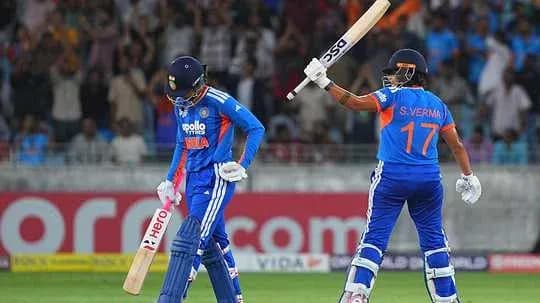
India walked into this Asia Cup final as the class of the field. They walked out of it with the trophy, a 72‑run hammering of Sri Lanka, and a reminder that when Smriti Mandhana and Shafali Verma go in tandem, this team operates on a different plane.
By the time the first wicket fell, the contest was already tilting heavily blue.
Mandhana–Verma set the tone
The opening stand did not roar from ball one. It purred, then purred louder, then suddenly had Sri Lanka gasping.
Shafali began with two almost casual strokes off Mithali Ayodhya – a guided glide past gully, a nudge to midwicket – both finding the rope. No slogging, no violence yet. Just touch and timing. The brutality came next.
Chamari Athapaththu came on, and Shafali tore into her, launching two sixes in four balls. That was the ignition. From there, the gears shifted quickly.
Having eased herself in, Shafali surged to the fastest fifty in Women’s T20 Asia Cup history, getting there in 24 balls – one delivery quicker than Mandhana’s own benchmark from 2022. This time, the roles reversed. Mandhana, usually the artist-in-chief, was content to play the foil.
She had opened the innings with a boundary first ball, then slipped into a quieter, more calculated rhythm: singles, twos, the odd four, nothing frantic. While Shafali hunted the gaps and the stands, Mandhana anchored the partnership, turning over the strike and letting the storm rage at the other end.
Chamudi Praboda bore the brunt next. Shafali cashed in on anything remotely loose, cracking another pair of consecutive boundaries and cruising past fifty – her third of the tournament – in the eighth over. India were already galloping.
By the 12th over, the scoreboard read 120 without loss. The two left Sri Lanka chasing shadows and joined a rarefied club in the process, equalling the world record for the most 100-plus stands for any wicket in women’s T20Is – six of them now as an opening pair. The final, barely halfway through the first innings, was slipping away from the Lankans.
A wobble, but enough damage done
Sri Lanka needed a break, any break. It finally came in the 13th over. Shafali’s dismissal opened a tiny crack.
What followed briefly threatened to become something more serious. Harmanpreet Kaur and Mandhana collided in thought, not body, in a messy mix-up that left Mandhana stranded and run out. The set opener walked off, India’s serene progress suddenly interrupted.
The tempo dipped. The middle order went searching for the acceleration that had come so naturally to the openers and instead found trouble. Wickets began to fall as batters tried to keep the run-rate surging against increasingly desperate, disciplined bowling.
Yet the foundation had been too solid, the platform too high. Even as the innings frayed at the edges, India still powered past 180, helped by a last-ball six from G Kamalini, brought in for Pratika Rawal. That final blow underlined the depth of the assault: Sri Lanka were staring at a mountain.
History underlined the scale of the task. In Women’s T20 Asia Cup history, only one chase of over 150 had ever been completed – Sri Lanka’s own heist against India in the 2024 final. Two years on, they needed another miracle.
They never got close.
Early strike, Athapaththu fights back
Kranti Gaud made sure of that. Four balls into the chase, Imesha Dulani tried to repeat the lap shot that had opened Sri Lanka’s innings. The first had worked; the encore did not. Her stumps were shattered, Gaud roared in celebration, and Dulani departed with a send-off ringing in her ears.
For three overs, Sri Lanka crawled, India’s new-ball discipline choking the reply. Then Athapaththu, as she has so often, tried to drag her side into the contest.
She went after Shafali, who had been handed the ball. A slog-swept six, 12 runs off the over, and suddenly there was a flicker of life. Athapaththu settled, Vishmi Gunaratne joined her, and the pair stitched together a stand that at least gave the chase a shape.
They moved Sri Lanka past 50 without further damage. Athapaththu then targeted Prema Rawat, taking 11 off the over with a six and a four in back-to-back deliveries. For a brief spell, India’s grip loosened. The field spread, the noise rose, and the chase, just for a moment, looked plausible.
Deepti, Charani slam the door
Then Deepti Sharma stepped in and slammed it shut.
Her second over turned the final. Athapaththu charged down, looking to keep the pressure on, but Deepti’s flight and dip beat her, and the stumping swung the game decisively back India’s way. Three balls later, Gunaratne’s stumps were rattled. Two set batters gone in one over; Sri Lanka’s backbone snapped.
From there, it became a procession.
Shree Charani, in the middle of a standout 2026, sliced through the middle order, hitting her lengths, attacking the stumps, and never letting Sri Lanka rebuild. Every attempt at resistance met sharp, relentless spin.
Beyond the top three, only Nilakshika Silva managed to reach double figures. The rest fell away, one by one, as the required rate ballooned and Indian spinners toyed with both flight and pace. The chase fizzled rather than flared, Sri Lanka eventually bowled out for 111.
India’s 72-run win now stands as the second-largest margin of victory in the final of a five-plus team Women’s T20I tournament, behind only Australia’s 85-run demolition of India in the 2020 T20 World Cup final at the MCG.
This time, though, India were on the right side of the thrashing – with a fourth Asia Cup in the cabinet and an opening pair reminding the world why every team fears seeing Mandhana and Verma walk out together.