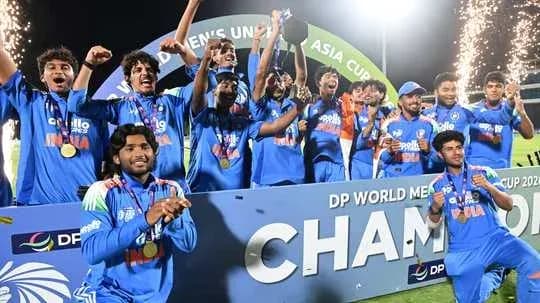
In the fading light of Al Amerat, with the equation tilted heavily against them and nerves shredded on both sides of the boundary rope, India’s Under-19s produced a finish that will live long in age-group folklore. Three needed off the final ball. One wicket in hand. Mohit Ulva on strike. He threaded the ball to the rope, and an entire dugout erupted onto the field.
A chase of 338 had seemed ambitious from the outset. At several points, it looked impossible.
A chase that kept slipping away
India began cautiously, almost warily, against a Pakistan attack that knew early wickets would crack open the contest. The openers took their time, absorbing pressure, before Aaryavir Sehwag shifted gears.
Sehwag, who later walked away with the Player of the Tournament award, batted like someone who had owned this competition. He was the first to break the shackles, peppering the field with authoritative strokes and bringing up yet another fifty-plus score — his fourth of the tournament. It was a statement knock, but not a match-defining one; he fell before he could turn it into the big hundred India craved.
Lakshaya Raichandani played the anchor. He reached his half-century, but it took him 72 balls, and as his innings stretched, the asking rate began to climb. India needed a jolt. Pakistan sensed it.
They responded with regular strikes. Each breakthrough dragged India back, forced them to reset. The chase became a grind, then a scrap.
Anvay Dravid and Raichandani finally broke the tension with a burst of boundaries, briefly swinging the momentum. For a few overs, India’s dressing room dared to believe again. The partnership looked like the one that would realign the chase.
Then came the gut punch.
Both fell off successive deliveries. Two set batters gone in a blink. The equation still steep. Pakistan’s fielders swarmed together; India’s balcony fell silent. At that moment, the final felt done.
Chauhan ignites the fightback
Manal Chauhan refused to accept that script. Walking in with the game listing badly, he counterpunched.
He went after anything loose, dragged the chase back into the realms of possibility, and kept India’s hopes alive even as wickets continued to tumble around him. This wasn’t blind slogging; it was calculated aggression, the kind that rattles young bowlers and forces captains into hurried conferences.
Chauhan and Ulva eventually came together with the target still distant and the overs running out. What followed was pure drama.
They launched a late assault, turning the final overs into a boundary hunt. Pakistan, who had controlled large stretches of the game, suddenly found themselves under siege. Misfields crept in, lines wavered, and the pressure that had sat so heavily on Indian shoulders shifted across the pitch.
Yet the pendulum refused to settle.
The ninth wicket fell in the 48th over. India were still short. Pakistan, despite the onslaught, would have backed themselves from there. One mistake, one dot ball at the right time, and the trophy was theirs.
Ulva had other ideas.
He opened the penultimate over with a four and a six, ripping into the equation and into Pakistan’s composure. By the time the final over began, India needed 8 off 6. The tension was suffocating.
Ahmed Hussain ran in for the last over and dragged the contest to the very edge. Every ball felt decisive. Every run, a roar or a groan. It came down to the final delivery: 3 required, Ulva on strike, fielders pushed back, hearts in mouths.
Ulva went for the win, not the tie. He found the boundary, and with it, the title. Helmets flew, players sprinted from the dugout, and the outfield turned into a blur of blue shirts and unfiltered joy.
Pakistan’s batting surge and sudden slide
For Pakistan, the heartbreak will sting even more because of how commandingly they batted earlier in the day.
Usman Khan set the tone with a superb century, once again delivering on the big stage. He held the innings together, mixed control with ambition, and ensured Pakistan always looked on course for a massive total.
At the other end, Abdul Qadir lit up the final. His 80 off just 54 balls was a whirlwind, built on raw power and clean hitting. He cleared the ropes eight times, ripping into India’s attack and forcing them onto the defensive. Every time India thought they had a hint of control, Qadir swung it away.
When he departed, Farhan Yousuf took charge. The captain played with authority, adding a brisk half-century that seemed to seal India’s fate. At 299 for 3 after 44 overs, Pakistan were cruising, perfectly placed to surge past 350 and beyond.
Then the innings unraveled.
From that dominant platform, Pakistan mustered only 38 runs in the final six overs and lost six wickets in the process. The collapse was sudden and jarring. Set batters gone, new ones unable to adjust, India’s bowlers finally hitting their lengths under pressure.
Those lost runs lingered in the background all evening. In a final decided off the very last ball, that stuttering finish with the bat proved costly.
A final that will echo
When Ulva’s winning boundary raced away, it did more than seal a trophy. It capped a chase that swung from hopeful to hopeless and back again, a contest where both sides tasted control and panic in equal measure.
Pakistan had the runs, the momentum, and for long stretches, the game. India had resilience, depth, and just enough nerve when it mattered most.
In youth tournaments, results often fade as players move on to bigger stages. This one will not fade so quickly. An Under-19 Asia Cup final, decided with three needed off the last ball, between India and Pakistan, under pressure that felt far bigger than the age-group tag.
Those are the days that turn promising youngsters into hardened cricketers.