India’s campaign at the Asian Games 2026 rolled through Tuesday like a restless tide — surges of promise, crashes of disappointment, and just enough resilience to keep the day alive.
Lakshya lights up the badminton hall
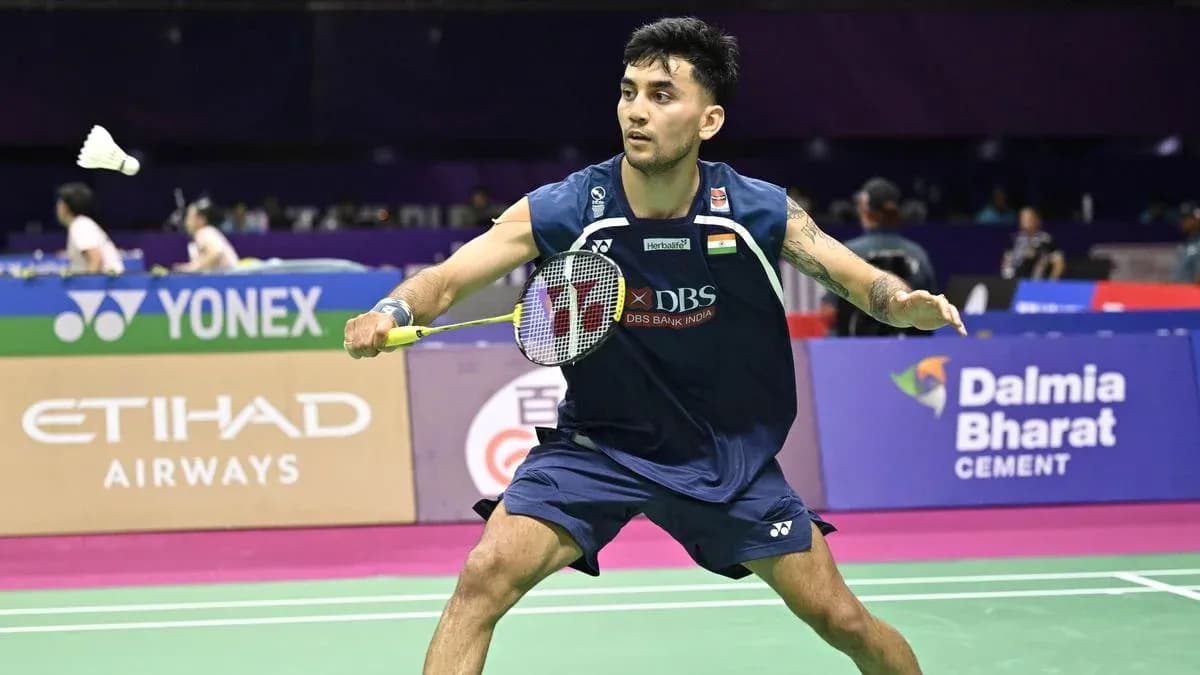
In the men’s team quarterfinal against Japan, Lakshya Sen dragged India into the contest with the kind of scrap that defines knockout badminton.
Up against World No. 7 Kodai Naraoka, Lakshya started in reverse. He surrendered the opening game 11-21, struggling to find length and rhythm. Then something flipped. He tore through the second game 21-5, turning defence into attack and pinning Naraoka to the backcourt.
The decider was a test of nerve. Lakshya trailed by five at one stage, but refused to let the tie slip. Point by point, he reeled the Japanese star in and finally closed it out 21-19 to seal a 2-1 win (11-21, 21-5, 21-19) and give India a 1-0 lead in the tie.
Satwik-Chirag now walk into their doubles clash against Hoki-Kobayashi with that slender cushion — and the weight of expectation.
Sindhu’s battle, Japan’s statement
The women’s team quarterfinal against Japan began with all eyes on P. V. Sindhu. A two-time Olympic medallist, a big-match player, and still the emotional centre of this Indian side.
Her opponent: World No. 3 Akane Yamaguchi, at home, in form, and ruthless.
Yamaguchi controlled the early exchanges, building a 17-13 lead in the first game. Then Sindhu did what she has done so often in her career — she refused to fold. From 13-17 down, she stormed back, saving a game point at 20-21 and taking the opener 23-21 after both players misjudged crucial points at the death.
The comeback, though, drained its share of energy. Yamaguchi held a narrow edge in the second game and, this time, did not let it go. Sindhu threatened another late charge from 12-17, but the Japanese star held firm to take it 21-18 and force a decider.
The third game was brutal. Yamaguchi raced to an 11-4 lead at the change of ends and never loosened her grip, closing out the match 21-11. The final scoreline — 21-23, 21-18, 21-11 — gave Japan a 1-0 lead and handed India an early blow.
Unnati Hooda stepped in next, tasked with dragging India back into the tie. She fought hard, even led 11-4 in the second game after losing the first 16-21 to Tomoka Miyazaki. But the chance slipped. Miyazaki reeled her in, took the second 21-18, and pushed Japan to the brink of the semifinals.
India’s last hope lay with the doubles pair of Treesa Jolly and Gayatri Gopichand. The World Championships bronze medallists responded with authority, beating Yuki Fukushima and Mayu Matsumoto 21-17, 21-16 to keep the contest alive at 1-2.
That lifeline didn’t last. In the third singles, Tanvi Sharma ran into a wall. Former World Champion Nozomi Okuhara controlled the rallies, dictated the tempo, and shut the door with a 21-12, 21-10 win. Japan took the tie 3-1, and India’s wait for a women’s team medal — stretching back to 2014 — continues.
Mandhana and Co. tee up gold in women’s cricket
On the cricket field, India’s women produced the kind of batting display that sets up a final long before the last over.
Opting to bat first against Sri Lanka in the gold-medal match, the openers set the tone. At the end of the PowerPlay, India was cruising at 67/0, with Smriti Mandhana on 38* and Shafali Verma on 29*, both dominating the Sri Lankan attack.
They never really took the foot off the pedal. Mandhana top-scored with a blistering 79 off 45 balls, while Shafali’s 48 off 29 kept the scoring rate soaring. Richa Ghosh then arrived to twist the knife, hammering 49 off just 22 deliveries.
India closed on 216/3 — its third-highest WT20I total — leaving Chamari Athapaththu and Sri Lanka staring at a daunting chase in a high-pressure final.
Shooters miss the podium, but China rewrite the record books
In the 10m air rifle mixed team event, India’s Parth Mane and Elavenil Valarivan began the day with promise. They shot 634.6 in qualification, finishing second behind China, whose pair Wang Zifei and Sheng Lihao shattered the Qualification World Record with 638.9.
Vietnam initially squeezed into the final as the fourth team, only to be disqualified, allowing Japan to join China, India and Republic of Korea in the medal round.
Once the final began, the margins narrowed — and India slipped. After the first 10-shot series, China led with 107.2, followed by Korea (104.9), Japan (103.9) and India (103.6). The pattern held. At the end of the second series, China stayed in front with 211.9, Japan climbed to second with 209.4, Korea sat third with 209.2, and India remained fourth on 207.9.
There was no late surge. After three series, India stood on 312.3, still fourth, while China (315.7), Japan (314.9) and Korea (314.3) pulled away. The final totals told the story: China took gold with a new World Record of 507.1, Republic of Korea claimed silver with 502.9, Japan earned bronze on 439.7, and the Indian pair finished fourth — a step off the podium despite a strong start.
Kabaddi: champions flex their muscles
If there was any doubt about the intent of India’s men’s kabaddi team, it vanished in 40 minutes.
The defending champions bulldozed Korea 63-31 in their second Group A match, making it two wins from two and underlining their status as the team to beat. The scoreline spoke of dominance in every department — raids, tackles, and temperament.
The title defence is not just on track. It is roaring.
Swimming: relay team books a lane in the final
In the pool, India’s men’s 4x100m medley relay team did enough to stay in the medal conversation.
The quartet of Rishabh Das, Danush Suresh, Benedicton Rohit and Akash Mani clocked 3:40.41 in the heats, finishing seventh among sixteen teams. It was solid, not spectacular, but crucially good enough to qualify for the final scheduled for 2:55 p.m. IST.
The real question now: can they find another gear when the lights burn brighter?
Equestrian eventing: hard work, harsh numbers
Eventing opened with dressage, and India’s riders found themselves fighting the numbers as much as the competition.
Fouaad Mirza, a double Asian Games silver-medallist in this discipline, rode his 10-year-old bay gelding Camouflage 38 to a score of 38.70, earning a percentile rating of 61.33 and placing 26th. Arjan Singh Nagra, on his 12-year-old grey stallion Cooley Goodwood, edged ahead with 38.20 and a 61.80 percentile, finishing 23rd.
India’s best dressage performance came from Ashish Limaye. On Willy be Dun — the same 14-year-old bay gelding he rode at the Hangzhou Asian Games — Limaye scored 35.50, with a 64.47 percentile, good enough for 14th place.
In a 32-rider field, only three competitors crossed the 70-percentile mark, with China’s Tian Hua and his Irish Sport Horse gelding Manjushri leading the standings. Thailand’s Korntawat Samran and Japan’s Toshiyuki completed the top three.
The team picture was stark. Eventing totals scores across dressage, cross-country and show jumping, but after the opening phase India sat seventh out of eight nations with 112.40, well off the medals. Japan led with 91.60. In dressage, lower scores reflect fewer errors and higher rankings, and for now, India has ground to make up on both fronts.
Table tennis: women fight through, men bow out
The women’s team delivered drama, then delivered the result.
Facing Thailand in the round of 16, India trailed 0-1 after Sreeja Akula let a two-game lead slip against Orawan Paranang. She led 2-0 and even held match point at 10-9 in the decider, but Paranang clawed back to win 3-2 (7-11, 1-11, 11-9, 11-6, 12-10) and hand Thailand the early advantage.
Yashaswini Ghorpade steadied the ship. In the second singles, she outlasted Suthasini Sawettabut in a five-game scrap, winning 3-2 (11-8, 5-11, 7-11, 11-9, 11-9) to level the tie at 1-1.
The pendulum swung again. Diya Chitale fell 2-3 (7-11, 11-5, 11-7, 7-11, 11-13) to Jinnipa Sawettabut, leaving India trailing 1-2 and under pressure once more.
Ghorpade responded with a flawless performance in the fourth singles, sweeping Orawan Paranang 3-0 (11-5, 11-8, 11-9) to drag the tie into a decider. This time, Sreeja Akula did not let it slip. She beat Suthasini Sawettabut 3-1 (9-11, 11-6, 12-10, 11-8), sealing a 3-2 victory and a place in the quarterfinals, where India will face North Korea.
The men’s team, though, could not match that escape act. Up against Republic of Korea in their round of 16 clash, India went down 0-3. Harmeet Desai lost the opener 1-3 (11-8, 7-11, 8-11, 9-11) to Jang Woojin. Manush Shah battled hard in the second rubber but was dragged into a decider and beaten by Oh Junsung. In the third match, An Jaehyun closed the door with a 3-1 (12-10, 11-6, 7-11, 12-10) win over Manav Thakkar, ending the campaign of the two-time bronze medallists.
Wushu and gymnastics: effort without reward
In Wushu, Hanjabam Langlentombi Devi competed in the Women’s Nanquan & Nandao combined event and finished ninth overall with a total of 18.839. She placed ninth in Nanquan with 9.403 and improved slightly to eighth in the Nandao final with 9.436, but it wasn’t enough to trouble the podium.
On the gymnastics floor, Pranati Nayak produced a solid showing in the Women’s Vault. She sits fourth with a total of 12.916, built on a 13.00 in her first vault and 12.433 in her second. It is close, agonisingly so, but still outside the medals — for now.
Fencing: early sparks, hard lessons
In women’s epee, Taniksha Khatri provided India’s brightest moment of the day on the piste. She first beat Thailand’s Natpapat Sangngio 15-10 in the round of 32, becoming the first Indian fencer of the day to win a knockout bout. Her run ended in the round of 16, where she lost 9-15 to reigning World Champion Sera Song of South Korea.
Mitva Chaudhari, also in women’s epee, opened her knockout campaign against China’s Yang Jingwen in the round of 32 but could not progress.
In men’s foil, both Hemash Singh Sanasam and Sachin advanced from the pool stage after mixed results. Hemash beat Sammuel Tranquilan of the Philippines 5-2 and Oman’s Saeed Al Shuaibi 5-1, but lost to Singapore’s Raphael Juan Kang Tan 2-5 and Macao’s Chong Kio Cheong 2-5. Sachin opened with a 5-0 win over Pakistan’s Baryal Khan, added victories against Kazakhstan’s Galim Nurumov (5-3) and Mongolia’s Chingis Narmandakh (5-1), but suffered defeats to Korea’s Jeonghyun Youn (0-5) and Chinese Taipei’s Chen Chih-Chieh (2-5). Both finished fourth in their pools.
The knockout draw was unforgiving. Hemash led Kazakh fencer Galim Nurumov 6-5 after the first period in their round of 32 clash, but Nurumov surged back to win 15-9. Sachin also fell 9-15 to Kazakhstan’s Timofey Semyonov, ending India’s challenge in the event.
Soft tennis: mixed fortunes on the courts
Soft tennis offered a bit of everything.
In men’s singles Group C, Aryan Thakur opened with a dominant 4-0 win (4-2, 4-0, 4-2, 4-0) over Mongolia’s Bold-erdene Altangerel. His second outing told a different story. Facing Chen Po-Yi of Chinese Taipei, Aryan went down 0-4 (1-4, 2-4, 2-4, 1-4). The defeat confirmed India would finish second in the group and meant Aryan missed out on the final-eight stage.
In women’s singles Group D, Aadhya Tiwari started with a 1-4 loss (4-1, 0-4, 0-4, 2-4, 4-6) to Thailand’s Alisha Ziegler but bounced back later in the day. She swept Pakistan’s Kainaat Shallwani 4-0 (4-2, 5-3, 4-1, 5-3) to register her first win.
There was a clean, clinical performance from Jay Meena as well. In his men’s singles group-stage match, he defeated Pakistan’s Hussain Arain 4-0 (4-2, 4-0, 4-2, 4-0) to move into the knockouts, adding a quiet but efficient tick to India’s tally of progress.
Karate: so close, so cruel
Karate offered India both a historic opportunity and a harsh lesson in fine margins.
In men’s kumite -84kg, Chetan Bhatt began directly from the semifinals, just one win away from guaranteeing a first-ever karate medal for India at the Asian Games. That dream ran into Jordan’s Mohammad Alja’Fari, who dominated their bout 8-0, pushing Chetan into the bronze medal match.
The bronze bout against Chung Meng-yu of Chinese Taipei was a cagey affair. It finished 1-1, both scoring a yuko, but Chung took the medal on the first-point advantage — a technicality that cut deep. Chetan walked away without a medal, but with the sense that he had stood on the very edge of history.
In women’s kumite -55kg, Alisha Choudhary lost 1-6 to Indonesia’s Cok Istri Agung Sanistyarani in the round of 16. There was a brief hope of a repechage route to bronze, but that closed when Sanistyarani lost in the semifinals, denying Alisha a second chance.
Esports and sepaktakraw: new frontiers, familiar hurdles
On the virtual pitch, India’s eFootball pair of Chinmay Sahoo and Danial Patel opened their Group D campaign with a 0-0 draw against Uzbekistan’s Abubakir Iminjonov and Farrukh Mirkhamitov. It was a cautious start in a discipline still finding its place in India’s broader sporting narrative.
In sepaktakraw, the men’s regu team ran into a powerhouse in Malaysia. The Indians pushed hard in the first match of their second Group B fixture but lost 1-2 (13-15, 15-11, 6-15). Malaysia then tightened its grip, winning the second match 2-0 (15-9, 15-12) to take an unassailable 2-0 lead in the tie, before sweeping the third match 2-0 (15-11, 15-5) to complete a 3-0 victory.
India will face the Philippines in its final group match, searching for a response.
Across arenas and disciplines, India’s day in Aichi-Nagoya swung between near-misses and statements of intent. Some doors shut, some stayed ajar, and a few — like that women’s cricket final and the men’s kabaddi campaign — look ready to blow wide open.