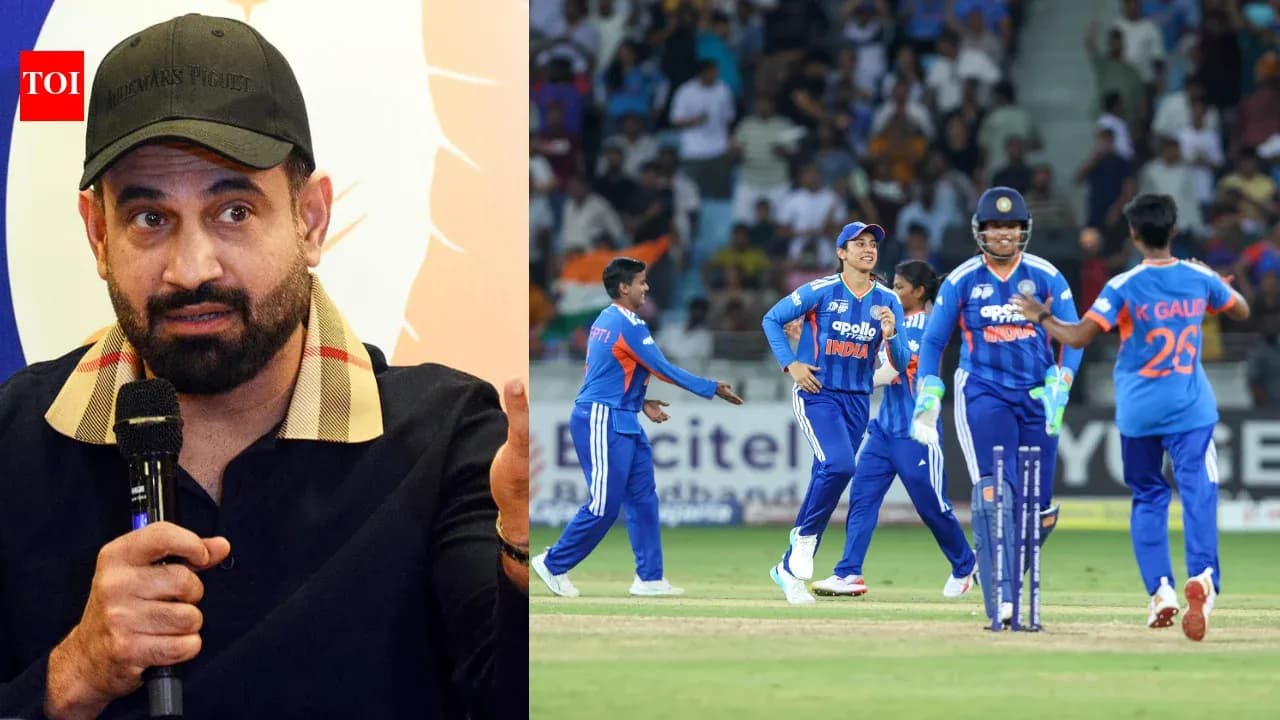
Irfan Pathan needed only four words to light up social media. “Aaj Sunday hai kya?”
The former India all-rounder hit send on X minutes after India’s women demolished Pakistan by seven wickets in the Women’s Asia Cup 2026, and the post exploded across timelines. It was not just a one-liner. It was a sequel.
Pathan was dipping straight back into a taunt that has followed India–Pakistan cricket for over a year. During India’s run of three T20I wins over Pakistan on consecutive Sundays, he had famously asked, “Sunday kaisa raha padosiyo,” turning a throwaway line into a running gag at Pakistan’s expense. This time, the context was different, but the dominance felt eerily familiar.
Spin twins rip through Pakistan
On the field in Group A, India’s spinners turned a high-voltage rivalry into a mismatch.
Pakistan crawled to 55 all out in 18.1 overs, their lowest total in T20 cricket. The collapse was brutal. And it was orchestrated almost entirely by two young spinners who seized the stage.
Shree Charani, a 22-year-old left-arm orthodox bowler, sliced through the middle order with clinical precision. She finished with 3 for 7 from four overs, figures that would look scarcely believable in a net session, let alone an India–Pakistan clash.
At the other end, 24-year-old leg-spinner Prema Rawat matched her for impact, if not for economy. Rawat returned 3 for 9 in her four overs, repeatedly dragging Pakistan’s batters out of position and into trouble. Every over tightened the noose.
For a brief spell at the start, Pakistan looked settled. They reached 27 without loss inside five overs, Muneeba Ali making 13 and Shawaal Zulfiqar 14. The surface looked manageable, the chase ahead looked defendable.
Then the first wicket fell. And the innings simply disintegrated.
Once Harmanpreet Kaur recognised the amount of turn on offer and turned fully to spin, Pakistan had no escape route. Six wickets vanished for just nine runs. From 27 without loss, they slumped to 36 for 6 after 10 overs, the innings effectively in ruins.
India’s bowlers sent down 78 dot balls in 18.1 overs. That number tells the story as sharply as the wickets do. Pakistan were pinned, over after over, with no release, no boundary bursts, no counter-punch.
Shafali Verma chipped in with 1 for 10 from three overs, using her off-spin as another squeeze option. Deepti Sharma then closed the innings with 2 for 5 in 3.1 overs, adding the final touches to a dismantling that was as ruthless as it was controlled.
Harmanpreet’s landmark day
If the ball belonged to the spinners, the occasion belonged to Harmanpreet Kaur.
By walking out as captain, she became the first international skipper — across men’s and women’s cricket — to lead India in 150 T20Is. It is a number that speaks of longevity, trust, and a career spent carrying expectations in the game’s shortest format.
She chose spin early, backed her young bowlers hard, and watched them tear through Pakistan’s order. Then she picked up the bat to make sure there would be no late drama.
Chasing 56, India did not need to hurry, but they refused to dawdle. The target vanished in just 8.4 overs.
Shafali Verma made a brisk 12, Smriti Mandhana added 9, and Pratika Rawal chipped in with 4. None of them stayed long, but they kept the tempo high enough to ensure Pakistan never sensed a way back.
Harmanpreet finished what her bowlers had started. She stayed unbeaten on 18, guiding the chase with calm authority, and ended the match in style — a clean swing down the ground for six to seal yet another commanding win over Pakistan. Deepti Sharma stood alongside her on 12 not out, the pair untroubled as the result became a formality.
A rivalry tilting one way
The scoreline underlined a pattern that has grown stronger with each edition of this tournament. India have now beaten Pakistan in seven of their eight meetings in the Women’s T20 Asia Cup. Pakistan’s solitary win stands as an outlier in an otherwise one-sided ledger.
This latest victory did more than add another number to that record. It showcased the depth of India’s spin resources, the composure of their leadership, and the growing gap between the two sides in pressure games.
By the time Harmanpreet’s winning six sailed straight back over the bowler’s head, the contest had long since lost its tension. That was precisely why Pathan’s “Aaj Sunday hai kya?” landed so cleanly online.
Another India–Pakistan clash. Another crushing margin. Another old taunt brought back to life.
The question now is not what India can do in this rivalry — that script feels settled — but who, in this Asia Cup, can stop them from turning dominance into another title.