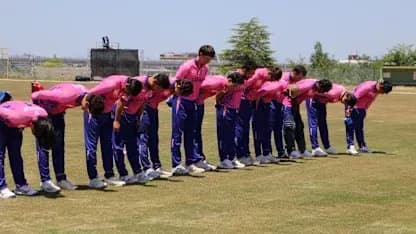
Japan sharpened their focus for the Asian Games with a bold selection call, leaving out several T20I-eligible players under ICC regulations in favour of a squad that fits the stricter tournament criteria – and leans hard into the country’s own player pathway.
The decision opens the door for a new wave of names and a few familiar ones with unfinished business.
Jake Kusuda-Nairn, the spin-bowling all-rounder who has turned heads in domestic cricket, steps into the frame, rewarded for a run of eye-catching performances. His inclusion signals Japan’s intent: trust the form players, not just the established ones.
There is also a recall for Tsuyoshi Takada, a figure who links the current side to its early T20 ambitions. Takada first pulled on the national colours at the ICC East Asia-Pacific Twenty20 Championship back in 2013. A decade on, he returns to a very different landscape, but with the same brief – steady the side and bring experience to a squad still finding its ceiling.
Two names underline the quiet revolution happening in Japanese cricket’s schools system. Wataru Miyauchi and Makoto Taniyama both come through Japanese schools with cricket Bukatsu programs, proof that the sport’s roots are starting to spread beyond expat circles and weekend clubs.
Taniyama’s story carries extra colour. A leg-spinner who honed his craft by studying Shane Warne clips on YouTube, he wears shirt number 23 in tribute to the Australian legend. The admiration is not just cosmetic. Taniyama is already Japan’s leading wicket-taker across all pathway and international competitions, a remarkable return for a bowler who learned his art online and then turned it into hard numbers on the field.
There is youth, too, with tournament pedigree. Charlie Hara-Hinze, part of the U19 Cricket World Cup side that beat Tanzania, keeps his place in the national set-up. That victory marked one of Japan’s most significant results on the global stage; now Hara-Hinze carries that experience into a senior environment that expects more days like it.
Another important comeback arrives in the form of spinner Benjamin Ito-Davis. His campaign at the East-Asia Pacific T20 World Cup 2028 Sub-Regional Qualifier ended abruptly with a hand injury, cutting short a promising tournament. Now he returns to a squad that knows exactly how fine the margins are in regional cricket.
Japan finished second in that qualifier, level on points with Papua New Guinea and still alive in the race for a 2028 T20 World Cup berth. Net run rate, not head-to-head, pushed them behind the Barramundis, even after Japan beat them on the final day.
That sting lingers. It also shapes this Asian Games build-up.
This is a group forged by narrow misses and small breakthroughs, by YouTube-learned leg-spin and school-club graft. The names may not yet be familiar to the wider cricket world, but the direction is clear: Japan are no longer just making up the numbers. They are planning for the day when qualification is not a near miss on net run rate, but an expectation.