Japan does not yet move the cricketing needle like India, England or Australia. But the sport’s powerbrokers have made up their minds: it has to.
This is not about rankings or trophies. It is about stadiums, infrastructure and a country that has quietly become one of the world’s most reliable mega-event hosts.
From Olympic stage to cricket’s next frontier
Tokyo delivered the Olympics in 2021. The country has staged the World Aquatics Championships, the World Athletics Championships and now steps into another multi-sport spotlight with the Asian Games. Every time Japan organises a global showpiece, administrators in other sports take note.
The ICC is one of them.
“So part of our longer-term strategic planning with Japan is how do we work with them to build up their capabilities to host larger ICC events,” says William Glenwright, ICC GM – Development, outlining a vision that stretches years into the future. On that distant horizon sits the possibility of a Youth World Cup on Japanese soil, perhaps as a co-host, as part of a broader push into East Asia.
That ambition needs a bridge. India have just provided one.
India’s visit: a statement as much as a series
When the world champions agree to play a T20I against the team ranked 41st, it is not a courtesy call. It is a signal.
“India's tour of Japan is so important,” Glenwright explains, and he is not just talking about the cricket. For him, this is a stress test of an entire ecosystem: logistics, operations, administration, media, and the sheer organisational heft required to welcome the sport’s biggest drawcard.
It is also a crash course for the Japan Cricket Association. If Japan is to be taken seriously as a future host of ICC tournaments, its administrators must learn what it means to stage elite international cricket, not just in the middle but around it. Ticketing. Broadcast. Security. Match-day operations. All of it.
“Having a full member and the world champions playing any associate member is hugely important to us from a cricket perspective,” Glenwright says. The impact, though, runs deeper. It is about what that fixture represents to the country itself – a sign that cricket belongs on Japan’s sporting map, not as an exotic curiosity but as a credible, growing presence.
A quiet rise in the numbers
Behind the symbolism sits a clear trend line. Japan’s men’s team, still largely anonymous in the global conversation, has been busy.
Seven games in 2022 (five wins, two defeats). Eight in 2023 (four wins, four losses). A surge in 2024: 25 matches, 18 victories, only six defeats and one abandoned. Eleven more in 2025 (six wins, five losses). Ten already in 2026, with eight wins and just two defeats.
These are not hollow numbers padded against novices. Japan have beaten Kuwait (ranked 23rd), Bahrain (27th) and Papua New Guinea (22nd). For a side sitting 41st, those are scalp-raising results.
The women’s trajectory is even more striking. In 2022 they played four times and lost all four. By 2023, they had 16 games, winning four. In 2024, they flipped the script: 10 wins and four losses from 14 matches. In 2025 they took seven of 11. In 2026, five games so far, three wins, two defeats.
The curve is unmistakable. Japan are not just participating anymore; they are competing.
Mai Yanagida and a date with the world champions
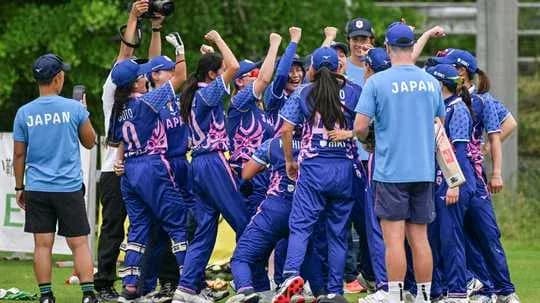
No one feels that shift more directly than Mai Yanagida, captain of the women’s side, who leads Japan into their Asian Games opener against India on Friday morning (IST).
“Yeah, Japan is not a cricket nation like India,” she admits, but she has lived the change. Awareness has climbed. So has the profile of the players. The hope now is simple: that a marquee opponent brings a crowd, and that the crowd sees something worth coming back for.
Her squad has done its homework. They watched India roll through the recent Asia Cup. They have followed the WPL, absorbing the rhythms and standards of the elite women’s game. Now they step out to face those same stars.
“Facing India is just unreal,” Mai says. It is not fear that dominates, but anticipation – the chance to share a field with a team that has just lifted a major trophy, a team stacked with “top-class players”. Intimidation lurks, of course. The gap in pedigree is obvious. But for Japan, this is not a mismatch; it is a measuring stick.
Screens light up: a digital foothold
The ICC has started to test the water with fans as well. For the first time, select matches involving Japan were live-streamed on YouTube and Facebook in key emerging markets.
The response was telling.
Across platforms in Japan, streams drew more than 1.1 million views. On YouTube, non-English feeds aimed at Japan and Indonesia totalled 201,000 views; Japanese-language coverage delivered 58% of that, around 118,000 views, leaving the remaining 42% split between Hindi and Urdu. On Facebook, non-English feeds across those two territories pulled in 252,000 views, and Japanese accounted for a hefty 70%.
Those are not blockbuster numbers by Indian standards. For a so-called non-cricket nation, though, they are a clear signal: there is an audience forming, and it prefers to watch in its own language.
The ICC has noticed.
Asian Games: a gateway, not a sideshow
For Glenwright and his colleagues, the Asian Games are not just another entry on the calendar. They are a strategic lever.
The Olympic Games, he points out, are brutally selective. Only a limited number of teams and sports can squeeze in. Regional multi-sport events like the Asian Games open the door to more members, more athletes and, crucially, more money.
That exposure unlocks government funding, support from national Olympic committees and interest from sponsors. It also gives emerging teams like Japan a stage on which to face full members in meaningful competition, not just in warm-up fixtures or development tours.
There is also the legacy that remains once the medals are handed out.
“On account of the Asian Games, we now have, or Japan Cricket now has, a second international cricket ground available to them,” Glenwright notes. Sano has long been the hub. Now Nagoya joins it as a second international-standard facility.
That changes the conversation. Two grounds mean the basic requirement for hosting most ICC events is suddenly met. Double-header schedules, concurrent matches, proper tournament structures – all of that becomes realistic.
Japan is no longer just a theoretical host. It is in the frame.
Pitch, perception and the path ahead
Not everything has been smooth. The Asian Cricket Council, which oversees cricket at the Asian Games, has flagged concerns about some aspects of the venue – not the square itself, but the athlete facilities, changing rooms and media areas.
From the ICC’s perspective, those worries are being dealt with.
“The ground itself, we have no concerns with,” Glenwright says. A World Cup qualifier was staged there earlier this year, and reports on the pitch and outfield were glowing. The ICC would not have taken that risk if it doubted the playing surface.
The off-field infrastructure has needed work, but the latest updates reaching Dubai suggest those issues are being addressed. For the ICC, the cricketing core is sound, and that is what matters most as it pushes to elevate Japan’s role in the global game.
The numbers are trending up. The facilities are catching up. A women’s side led by Mai Yanagida now walks into an Asian Games clash with India not as cannon fodder, but as a symbol of where this project might lead.
If Japan can turn this moment into momentum, how long before the country is not just hosting the world’s biggest events in other sports, but welcoming cricket’s next generation on a World Cup stage of its own?