For years, when Naoki Alex Miyaji spoke about India coming to Japan, it sounded more like a fantasy than a fixture. The CEO of the Japan Cricket Association would float the idea and people would smile politely. World champions flying across continents to face the 41st‑ranked Associate nation? Nice dream. Not happening.
Then came the Asian Games. And the dream grew legs.
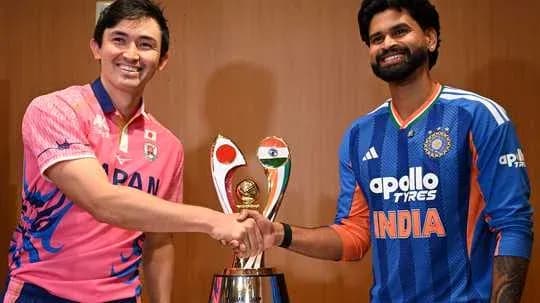
On Tuesday, at Sano International Stadium, Japan will walk out to face India in a men’s T20I. A little-known side led by Kendel Kadowaki Fleming against Jasprit Bumrah, Abhishek Sharma, Shreyas Iyer and company. A mismatch on paper, but a landmark in reality.
“The CEO has had this dream for a long time,” Kendel tells Cricbuzz. When Japan learned they would host the Asian Games, Miyaji started pushing the idea harder: India, in Japan, for an official game. It sounded audacious. Now it’s on the schedule.
“For it to turn into reality is extremely special for a lot of people involved, and as a men's team, we can't wait,” the captain says.
It took more than wishful thinking. It took lobbying, planning, persistence. Kendel knows the scale of the effort that has gone into this one fixture. He points to the leadership at the Japan Cricket Association, and particularly Miyaji, for driving it. The Board of Control for Cricket in India then did what few expected: it said yes.
That single yes has changed the shape of Japanese cricket’s year.
Japan are fully aware of the context. India have never played a bilateral series or even a standalone match against an Associate nation before. This is uncharted territory for the world champions, and a once‑in‑a‑generation opportunity for the hosts.
For the Japanese players, it is more than a big game. It is a window.
The chance to share a field with India’s stars, to feel the speed of Bumrah from 22 yards away, to watch Abhishek and Iyer at close quarters, is one side of it. The other is what this spectacle might do for the sport in a country where cricket barely registers in the mainstream.
“It's got the potential to accelerate the growth of cricket across the country,” Kendel says. He expects a crowd bigger than anything Japanese cricket has seen before. The standard of players on display will be, by some distance, the highest the Sano ground has ever hosted.
“It still does sound quite surreal to be hearing about them playing here in Japan,” he admits.
Surreal, but not intimidating. Kendel is clear on that. There are no grand promises, no bold predictions. Just a simple commitment.
“I can't guarantee any outcome, but what I can guarantee is that we will try our best. We'll compete and hopefully we'll give it our best shot.”
This is a side built on modest resources and steady work. Kendel, 30, is a left-handed batter and right-arm off-spinner. Around him, Japan have stitched together a squad that blends experience with emerging talent. The pathway system has started to bear fruit, with players like 17-year-old all-rounder Charlie Hara-Hinze, a left-arm spinner, coming through.
Spin has long been Japan’s calling card. Not by design at first, but by necessity. The conditions they encounter, whether at home or on trips to places like PNG, Thailand and Oman, have encouraged slow bowling. Over time, it has become part of their identity.
They have also earned a reputation for punching above their weight. At the ICC Men’s T20 World Cup Qualifier 2026, Japan pulled off a statement win, beating Kuwait by five wickets. It was a result that hinted at growing competitiveness against higher-ranked teams, a sign that they are no longer just making up the numbers.
Now comes a different kind of test, one that stretches far beyond the scoreboard.
The International Cricket Council has circled September 22 in bold. William Glenwright, the ICC’s Head of Global Development, does not hide his enthusiasm. In a calendar that saw more than 1,000 bilateral games last year and over 860 already this year, this one still stands out.
“It's enormous, one of our aspirations as an international federation,” he says.
For the ICC, this isn’t just another fixture. A full member, and not just any full member but the reigning world champions, playing away to an Associate is loaded with meaning.
“Having a full member and the world champions playing any associate member is hugely important to us from a cricket perspective,” Glenwright explains. The symbolism runs deeper still. What does it say about cricket’s place in Japan? What does it signal about the confidence full members now have in Associates’ ability to host them in major international cricket?
That’s the ripple effect the ICC is banking on: a game that reflects a maturing ecosystem, where Associate nations are not just recipients of development funds but genuine partners in the global schedule.
Inside Japan, the context is different again. Cricketers are not celebrities here. They don’t dominate billboards or prime-time television. The country’s biggest sporting icon is Shohei Ohtani, the two-way phenomenon who has redefined what is possible in baseball.
“He’s the Virat Kohli of baseball,” Kendel says. In Japan, baseball is the sport that fills stadiums and headlines. It is the game many supporters grow up with, the one that shapes national sporting identity.
Cricket, by contrast, is a niche pastime. But Kendel refuses to accept that it must stay that way.
“There's no reason why we can't aspire to become like that in cricket someday,” he says. He knows the scale of the challenge. He talks about a long road, about the distance between Japan and the established full-member nations.
Yet that is precisely why this week matters. One match will not transform a sporting culture overnight. It can, however, plant a flag.
On Tuesday in Sano, as India’s stars walk out and the stands fill with more people than Japanese cricket has ever seen, the dream Miyaji kept talking about will finally be visible in real time. The question now is simple: how far can Japan ride the momentum of a day they were never supposed to have?