On an ordinary day in Bengaluru, the ‘Mysore Express’ stood still.
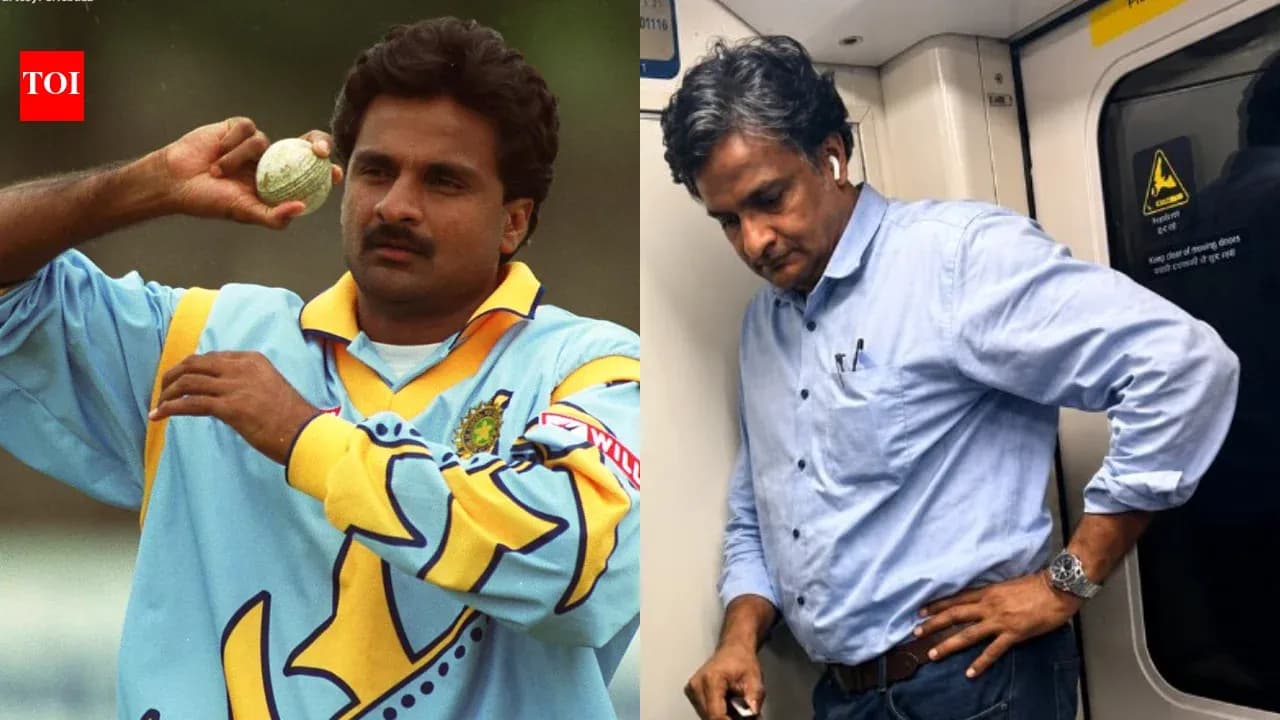
No new-ball partner. No roaring crowd. No television crew tracking his every move. Just Javagal Srinath, a trolley bag by his side, riding the Namma Metro like any other office-goer trying to get across a busy city.
The photograph that surfaced online is almost stubborn in its simplicity. Srinath, in jeans and a light-blue shirt, stands inside the Metro coach, his luggage parked next to him. No one in the frame appears to be asking for a selfie. No one is pointing. There is nothing in that moment to suggest that this man once led India’s pace attack through the 1990s.
And that is exactly why the image exploded across social media.
A fast bowler who outran the limelight
For a generation of Indian fans, Srinath was the rare Indian quick who could genuinely hurry batters. The Karnataka seamer, nicknamed the ‘Mysore Express’, shouldered India’s fast-bowling burden at a time when the country was still searching for a settled pace unit.
He played 67 Tests and 229 ODIs for India, a mainstay in an era before the current assembly line of fast bowlers. Yet years after retirement, it is not a searing spell in Johannesburg or a burst in the World Cup that has pushed him back into the public conversation. It is a quiet, almost forgettable commute.
The contrast is what grips you. A man who once opened the bowling for India now simply opens the Metro door and steps in. No fuss. No theatre. Just another Bengaluru commuter trying to get somewhere on time.
‘This is Srinath’: fans recognise a familiar trait
Once the photograph hit social media, the reaction was instant and affectionate. Fans didn’t marvel at his record. They nodded at his behaviour.
“This is Srinath,” many wrote, treating the image not as a surprise but as confirmation of what they already believed about him. Users recalled spotting him earlier in Bengaluru, walking alone, driving himself, or moving around without the security ring that often shadows former international stars.
The conversation quickly widened to an entire Karnataka generation. Names like Rahul Dravid, Venkatesh Prasad and Anil Kumble surfaced in the replies, as fans pointed to a particular culture around that state’s cricket. One widely shared comment summed it up: these were players who proved that “immense sporting success can coexist with absolute humility and grace.”
The Metro picture, for many, became a quiet rebuttal to the idea that sporting fame must automatically harden into celebrity distance.
Not the first ordinary moment that went viral
This is not a one-off glimpse into Srinath’s off-field life. A previous photograph, shared by a fan, showed him at Mysuru railway station, waiting with a bag slung over his back. No entourage, no special treatment. Just another traveller scanning the platform.
That image too drew praise, the same mixture of nostalgia and respect. The new Metro photograph has followed the same path, bouncing from one timeline to another, each share accompanied by a story, a memory, or simply a sense of pride.
The exact date of the Metro shot remains unclear; it cannot be independently verified when it was taken. But the timing hardly matters to those sharing it. For them, the point is not when Srinath boarded the train. It is how he chose to travel.
Still in the game, just in a different role
Srinath’s life after retirement never drifted far from the sport. Once the spikes were put away, he moved into the role of ICC match referee, trading the new ball for the match report, the dressing room for the officials’ box.
He remains a regular presence in international cricket, but in a very different capacity: the man in the blazer, not the one steaming in from his mark. The transformation from strike bowler to match official has kept him close to the game without dragging him into the modern circus of constant visibility.
For many Indian fans, though, he will always be the fast bowler who carried India’s pace hopes through the 1990s, often almost alone. That is why a single, unremarkable Metro ride can spark such a reaction. The photograph doesn’t show a former star basking in adulation or celebrating another milestone.
It shows something far rarer in the age of curated fame: a man who once thrived under the floodlights choosing, quite happily, to stand unnoticed under the Metro’s fluorescent tube lights.