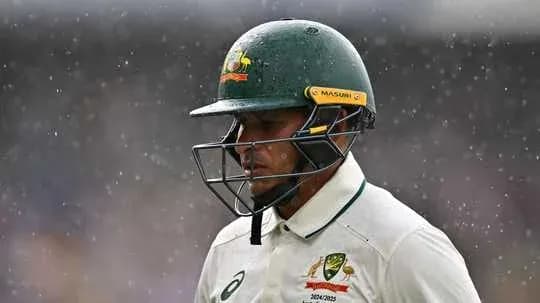
Kagiso Rabada has lived with the shadows of March 2018 longer than most fast bowlers should have to live with anything. Twenty-three wickets at 19.26 in a brutal, era-defining series against Australia ought to stand alone as a career peak. Instead, the old scandal has been dragged back into the light by Usman Khawaja – and Rabada wants no part of it.
Asked in Johannesburg whether he had “seen the blowback” in Australia after Khawaja’s latest claims, Rabada’s answer was clipped and cold.
“My take on it is we’re not concerned about what they have to deal with,” he said. “It’s not our topic to deal with. It’s obviously an Australian topic. I don’t see where we get involved in that.”
He wasn’t asked if he felt his 2018 haul was tainted. He wasn’t asked if he believed Khawaja. He wasn’t asked if the South African dressing room had discussed it. Yet his response made it clear: this is someone else’s mess.
The mess, though, is growing.
Khawaja’s autobiography, “Sabr”, released on Tuesday, has poured fresh fuel on the Sandpapergate fire. The scandal that once seemed dealt with, filed away under “Smith, Warner, Bancroft – bans served, lessons learned”, is roaring again.
Cricket Australia’s investigation at the time ring-fenced the guilt. Steven Smith, then captain. David Warner, then vice-captain and widely accepted as the architect. Cameron Bancroft, the man caught on camera with sandpaper, literally. Smith and Warner were banned for a year, Bancroft for nine months. Everyone else walked away officially clean.
Khawaja has now kicked that door back open.
“It was all of us. Not the batters, not the bowlers, not the staff. All of us,” he told Nine media at the weekend, arguing that the entire team knew of the plot to alter the ball.
The reaction from Pat Cummins, current captain and a member of that side, was swift and emphatic. He called a press conference in Sydney and went straight at the claim.
“When [Khawaja] says we all knew, if by that he means we knew sandpaper was going out on the field, he’s 100% wrong,” Cummins said, dismissing the allegation as “complete and utter nonsense”.
Yet the noise isn’t dying down. Australia have lost four of their last seven Tests, including two in South Africa last month. When a team that once strutted now stumbles, old questions suddenly feel relevant again. Calls for a fresh investigation into what really happened in Cape Town are getting louder.
Behind the scenes, the mood is no less charged. “I haven’t read his book, nor am I interested in his claims or remarks,” one figure said. “I hope he has evidence for what he has said.” That last line hangs in the air. If Khawaja can’t back it up, the blowback may yet turn on him.
There is another layer to all this – one South Africans understand instinctively. The two countries do not treat ball-tampering the same way.
“Australians play hard but fair,” an Australian voice said over dinner in Cape Town this week. “That’s why this came as such a shock.” In Australia, Sandpapergate triggered national soul-searching, televised tears, and a public inquiry into the culture of the men’s team.
In South Africa, the reaction to their own offenders has been almost the opposite: a shrug, a fine, and life goes on.
Faf du Plessis was nailed for ball-tampering against Pakistan in October 2013, using the zip on his trouser pocket. Vernon Philander followed in Galle in July 2014, scratching the ball with his fingernails. Du Plessis again in November 2016, this time in Australia, using saliva laced with a sugary sweet to coax movement. All three cases were clear-cut breaches.
Yet there was no national meltdown. No moral panic. No public demand for heads to roll. Cricket South Africa let the ICC handle the punishments and moved on. The public, by and large, did the same.
When Cricbuzz asked a former senior SuperSport crew member – from the broadcaster whose cameras caught Bancroft in the act in 2018 – why South Africa’s own repeat offenders had never been exposed at home, the answer came back, glib and utterly unconvincing: “Because they don’t do it at home.”
That’s the backdrop as Rabada and his teammates prepare for Bangladesh at the Wanderers on Sunday. They will want no part of fresh controversy. They have something else to protect: a team perched at No. 1 in the world rankings, defending the World Test Championship crown they claimed at Lord’s last June.
Rabada is central to that story. In the 2-1 win over Australia last month, the series that has now been dragged into the Khawaja storm, he reached 350 Test wickets in fewer deliveries than any bowler in history. That is the kind of record that should define a career, not a footnote in a scandal that refuses to die.
For Rabada, the jersey still matters more than the noise.
Playing for South Africa, he said, is “a blessing; it’s a gift. It’s something not a lot of people get to do. Each and every day I have the opportunity to represent my teammates and myself is me continuing to live my dream.” He wants the Bangladesh series to “show how healthy cricket is”.
There is a sense of hard-earned satisfaction in the camp. “It feels really good to be the No. 1 team in the world,” Rabada said. “After going through all the ups and downs it pays off to keep at it, to keep playing for the badge and not give up. It’s not always plain sailing.”
It certainly wasn’t against Australia. South Africa lost the first Test at Kingsmead, looked rattled, and then somehow clawed the series back. They squeezed out a win at St George’s Park despite losing most of the first two days to rain. At Newlands they were ruthless, winning by an innings to close out what many in the country regard as the most gripping home series in living memory.
Now comes Bangladesh, then England for three Tests across December and January, capping a packed Test summer for a side that went 20 months without a home Test before October.
Australia, meanwhile, are still trying to escape 2018’s long shadow. South Africa have learned to live with their own sins. The question is whether Khawaja’s words drag both teams back into a storm they thought they had already survived.