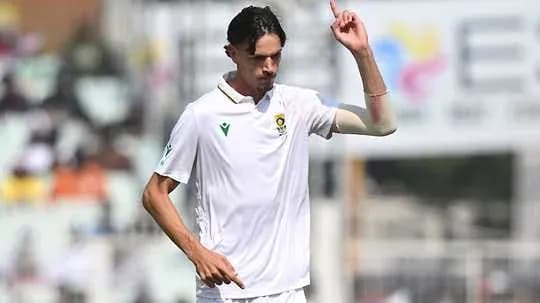
Marco Jansen has spent most of his international life running in with a new ball that belonged, in spirit if not in fact, to Kagiso Rabada or Lungi Ngidi. On Thursday at Kingsmead, it’s his attack. His stage. His problem.
South Africa’s fast-bowling stocks have been stripped back to the bare essentials. No Rabada. No Ngidi. No Anrich Nortje. No Nandre Burger. No Lizaad Williams. What’s left is a tall, rangy left-armer who once slipped quietly into the slipstream of giants and now has to be the one clearing the path.
He doesn’t have much time for what-ifs.
“Their not being a part of the squad is a loss,” Jansen said on Monday, speaking about Rabada and Ngidi. “They’re world-class bowlers, especially in South Africa. They know how to bowl in these conditions, and they know how to get the most out of the ball on a particular day. It feels like I’m going to have to take that leadership role and lead from the front for the first time.”
The numbers say this isn’t entirely new territory. The responsibility is.
In Test cricket, Jansen has taken the new ball in only four innings, all of them last November in Kolkata and Guwahati when Rabada was sidelined with a rib injury. Those are the only times he has bowled the first over of a Test innings. More often he has shared the new ball, doing so 16 times, always with Rabada alongside him.
The pattern repeats in white-ball cricket. In ODIs, Jansen has opened the bowling 14 times. Ngidi has shared the new ball on eight of those occasions, Rabada on three. Across 12 ODIs where he has been one of the two new-ball bowlers, Ngidi has taken the first over seven times, Rabada three.
T20Is tell the same story from a different angle. Jansen has been trusted with the new ball 18 times. Rabada has followed him in the second over in seven of those matches, Ngidi in two, Gerald Coetzee and Aiden Markram in three each. In the 10 T20Is where Jansen has bowled the second over, Ngidi has started six times and Rabada twice.
Strip away the formats and the picture sharpens. Jansen has delivered the first or second over of an innings 74 times for South Africa. On 54 of those occasions — almost 73% — the man at the other end has been Rabada or Ngidi.
Now both are absent. Their influence is not.
“I base what I think leadership looks like on playing with KG and Lungi,” Jansen said. “When things go sideways or it’s tough, especially when we’re in the field, they have a way of calming and slowing things down. That’s what I’ll be trying to do.
“Because the last thing you want when you’re struggling in an over or at the death when the ball is flying around is someone just giving solutions and saying do this or do that. It’s important to pick up on the moments when a bowler needs time to slow things down and ask simple questions; things like what’s the plan here or how are we going to get this guy off strike.
“We do all the work before the game. We know what plans we want to put into action, what balls we want to bowl, and which fields we want to set. On game day it’s all about how to get the guys in a mental space where they can execute their gameplans. It’s about getting the best out of them.”
That’s the voice of a bowler who has been watching closely. Learning quietly. Now he has to apply all of it with Australia walking out to face him in Durban.
Around him, the left-arm theme keeps growing. Marco Jansen, Corbin Bosch, Gerald Coetzee and Kwena Maphaka are the quicks still standing for this ODI series. Duan Jansen, who began his international white-ball journey in Namibia last month, is also in the squad.
Look a little further ahead and the idea becomes irresistible. Imagine Keshav Maharaj, another left-armer albeit a spinner, operating in a Test XI that also includes the Jansens, Maphaka and perhaps even a left-handed batter like Neil Brand or David Bedingham in a home summer stacked with Australia, Bangladesh and England.
The three-Test series against Australia starts in Durban on October 9. Bangladesh follow at the Wanderers and Centurion between November 15 and 27. Then England arrive for three Tests in Johannesburg, Centurion and Cape Town from Boxing Day to January 7. If the current injury trend drags on, that left-arm future might arrive sooner than anyone expected.
For now, South Africa will settle for Jansen simply being fit.
That, too, was not guaranteed. His build-up to the new season went sideways in a way that doesn’t show up on an injury list.
“My build-up to that game didn’t go as planned,” he said of his first-class outing for the Titans against the Dolphins in Centurion from September 10 to 12. “I planned to bowl two or three weeks before but then I got sick. I was on antibiotics for a week-and-a-half, two weeks. That cut my preparation short, so I only had three days of prep and felt heavily undercooked going into the match. I also saw two physios as well for small stuff. Coming back from after The Hundred I had to sort out stiffness in the body.”
On the field, he looked anything but undercooked.
Nine overs in the first innings brought 3/39. Then came a brisk 37 off 45 balls, laced with seven fours, to ram home the Titans’ dominance. In the Dolphins’ second innings he really stretched out, sending down 17 overs for 4/61. Titans won by an innings and 60 runs. Jansen walked off with a full workload under his belt and his rhythm restored.
South Africa need that version of him now: the one who can bowl long, hostile spells and still have enough left to think clearly for others.
Because this is no gentle audition. Australia at Kingsmead, with a makeshift attack and no Rabada or Ngidi to lean on, is as real as leadership gets for a 24-year-old fast bowler. The new ball will still feel familiar in his hand. The responsibility attached to it will not.
How he handles that shift — from apprentice to leader, from support act to spearhead — will shape far more than just three ODIs in Durban. It could define the tone of South Africa’s entire home summer.