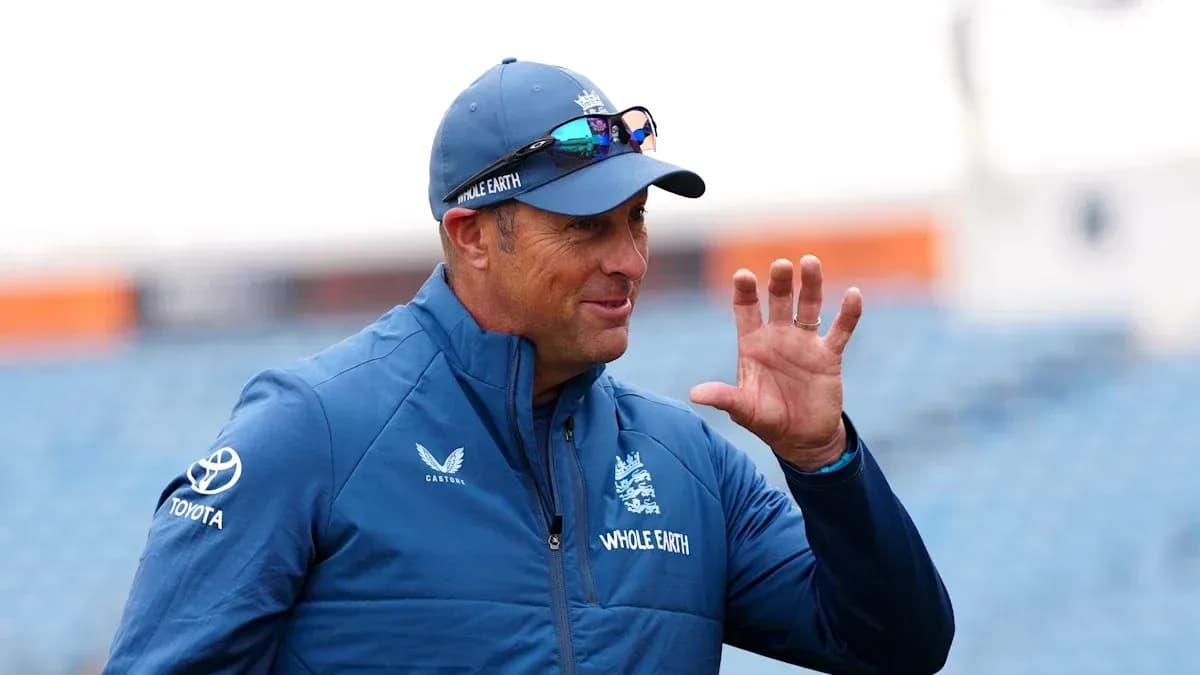
Marcus Trescothick walked away from The Oval with a 3-0 whitewash in his pocket and a question mark over his future.
England’s interim Test coach has just overseen a ruthless sweep of Pakistan, then immediately switches back into his regular role with Brendon McCullum’s white-ball set-up for the Sri Lanka series starting Sunday. Yet while the results have been emphatic, Trescothick’s own place in the next regime is anything but.
Stephen Fleming, the incoming red-ball head coach, is due to land in England in the coming days. Once he does, both the Test and white-ball sides will effectively be run by New Zealanders. McCullum already has his imprint on the limited-overs squad; Fleming will now be charged with reshaping the Test side alongside Joe Root.
Around them, the accents are increasingly familiar. Tim Southee and Jeetan Patel are embedded with the bowling group. Australian influence is growing too, with Marcus North recently installed as national selector and fellow countryman Mike Hussey sounded out by Fleming as a potential Test batting mentor.
Through all of that, Trescothick has been the senior English voice in the dressing room for the past four and a half years. Yet he admits he does not know whether that voice will still be heard when Fleming takes full control.
"There's another transition to happen with Stephen coming in to work with Joe Root and plan how they are going to move things forward," he said. "We'll see how it pans out. Within the next couple of weeks we'll probably know a little bit more."
He has spoken with Rob Key, the director of men’s cricket, but only in broad strokes.
"I've spoken with Rob Key a little bit over the last couple of weeks, had bits of discussions on what might happen. When Stephen is over, he and Rob and Brendon can really get together and thrash out how it's going to look."
Pressed on what he actually wants, Trescothick chose his words carefully.
"I probably do (have a preference) but it's probably best I don't mention it at the moment because it may not be what happens. I love doing both formats. It's been brilliant and a privilege."
The uncertainty over his role feeds into a wider question: how much English influence will remain at the heart of an England side increasingly shaped by overseas coaches?
Trescothick is clear on that point. Whatever happens to him, he wants homegrown coaches involved.
"Yeah, I'd like to think so. There's nothing better than working for your own national country," he said.
He is not the only candidate pushing that case by example. Sarah Taylor has drawn strong reviews for her work as a fielding consultant this summer. Michael Yardy has stepped up from the under-19s in recent weeks and briefly joined the senior set-up. Those names matter to Trescothick, not just for sentimental reasons but because he believes they understand the nuances of English cricket in a way others simply cannot.
"Within the course of the coaching system you want someone within that who can highlight things that are important to England players, England teams, England series. They are different to other countries and unique in their own way."
That word – “unique” – hangs over the debate. English conditions, English expectations, English pressure. Those are not abstract ideas to Trescothick; they shaped his own international career. His view is that the pathway should remain open for others who have walked the same route.
"We want to try and promote our own from within and get them up to the top because there's nothing better if you can get to that point. It's not the be-all and end-all but if we can have representation in there the better it will be."
The whitewash of Pakistan has shown England can still dominate at home. The next question, as Fleming’s arrival looms, is who gets to shape what that dominance looks like – and how loud the English voices will be in their own dressing room.