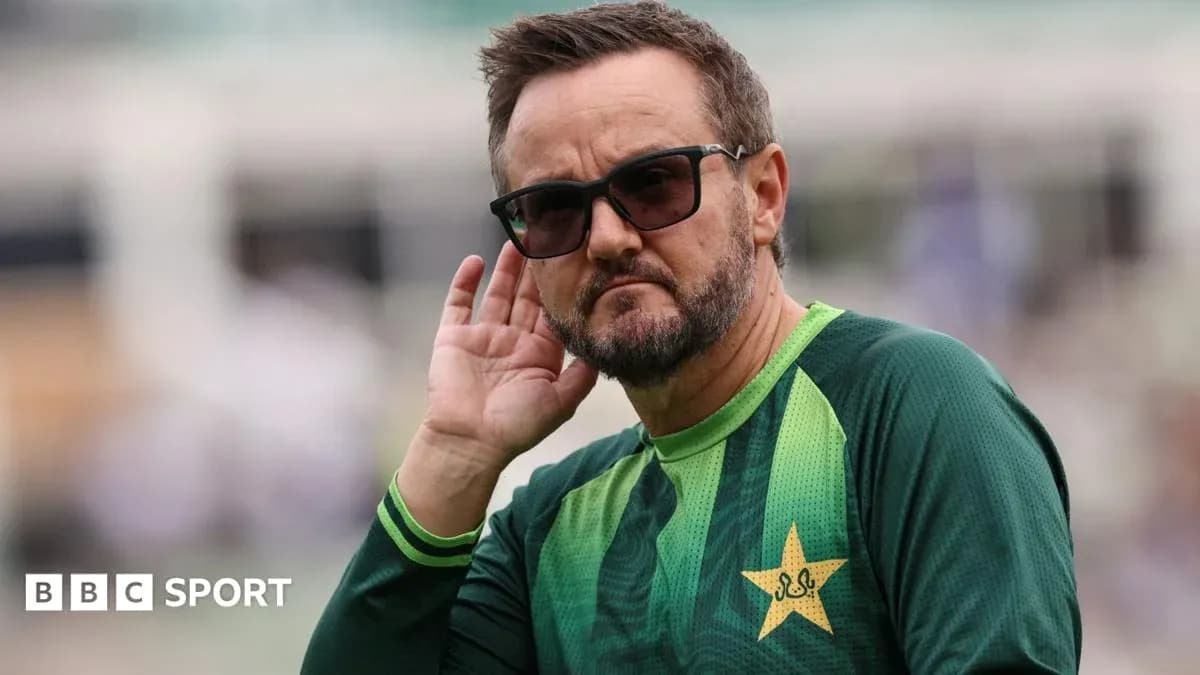
Mike Hesson has made it clear: he wants the Pakistan Test job, and he wants it properly, not as a short-term fix.
The 51-year-old New Zealander, parachuted in as interim coach for the third Test at Edgbaston, has already nailed his colours to the mast. Asked if he would be interested in taking on the role full-time, his answer cut through any doubt.
"I'll be open to it, for sure. I love Test cricket," he said.
Hesson stepped in after Sarfaraz Ahmed was removed from his Test duties following heavy defeats at Headingley and Lord's, a brutal two-match stretch that underlined just how far Pakistan’s red-ball game has slipped. The Pakistan Cricket Board turned to a man with pedigree: the same coach they had already entrusted with the limited-overs side in May 2025, and the architect of New Zealand’s rise between 2012 and 2018.
The result at Edgbaston was another defeat, this time by eight wickets. On paper, it reads like more of the same. On the field, there were at least hints of something different: a bit more resistance, a touch more structure, a side that didn’t completely fold once the pressure came.
Hesson, though, is under no illusions. This is a long job, not a quick rescue.
"I think there's enough talent around the system in Pakistan that if we can provide some good direction, we can make some strides forward," he said. "It's certainly not going to happen in a game or two, but I think there is some skill there I'd certainly be considering looking after."
That phrase – “considering looking after” – says plenty. He is not talking like a caretaker. He is talking like a man ready to invest years, not weeks.
England came calling – and were turned away
Hesson’s name carries weight in international cricket circles, and not just in Lahore or Wellington. He revealed he was sounded out about one of the biggest jobs in the sport: replacing Brendon McCullum as England’s Test coach.
McCullum was sacked in July after England’s high-octane “Bazball” era ran out of road. The England and Wales Cricket Board then turned to another New Zealander, Stephen Fleming, but not before checking on Hesson’s availability.
"I was contacted by my agent to say there had been an approach to have a discussion around my availability, as I'm sure many people were," Hesson explained.
He did not entertain it for long.
"I made it pretty clear I had committed to Pakistan," he said.
That line will not go unnoticed in Pakistan’s dressing room or boardroom. Nor will his track record of staying the course.
"Most of the positions I've been in, I've been in for five or six years. I see it through, then you have a break, then you refresh and try for something else."
It is exactly the sort of stability Pakistan’s Test side has lacked: a coach willing to build, absorb the chaos, and stay when the storm hits.
A red-ball team crying out for attention
The Edgbaston loss exposed familiar flaws but also triggered a familiar lament. Former captain Ramiz Raja, watching on for BBC Test Match Special, saw enough spirit to offer a sliver of praise, but his broader assessment was blunt.
Pakistan, he argued, simply do not invest enough in Test cricket.
"It's time to revisit Test match cricket," Ramiz said. "It's back to the drawing board because in the sub-continent not a lot of emphasis is put on Test match cricket."
The comment cut to the heart of Pakistan’s current malaise. White-ball tournaments, leagues, and short-term cycles dominate planning and selection. The red-ball side often feels like an afterthought, assembled late, underprepared, and then judged harshly when it fails.
Ramiz pointed to the turmoil around the team in recent weeks.
"Obviously there was mayhem around the team and that may have hurt the dressing room environment. But Pakistan were also a little underdone, undercooked with preparation."
Underprepared. Undercooked. Under pressure.
That is the environment Hesson has walked into. And yet, he wants more of it.
He sees talent in the system, believes direction and time can turn scattered promise into a coherent Test outfit, and has already turned down one of the sport’s marquee jobs to stay in the project.
The PCB must now decide whether this was a one-off audition at Edgbaston, or the first step in handing the Test side to a coach who tends to stay for “five or six years”.
If Pakistan truly are ready to “revisit” Test cricket, as Ramiz insists they must, Hesson’s commitment and hard-edged realism might be exactly where that conversation begins.