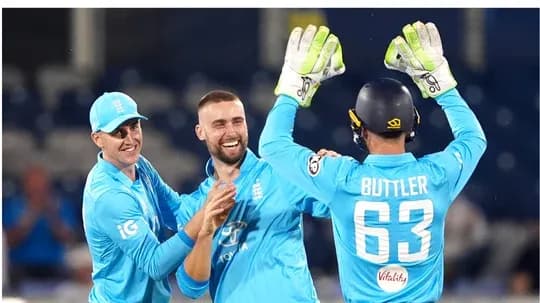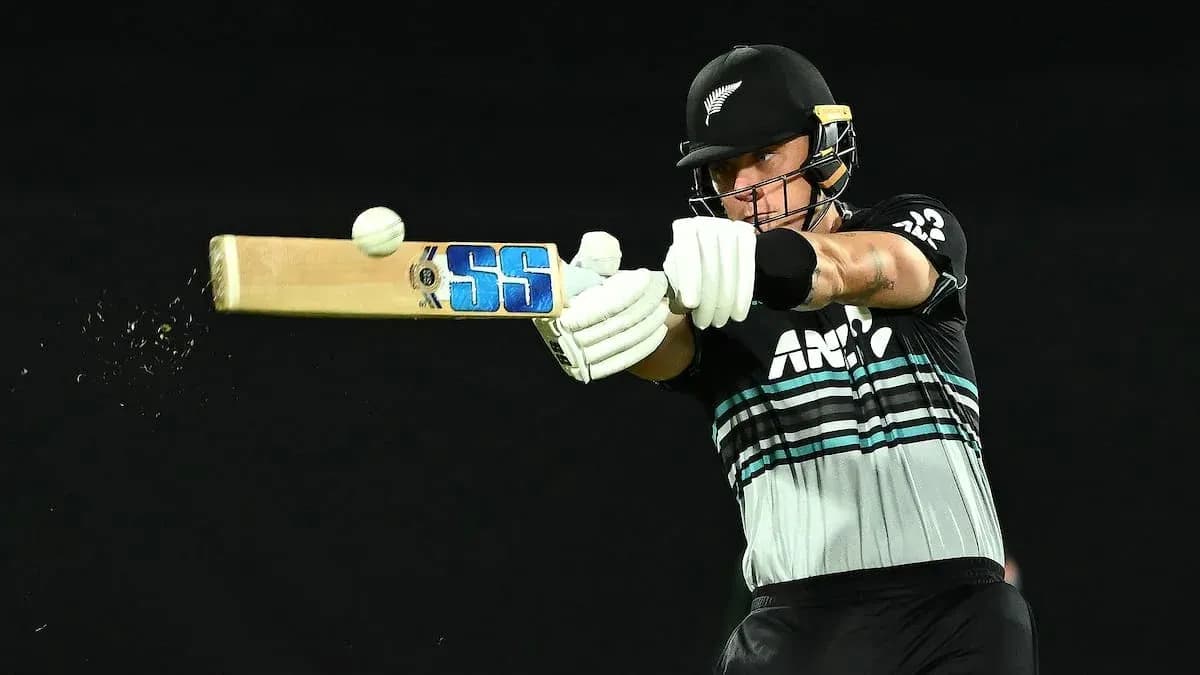
Matt Henry had his bursts. Nathan Smith had spells that bit. Mohammad Abbas, gliding in at his own pace, made batters doubt strokes they usually play in their sleep. Yet when the 2026 English summer is filed away, one name will sit in bold at the top of the page.
Ollie Robinson.
He arrived on a comeback trial. He has ended up owning the season.
A Summer Built for Seam – and One Bowler in Particular
The numbers are outrageous. Robinson has taken 26 wickets in just four Tests, with another innings still to come, at an average of 7.96. That is not a typo. It is the kind of figure you normally only see in a county April, not across an entire international summer.
Henry is next on the list at 13.33, Abbas at 20.80. Josh Tongue and Jofra Archer have both had strong campaigns at opposite ends of the speed gun, yet neither has matched Robinson’s ruthless efficiency.
The broader trend tells you why his method has been so deadly. Medium pace has come roaring back into fashion.
Balls below 80mph this summer have taken 40 wickets at 17.92, striking every 33.4 balls and going at just 3.21 an over. Deliveries above 80mph have claimed three times as many wickets, but at a higher average of 23.38. Only once in the ball-tracking era has sub‑80mph bowling produced a better average in England: 2019, when 26 such wickets came at 17.42, 13 of them in Ireland’s three‑day ambush at Lord’s.
This has been a seam bowler’s dream. Since 2006, only one English summer has offered a lower expected average for seamers than 2026. The expected number this year sits at 23.6; the reality is sharper still at 22.14. The ball has done enough, often more than enough. Seamers have not had to conjure wickets against flat conditions; they have simply had to hit the right length and let the pitch and the wobble seam do the rest.
That shift has changed where dismissals come from. Traditionally in England, you live off the outside edge: the cordon, the keeper, the slips waiting for that feather or hard nick. This year, the stumps have become the bullseye.
Bowled and lbw dismissals have made up 45.6% of all wickets – the highest proportion in an English summer since the war. In a landscape like that, the medium pacers have found their opening.
With wicketkeepers standing up more often, bowlers have attacked the stumps, not just the edge. They have forced batters to defend leg, middle, off – all three – against a ball that keeps whispering lies off the seam.
No one has exploited that better than Robinson.
False Shots, Real Damage
Robinson has not just taken wickets; he has scrambled minds. His false-shot percentage this summer stands at 39.7%. Two balls in every five are provoking a misjudgement – a play and miss, an inside edge, a mistimed drive. It is the highest figure recorded for any bowler in an English season for which this data exists.
Abbas, the next best this year, sits at 32%. Kagiso Rabada, Mark Wood, Archer – big names, high pace, serious operators – all trail Robinson’s level of deception.
Overlay that with his raw returns: 26 wickets, four Tests, three Player-of-the-Match awards in his first three appearances of the summer. The last England player to do that on home soil was Ian Botham in 1981, a season so mythic it has its own shorthand: Botham’s Ashes.
Robinson is not Botham. He does not swing the bat like a wrecking ball or bowl at 90mph. But in his own, more measured way, he has bent a summer to his will.
From Exile to Evolution
All of this would be impressive enough in isolation. It becomes far more compelling when you remember where he was two years ago.
Despite outstanding figures in his first 20 Tests, Robinson vanished from England’s plans early in 2024. Brendon McCullum’s regime wanted more pace to challenge Australia and reshape the attack. Robinson, with his 78‑82mph bracket, did not fit the brief.
Yet the numbers he had already banked were elite. After 24 Tests he now has 102 wickets at 19.10, with a possible innings still to come. For context, Jasprit Bumrah had 101 wickets at 22.79 at the same stage of his career. Robinson’s strike rate stands at 42.5 balls per wicket, compared to Bumrah’s 51.4.
He has six Player-of-the-Match awards in those 23 completed Tests. Since his debut in 2021, only Travis Head has more, with 10 in 48 matches. Robinson’s six in 23 mean he walks away with the award in over a quarter of his games – a higher share than anyone else in that period.
And yet the most interesting part of his return is not the continuity. It is the reinvention.
Less Swing, More Seam, Relentless Length
The new Robinson is a bowler stripped back to his essentials and then sharpened.
In his debut summer of 2021, he leaned heavily on swing. On average, the ball moved 1.06 degrees in the air for him. This year that figure has almost halved, down to 0.55 degrees. At the same time, his average seam movement has climbed from 0.72 to 0.85 degrees.
The length has tightened too. In 2021, 61.2% of his deliveries landed in the good-length zone. This summer that number has jumped to 69.5%.
The picture is clear. Robinson now charges in, hammers the 6‑8 metre zone, and trusts wobble seam to do the mischief after the ball lands. Less artistry in the air, more menace off the deck. Less searching for magic, more repetition of a brutal, disciplined method.
The angle has changed as well. So have the victims.
Left-Handers, New Angle, Same Result
Between 2021 and 2024, Robinson’s record against left-handers was good without being spectacular: 25 wickets at 28.32 from 1578 balls. Respectable, solid, not a glaring weakness but not a specialist weapon either.
In 2026, that has flipped. Against left-handers this summer, he has taken 11 wickets from just 262 balls at an average of 6.60. That is not just improvement; it is domination.
The key? Around the wicket.
In his first stint for England, Robinson only sent 37% of his deliveries to left-handers from that angle. It brought him seven wickets in 584 balls at 39.28. This year, 80% of his balls to southpaws have come from around the wicket. The return: ten wickets from 210 balls at 6.20.
Same bowler, new method. Angle changed, outcome transformed.
He now attacks the stumps from wide of the crease, dragging left-handers across, making them play, then jagging the ball back in or straightening it off the seam. With the keeper up, the drive is riskier, the leave more dangerous, the pad a constant target.
Robinson has not just slotted back into what England do. He has adapted to what England’s conditions have offered him in 2026: less conventional swing, more seam deviation, and a summer where the ball has kept batters honest all day long.
A Milestone, and a Statement
The numbers behind the story are already historic.
Robinson reached 100 Test wickets on the first morning of the third Test, trapping Saim Ayub lbw with a nip-backer from around the wicket. A left-hander, pinned in front, beaten by that new method. Fitting.
He got there in just 4285 balls – the fifth-fastest in the post-war era, behind only Dale Steyn, Vernon Philander, Waqar Younis and Kagiso Rabada. That is the company he is keeping now.
At that moment, his career average sat at 19.10, the sixth best among the 206 bowlers with 100 or more Test wickets, and the best of any bowler in the last 100 years. At home, the numbers are even more startling: 16.05 runs per wicket, the fourth-best home average of all time (minimum 50 wickets) and again the best of the last century.
These are not the figures of a stop-gap seamer or a horses-for-courses pick. They are the numbers of a bowler who has mastered his environment.
The Refined Expression of English Seam
For years, there has been a caricature of the English seamer: medium pace, a hint of swing, nibbling away outside off, living for the nick to slip. Robinson could easily have been filed under that stereotype.
This summer has blown that lazy label apart.
He has reduced his reliance on conventional swing, increased his use of wobble seam, pushed his length fractionally fuller, and found a ruthless, repeatable plan against left-handers from around the wicket. In a season when the stumps have mattered more than the cordon, he has attacked them with a clarity and consistency no one else has matched.
He no longer looks like a relic of England’s old seam-bowling culture. He looks like its most refined, data-age expression.
The summer of 2026 has brought medium pace back into vogue. The question now is not whether Robinson belongs in this England attack.
It is whether, from here, he becomes the one who leads it.