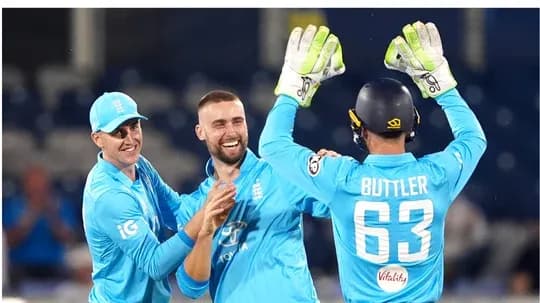
On a grey Lord’s afternoon, with Pakistan clinging to faint hope and England hunting a finish, Ollie Robinson quietly crossed a line that separates the very good from the truly exceptional.
He did it with a snarl of seam, a burst of precision, and a set of numbers that now place him at the top of a century-long list.
A modern master of the average
By the time tea arrived on day four of the second Test, Robinson had not only dragged England to the brink of victory, he had also slipped past Jasprit Bumrah to own the best Test bowling average of any bowler with at least 20 matches in the last 100 years.
His updated figures tell the story starkly enough. At the time of this landmark, Robinson had played 23 Tests, bowled in 43 innings and taken 99 wickets at 19.53 apiece, with best innings figures of 5 for 39. That average nudges him ahead of Bumrah, whose 234 wickets in 52 Tests have come at 19.79, with a best of 6 for 27.
Strip away the modern filter and only the greats of a different age sit ahead of them.
W Barnes, SF Barnes, R Peel, J Briggs – names from cricket’s sepia era – still dominate the all-time charts. W Barnes’ 51 wickets at 15.54, SF Barnes’ 189 at 16.43, Peel’s 101 at 16.98 and Briggs’ 118 at 17.75 belong to a different game, played on uncovered pitches and in another tactical universe. Robinson, listed just beneath them and above Bumrah, stands as the leading figure of the contemporary seam generation by this particular measure.
For a bowler who only debuted after 2000 to live in that company is striking. To sit on top of that modern pile, even more so.
Lord’s under his spell
The numbers, though, only make sense when set against the spell that pushed him there.
Pakistan, set 389 to win, had slumped to 14 for 3 before Saud Shakeel and Shan Masood dug in with a partnership that began to gnaw at English patience. By tea, Pakistan were 140 for 5. The target remained distant, but the fight had returned.
Shakeel played with intent, reaching his 15th Test half-century from just 54 balls. He drove, cut and clipped his way to 78 – his second fifty of the series and the innings that, for a while, held England at bay. Masood, more circumspect, occupied the crease for almost four hours for his 26, blunting the seamers and forcing England’s bowlers into long, searching spells.
The morning had hinted at a rout. Robinson and Jofra Archer, working in tandem in helpful seaming conditions, had threatened to run through Pakistan’s middle order. When that didn’t materialise and the ball softened, frustration seeped in. England’s fielders repeatedly urged the umpires to inspect the ball. The crowd’s murmur flattened. The game drifted.
Then Robinson came back.
Breaking the stand, breaking Pakistan
His return, with Jamie Smith standing up to the stumps, changed everything.
First came the end of the 97-run stand. Masood, initially given not out to an inswinger that tailed back in, looked relieved as the finger stayed down. England reviewed. Technology showed the ball striking him in line with leg stump. Decision overturned. Pakistan’s captain gone. Lord’s woke up.
Robinson didn’t let the moment slip. He quickly followed with Mohammad Rizwan, pinned in front for one as the batter attempted a swat and missed. Two blows in short order, and the resistance that had consumed almost four hours began to crumble.
By tea, Robinson’s figures in the innings read 4 for 24. Across the match, he had eight wickets for 35 runs. The scoreline said Pakistan were still alive; the mood in the ground said otherwise.
Shakeel remained Pakistan’s lone pillar, his 78 the highest score of the innings and the only knock that genuinely hinted at an unlikely chase. Yet even his fluency could not fully disguise the tightening grip of England’s seamers, with Robinson at the heart of it.
A landmark with real weight
Context matters with statistics, and Robinson’s new mark carries plenty.
To sit at an average of 19.53 after 23 Tests, with 99 wickets in the bank, is not a quirk of a short career or a handful of freakish spells. It has been built over 43 innings, in varied conditions, against different batting line-ups. It has survived the inevitable lean days and the flat pitches.
Bumrah’s record remains immense: 234 wickets, 52 Tests, a near-identical average, and match-winning spells around the world. Yet on the cold numbers of bowling average among post-2000 debutants with at least 20 Tests, Robinson now stands just above him.
- W Barnes (England, 1890): 21 Tests, 51 wickets, Ave 15.54, Best 6/28
- SF Barnes (England, 1914): 27 Tests, 189 wickets, Ave 16.43, Best 9/103
- R Peel (England, 1896): 20 Tests, 101 wickets, Ave 16.98, Best 7/31
- J Briggs (England, 1899): 33 Tests, 118 wickets, Ave 17.75, Best 8/11
- OE Robinson (England, 2026*): 23 Tests, 99 wickets, Ave 19.53, Best 5/39
- JJ Bumrah (India, 2026*): 52 Tests, 234 wickets, Ave 19.79, Best 6/27
Robinson’s name now sits in that column of great economy and relentless threat, a modern outlier in an era when bat dominates most conversations.
One wicket from three figures
As England closed in on victory at Lord’s, the statistical sub-plot refused to fade.
Robinson’s four wickets in the fourth innings had dragged Pakistan to the edge. His eight for 35 across the match had underpinned England’s control. His average had dipped below Bumrah’s, chiselled down to around 19.5.
And there he stood: 99 Test wickets, one shy of three figures, already atop the modern bowling-average list.
The next scalp will bring its own milestone. The real question now is how long he can keep that number – 19.53 – in the rare air where only the greats tend to breathe.