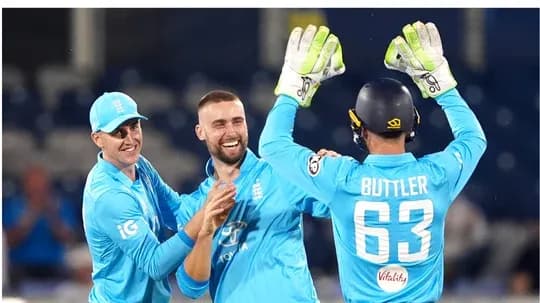
Ollie Robinson has always made bowling look like breathing.
Five years on from his England debut, after the drops and recalls, the whispers about fitness and the questions over trust, that hasn’t changed. If anything, this summer has underlined it. In three Tests he has taken 23 wickets, and at Lord’s in the second Test he operated with such control that England barely needed a spinner. The conditions have been tailor-made for him. He has made them look custom-built.
Calling him “robotic” sounds harsh until you understand what it means in this context. Glenn McGrath was like that. Metronomic. Relentless. Every stride, every release, the same. Robinson lives in that same world of repetition and rhythm, his action so smooth it looks like it’s been drawn with a ruler. His wrist position is immaculate. The seam stays proud, the ball obeys.
This summer, whatever he has asked the ball to do, it has done. Swing in. Shape away. Wobble off the seam. He has not hunted wickets with desperation or gimmicks. He has simply hit his length, over and over, and let the ball talk. When you’re in that kind of groove, you feel you could run in blindfolded and still find the edge. Few sensations in cricket match that.
Robinson the thinker
The beauty of Robinson is that he is not just a repeatable action and a helpful Dukes ball. He reads the game as sharply as anyone in this England set-up.
He spots a weakness quickly. A bat coming down from gully. A front foot that doesn’t quite get to the pitch. A backlift that leaves a gap between bat and pad. Then he translates it into a plan for the very next over. That tactical brain has been there from the start. Coaches who worked with him early on talk about a young seamer already giving mini-lectures in the dressing room on how to dismiss specific batters.
It all feeds into the bowler he has become now: part craftsman, part analyst, always calculating.
That is why his omission from last winter’s Ashes squad still jars with many. As England debated pace and “impact”, Robinson found himself on the outside, amid talk of a breakdown in trust with the Ben Stokes–Brendon McCullum regime and public questioning of his conditioning. Bowling coach Jon Lewis called out his fitness in 2022. The message was clear: get fitter, get faster, or get left behind.
There have been times when Robinson has not been handled especially gently. Yet the decision to leave him at home last winter may have sharpened his focus. Now, under Joe Root’s captaincy, England are cashing in.
Keeper up, game changed
Australia have played their own part in this rebirth. Their Ashes tactic of pushing Alex Carey up to the stumps for the seamers has quietly reshaped how teams think about medium-fast bowling. England have copied it with Robinson, and it suits him perfectly.
With Jamie Smith standing up, batters cannot simply stroll down the pitch to smother his movement. The risk of being stumped is too great. That one adjustment gives Robinson licence to pitch the ball a yard fuller. Fuller means more time in the air. More time in the air means more swing. From that length, the stumps come into play. On English pitches, it’s a nightmare for top orders.
None of it works without a competent keeper. Smith deserves credit. He struggled badly with the gloves during the Ashes, but his work with wicketkeeping coach Sarah Taylor has clearly bitten. Before play, she hammers tennis balls at him with a racket, the ball skidding low, a batter in front feathering edges or missing entirely. Smith has to stay low, stay soft, and cling on. At Lord’s, the benefits were obvious.
The question now is whether this partnership between bowler and keeper can travel.
The next examination
England head to South Africa this winter for a three-Test series. Harder pitches. Less lateral movement. Hotter days that expose any frailty in the legs and lungs. Those are the environments where England have often looked at Robinson, weighed the risk, and gone for a quicker option instead.
That should change. He has earned the right to be tested in those conditions.
Behind the scenes, England are working to keep his pace at around 82mph throughout a day’s play, rather than the familiar pattern of starting there and sliding down to 77–78mph as the overs pile up. If he can hold that higher base speed, the extra bounce he extracts should help offset the reduced movement. On flatter decks, that could be the difference between being a threat and being a holding option.
At Lord’s, he showed he can be both. His economy rate – just 1.29 runs per over – allowed Stokes to use him almost like a spinner, locking up an end while rotating quicks at the other. England may not have a frontline slow bowler in this new-look attack, but Robinson’s control means they can still squeeze teams.
Do not break the quartet
That new seam group – Robinson, Jofra Archer, Gus Atkinson and Josh Tongue – has given England something they have not had for a while: variety with genuine menace. Different angles, different speeds, different questions for batters to answer.
Now comes the temptation to tinker. Rest this one. Rotate that one. Protect bodies. Protect futures.
They should resist it for Edgbaston.
England have been on a poor run. They need wins, yes, but they also need continuity. Attacks grow into themselves. Bowlers learn when to attack and when to dry up runs. Captains learn who wants the ball with the game on the line, and who needs one more over with the breeze at their back. That only comes with time together in the middle, not in the gym or on a spreadsheet.
Root must learn how to deploy each of them – when to unleash Archer, how long to keep Atkinson on, when Tongue’s angle is most dangerous – with Robinson as the constant. The leader. The bowler who can set a tone and hold it.
Right now, this is England’s best attack. It has a clear spearhead, a clear identity, and the numbers to back it up.
The real measure will come not on a damp English morning with a new Dukes ball, but on a hot afternoon on a hard, unresponsive pitch, when the legs ache and the ball is 60 overs old. That is where we will find out if this “robotic” rhythm can carry England through a new era – and whether Ollie Robinson can turn this summer’s mastery into something far more enduring.