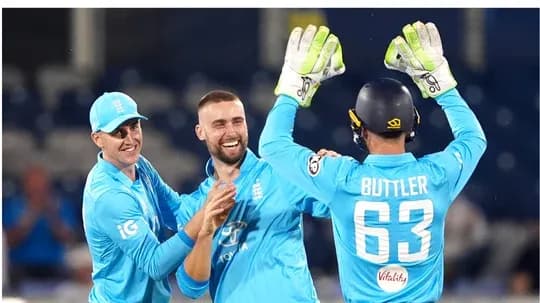
Ollie Robinson has always looked like he was born to bowl.
Five years on from his England debut, after the drops, recalls and another spell in the wilderness, that first impression still holds. The action remains pure. The rhythm, unforced. The ball, an obedient accomplice.
Call him robotic and it sounds like an insult. In Robinson’s case, it is the highest praise. Glenn McGrath carried that same metronomic menace: stride, load, release – over and over, each ball a near-perfect copy of the last. Robinson lives in that same neighbourhood of repeatable brilliance.
Watch him closely and the craft is obvious. The run-up is smooth, the gather balanced, the wrist position immaculate. The seam leaves his hand bolt upright, the ball doing exactly what he asks of it. Swing in, swing away, wobble just enough off the pitch to prise open technique and temperament. This summer, it has all been on tap.
The conditions have been made for him. Cloud cover, helpful surfaces, Dukes ball in hand. Twenty-three wickets in three matches tell their own story after England’s win in the second Test at Lord’s. If Robinson could zip this weather into his kitbag and take it everywhere, he would. But you still have to put the ball in the right place, over after over, spell after spell. He has done that magnificently.
He has not gone hunting for magic deliveries. No frantic changes, no chasing wickets with funky fields or wild plans. Just that natural flow from fingertips to bat splice, the sense that he could run in blindfolded and still find the edge. Bowlers live for that feeling. Few ever truly reach it.
What elevates Robinson beyond a beautiful action is his brain. He reads the game quickly, almost greedily. A slight shuffle across the crease, a bat coming down a fraction late, a front foot rooted when it should be light – he sees it, stores it and turns it into a plan. Coaches speak of how, even early in his England days, he would address team-mates about how to dismiss particular batters. Not just his own method, but how the entire attack could work a player over.
That tactical sharpness is now meshing with form, fitness and responsibility. And it has reopened an awkward question.
Were Ben Stokes, Brendon McCullum and Rob Key wrong to leave him out of the Ashes squad last winter?
Their logic was clear enough at the time. They wanted pace, hostility, spells that could blast through Australia on flat pitches. There was also talk of trust fraying between Robinson and the new regime. Fitness, again, sat at the heart of the debate. Bowling coach Jon Lewis had publicly challenged him on that front back in 2022. For a seamer, there are few harsher spotlights than a question about your engine.
There have been moments when Robinson has not helped himself. Spells where the pace slid, the body language dipped, the radar wandered. Yet there have also been times when he has not been handled with much care. The omission last winter cut deep, but it might just have sharpened his focus. Joe Root, now back as captain, is the one reaping the benefit.
There is another twist to this resurgence, and it comes from an unlikely source: Australia.
During the Ashes, Alex Carey revived the old art of the wicketkeeper standing up to the stumps for seamers. It cramped batters, dragged them back in the crease, and turned good lengths into suffocating ones. England have borrowed that tactic for Robinson, with Jamie Smith now stationed up to the stumps.
It sounds simple. It has been transformative.
With the keeper back, modern batters happily walk at a bowler like Robinson, smothering movement and turning a nagging length into something they can reach. With Smith up, that option all but disappears. Step out and you risk being stumped. Stay home and you must deal with a fuller ball that swings late and threatens your pads and stumps.
That single yard fuller has changed the geometry of his bowling. More balls are hitting the top of off, or thudding into the pad on a perfect length, instead of sailing harmlessly over from a shorter one. The movement through the air has more time to bite. Robinson’s strengths have been pulled into sharp focus.
None of it works without a high-class wicketkeeper. Smith deserves his share of the applause. He struggled badly with the gloves during the Ashes. Since then, he has worked relentlessly with wicketkeeping coach Sarah Taylor, who has put him through brutal pre-play drills: tennis balls smashed at him with a racket, batters standing in front, edges, misses, ricochets, the ball skidding low. Smith has had to stay down, stay soft, and cling on.
The improvement has been obvious. The standing-up tactic is only as good as the hands behind the stumps. At Lord’s, the results spoke loudly.
Now comes the real examination of Robinson’s evolution. Can he do it on hard, unforgiving pitches? Under a burning sun, when the ball stops talking and the body starts to complain? England will find out in South Africa this winter, where three Tests will offer no hiding place for bowlers who fade after a couple of spells.
Historically, England have been wary of picking him on flat, batter-friendly surfaces. That caution has to end. He has earned the right to be thrown into those conditions, not protected from them.
Behind the scenes, England are working to keep his pace where it needs to be. The aim is simple: hold him around 82mph rather than watching him start there and drift down to 77 or 78mph as the day wears on. If he can maintain that level, the extra bounce he extracts should compensate for any reduction in lateral movement. On truer pitches, that bounce can be just as destructive as swing.
Before South Africa, though, lies a more immediate temptation: rotation.
England’s new-look seam quartet – Robinson, Jofra Archer, Gus Atkinson and Josh Tongue – has shown real promise. Different methods, different angles, a shared sense of intent. There is no frontline spinner in the mix, but Robinson’s control offers something close. At Lord’s, he went at just 1.29 runs per over, operating like an old-fashioned holding bowler while still threatening the outside edge. That kind of economy lets the quicks attack from the other end.
The instinct, after a couple of wins and with workloads in mind, might be to rest one or two at Edgbaston. That would be a mistake. This is the moment to build an attack, not dismantle it.
England need victories. They also need relationships – bowlers learning how to hunt together, when to take the ball, when to hand it over, how to build pressure in pairs. Root must learn, quickly, how to use each of them, how to ride Robinson’s spells, how to unleash Archer, when to turn to Atkinson or Tongue.
Right now, with Robinson as the figurehead, this looks like England’s best attack. It has balance, skill and a leader who can set the tone with both ball and brain.
Break it up now, and they risk losing more than just a bit of freshness. Keep it together, and Birmingham might just feel like the start of something, not a brief, enticing glimpse.