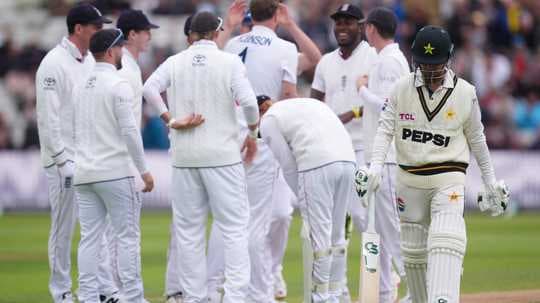
At Edgbaston, Pakistan’s tour of England is unravelling by the day, yet Michael Smith insists the dressing room is anything but broken.
The visitors have not reached 200 once in five completed innings on this trip. In the final Test, they are 52 for 2, still 268 runs short of making England bat again. The scoreboard screams crisis. Smith, Pakistan’s recently appointed batting coach, talks instead of opportunity, patience and a “bloody exciting” project.
Runs scarce, questions plenty
On the field, the story has been brutal. Pakistan’s batting has repeatedly folded against a sharp, home-grown attack in conditions that have offered little margin for error. Each innings has followed a familiar pattern: early promise, a cluster of wickets, and a total that leaves the bowlers with no real foothold in the contest.
Off the field, the noise has grown louder. The PCB has already recalled seven players and head coach Sarfaraz Ahmed after the Lord’s defeat, and launched an inquiry into the conduct of some squad members. For a young group trying to find its feet in England, the backdrop could hardly be more turbulent.
Smith refused to wade into the politics.
“I know nothing about that [the inquiry] so I can't really comment on anything like that,” he told reporters after the second day at Edgbaston. “It's the first time I've heard of those things so I'm not too sure.”
He steered the conversation back to the crease.
“For me there's a lot of quality in Pakistan. We've seen it for many years and lots of countries go through slight changes. This is one where we've got some younger players with some experienced players but it's the learning and how quickly we can get them to learn and get comfortable in the Test environment to really help them from a long-term point of view.”
A batting order in transition
The inexperience is stark. Of the top seven in this Test, only Babar Azam and Shan Masood have previously toured England. The rest are discovering these conditions in real time, under floodlights, against a relentless attack, with a series slipping away.
Smith accepts they are in what he called a “transition phase”, with one glaring weakness: they simply have not batted long enough.
“We've shown some real good signs but just not for long enough and I think that's probably the biggest lesson,” he said. “We need some of our guys to be playing for hours at times and in certain game plans.
“I think Saud [Shakeel] has shown us at times, Azan [Awais] has shown us and Shan [too], but we need that for hours and not just for half a session or so.”
There have been flashes. A compact hour from Saud Shakeel here, a neat passage from Azan Awais there, Shan Masood finding a rhythm for part of a session. Then a mistake, a good ball, a loose shot – and the innings caves in again.
“Some of the players, it's their first tour of England and they haven't got a lot of Test experience so they are learning some challenging lessons along the way and they have to learn on the Test circuit which is a challenging one,” Smith added. “We’ve got to keep making sure that we're showing small really good signs at times but we need to now put a big play in to really get that confidence going again.”
Holding the line in a harsh arena
The temptation, when a side cannot get past 200, is to tear everything up. Smith is not there yet. He has only just taken the role and is still feeling his way through the system, the players, and the demands of touring with Pakistan.
He made it clear he is not rushing to prescribe structural overhauls, but he recognises the scale of the task.
“It’s been tough, it’s been challenging but let’s not take away [the fact that] we've come up against a really good bowling unit in home conditions who've been excellent,” he said. “I suppose we might not see the sort of success we want to see now but hopefully if a lot of these players are back on our next UK tour we'll really see an upward trend and I think that's the time to really judge them - especially some of the younger players who get their first taste of the English type of conditions.
“It's tough cricket but the one thing our boys are really doing is embracing being on tour and actually enjoying themselves on tour as well as a group, as a whole.”
Inside the camp, Smith insists, the mood is “good”. That will raise eyebrows outside the dressing room, where the results and the off-field upheaval paint a bleaker picture. Yet coaches often cling to what they see in training, in meetings, in the quieter corners of a long tour, rather than the noise around them.
“A bloody exciting challenge”
If the numbers are grim, Smith’s language about the future is anything but.
“I think I've got a bloody exciting challenge on my hands because there are some serious players,” he said. “Let’s not worry about what's happening here, we've got some really exciting players and [their] potential is exceptionally high. It's just how quickly can we get them to that level, especially playing outside of Pakistan. That's going to be a big challenge and something we're really excited about.”
That is the crux of it. Pakistan’s batters are being forced to learn abroad, in one of the most unforgiving environments in Test cricket, with little experience to fall back on and even less time to adapt. Smith sees a group that might be judged more fairly on the next UK tour than on this bruising initiation.
For now, though, the reality is stark. Pakistan’s “immediate challenge”, as Smith put it, is simply to drag this match into a fourth innings. To do that, they must clear 200 for the first time in the series and then keep going, deep into the kind of territory they have not yet touched on this tour.
Edgbaston will not wait. Neither will England’s bowlers. If Pakistan’s young batting order wants breathing space, it has to earn it – over hours, not flashes – starting from 52 for 2.