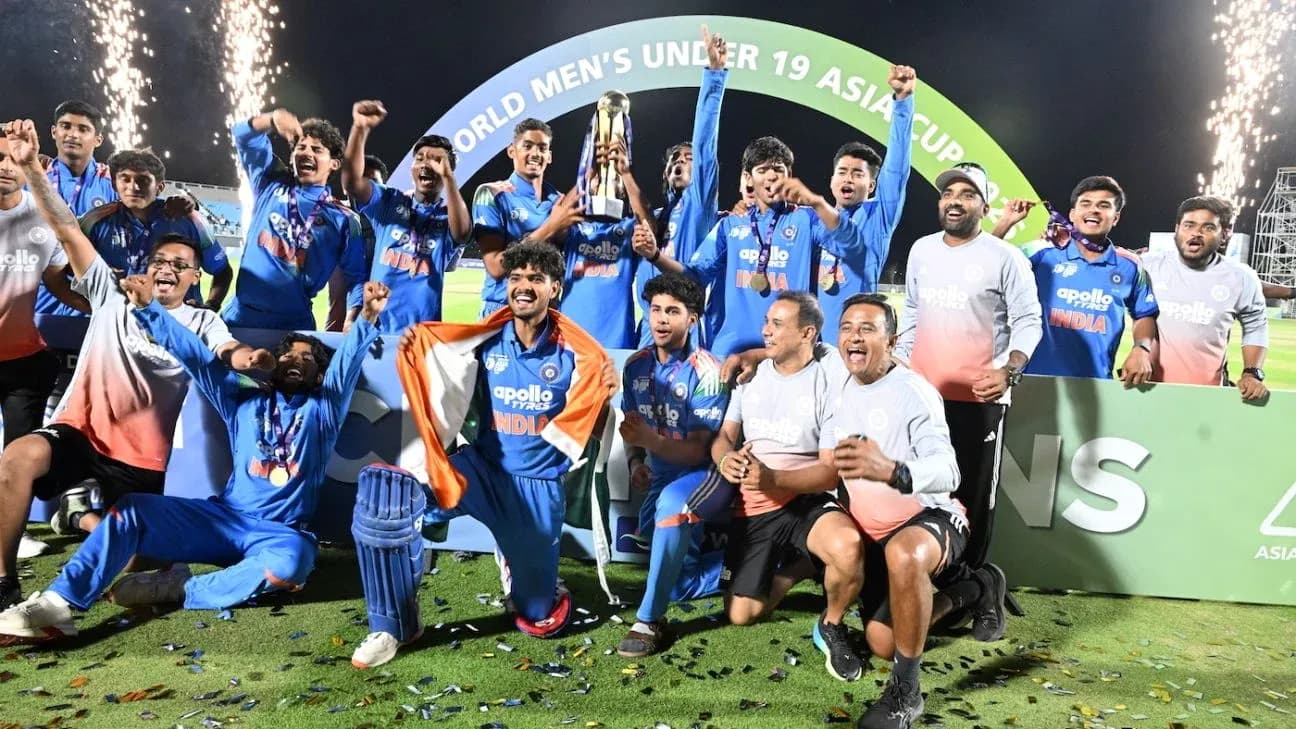
For most of the night, this felt like Pakistan’s trophy. By the time the last yorker crashed into the stumps, it looked like they had earned every inch of it.
This was a final built on nerve, disguise and just enough chaos, as Pakistan’s attack repeatedly toyed with Indian batters’ timing, then cashed in when the big shots finally went wrong.
Pakistan’s innings: brilliance, then a stumble
It began with a jolt.
At 62, India finally prised out the first wicket. Hayam Khan skipped down the track, looking to impose himself, but walked straight into a trap. The bowler gave it air, wide of off stump, dragging him into an ugly slog he was never set for. The outside edge flew to the keeper and the door cracked open.
From there, though, Pakistan countered with steel and flair.
Abdul Qadir took charge. He lived dangerously, driving on the up and going aerial far more often than any coach would recommend in a final. But he made it compelling. Arjun, calm and methodical, kept teasing him wider outside off, changing nothing and yet changing everything. Finally, on 80, Qadir misjudged one floatier, wider ball too many. Too early into another aerial drive, he carved a thick leading edge straight to cover. Pakistan were 197 for 2, and one of the most entertaining 80s of the tournament ended with a miscue rather than a standing ovation.
Usman Khan ensured the innings never sagged. He moved around the crease, opened up the off side and kept India’s seamers guessing. On 240, he tried to manufacture one big blow too many. Backing away to target the vacant long-off boundary, he flat-batted a short ball but failed to find the middle. The ball hung long enough for mid-off to settle under it. A brilliant innings ended with the bat raised and a standing ovation from his teammates, the scoreboard now 240 for 3 and the platform laid.
For a while, Pakistan seemed on course for a towering total. Then the finish turned frantic.
Ahmed Hussain’s stop-start stay ended on 299. Dancing down the track and drifting leg side, he ran into a clever slower ball, dragged back of a length and wide of off. One hand came off the handle, the shot lost all conviction, and Sehwag at extra cover snapped up the chance.
Farhan Yousaf followed in the same over. Down on one knee, eyes on the stands, he launched into another slower ball. The lack of pace ruined his timing; the “biiiiiiig hoick” climbed into the night rather than clearing it. Long-on settled under it. Six runs, two wickets, and suddenly India were alive again. Pakistan, 305 for 5, had gone from cruising to calculating.
The wobble continued. At 311, HA Dar received a gift: a full toss on the hip, begging to be worked away. Instead, he flicked it aerially and picked out square leg. A poor ball, a poorer dismissal, and India were swarming.
Hamza Zahoor then tried to drag the total beyond India’s reach. On 317, he saw a ball in the slot outside off and went for the big slog down the ground. Again, the connection wasn’t clean; again, the fielder at long-off didn’t have to move much. Another wicket, more momentum surrendered.
The last act belonged to pace and precision. At 332, Niqab Shafiq lined up for one last heave, this time across the line. The bowler went the other way: pace up, yorker length, arrowing straight in. The ball rifled past the bat and smashed into the stumps. The spectre of the slower ball had done its job earlier; the hard, fast one finished the job. Pakistan closed on 332 for 8 – imposing, but not untouchable.
India’s chase: promise, then a collapse
India began with intent and, for long stretches, matched the rate.
VK Vineeth looked set to anchor the chase until Pakistan’s quicks changed angles and intent. At 146, the bowler banged it in short, using his height to target the back shoulder. Vineeth swivelled into a pull, cramped and hurried. The ball ballooned off the outer part of the bat and dropped into the hands of midwicket. India were 146 for 2, and the first crack had appeared.
Arjun Rajput tried to force the pace and paid the price. On 172, with the chase finely poised, he punched at a back-of-a-length ball angling away. The outside edge flew to the keeper. The bowler’s arm shot up, the cordon erupted, and Pakistan knew they had removed the “big fish”. India, from a position of control, were suddenly 172 for 3 and searching for a new anchor.
Abdul Qadir’s dismissal earlier had given India a way back; now Pakistan’s bowlers returned the favour, tightening the screws.
At 217, LR Raichandani lost his shape completely. Throwing his hands across the line at a full ball aimed at the stumps, he failed to get over the shot. The ball flew to midwicket, where the fielder produced a stunning one-handed catch, leaping through the air. It was more than just a wicket. It felt like a hand on the Asia Cup trophy.
The pressure grew heavier with every dot ball.
Pakistan’s cutters and changes of pace kept digging away at India’s middle order. ADB Savsani tried to break free at 251, slashing hard at a cutter pounded into the pitch outside off. He got the height but not the distance. Deep cover point charged in and flung himself forward, clutching the ball inches from the turf. India slipped to 251 for 7, the asking rate rising and the dressing room suddenly very quiet.
The defining moment of the collapse came just three runs later.
KP Patel tried to run a short ball down to third man, only to find the edge. The ball seemed to carry to the keeper, Zahoor, who dived forward and claimed it cleanly. In the same motion, he underarmed the ball into the stumps at the striker’s end as the batters scrambled. Pakistan converged on him in a wild celebration, sensing a decisive breakthrough. The decision came: caught behind. India were 252 for 8, the chase now hanging by the thinnest of threads.
From there, Pakistan’s bowlers simply squeezed. Every slower ball, every back-of-a-length cutter, every change of angle chipped away at India’s belief. The early fluency vanished; the final overs belonged entirely to the fielding side.
By the time the last wicket fell, the pattern of the night was clear. Pakistan had read the surface better, trusted their variations longer and, under the brightest lights, held their nerve when India’s batters could not.
One hand on the trophy? By the end, it looked like both.