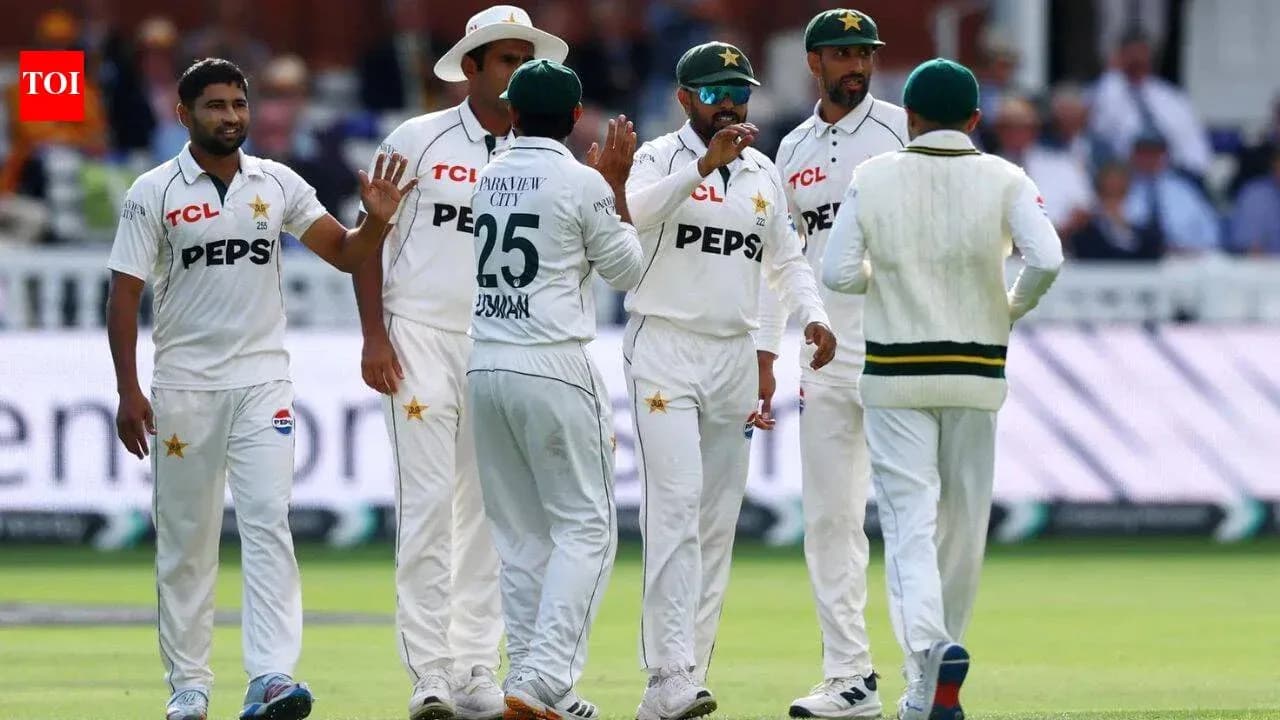
At Lord’s, where Pakistan’s past still hangs in the air like a stubborn mist, the old spectre has stirred again.
The team had just been thrashed by 194 runs in the second Test against England when the Pakistan Cricket Board (PCB) pulled the handbrake on their tour – and, potentially, on a few careers. Seven players were abruptly dropped mid-series. Two members of the coaching staff were told their work was done. An internal disciplinary inquiry was quietly set in motion.
All of it against the backdrop of a venue forever tied to Pakistan’s darkest cricketing scandal.
Sweeping changes after heavy defeat
The scoreboard at Lord’s had barely stopped ticking when the axe fell. Mohammad Rizwan, Salman Ali Agha, Imam-ul-Haq, Ali Usman, Khurram Shahzad, Aamir Jamal and Muhammad Awais Zafar were all removed from the squad after the second Test.
Head coach Sarfaraz Ahmed and bowling coach Umar Gul were also released from their duties, an extraordinary mid-series shake-up in a three-Test contest.
In their place, Pakistan called up seven players, five of whom are yet to play international cricket. The two capped batters, Saim Ayub and Abdullah Fazal, offer familiar faces at the top. Around them, a new and largely untested core: pace-bowling all-rounders Razaullah Khan and Mohammad Imran, left-arm spinner Arafat Minhas, wicketkeeper Saad Baig and left-arm pacer Mohammad Imran Junior.
On paper, it could be read as a ruthless response to a poor performance. Inside Pakistan cricket circles, it already feels like something far more combustible.
“More than cricket”
The timing and scale of the changes have raised serious questions. It has been learnt that the decisions were driven by reasons “more than cricket” – a phrase that carries particular weight in Pakistan, and even more so at Lord’s.
Attempts to clarify the situation have gone nowhere. Queries sent to the PCB and to the England and Wales Cricket Board (ECB) remained unanswered for more than 72 hours.
When a response finally did emerge, it came not in the form of detailed explanations, but as a carefully worded statement from Amir Mir, PCB’s Director Media and Digital Communications.
“The Pakistan Cricket Board has initiated an internal disciplinary inquiry following media reports concerning discipline and conduct, which are currently being reviewed internally. The PCB handles such matters in accordance with its standard procedures. The process is being conducted under PCB regulations, ensuring that all concerned individuals are given due consideration.”
The board has not publicly specified who is under investigation or what exactly is being probed. The wording is cautious. The atmosphere around the team is anything but.
Phones seized, questions mount
According to Pakistani outlet 365 News, players’ devices have been handed over to the PCB and will remain in the board’s custody until the end of the final Test.
The report did not reveal which players had their phones taken, and the PCB has not explained why the devices were seized or how many individuals are involved. The lack of clarity has left a vacuum that speculation is eager to fill.
For a team with Pakistan’s history at this ground, the optics are stark. Lord’s was the scene of the 2010 spot-fixing scandal that sent Salman Butt, Mohammad Asif and Mohammad Amir to prison and earned them bans for deliberately bowling no-balls at pre-arranged moments in a Test match.
Thirteen years on, Pakistan are again at Lord’s, again under scrutiny, again facing questions about discipline and conduct. No formal allegations of fixing have been made in this instance, but the echoes are impossible to ignore.
Imam-ul-Haq in the firing line
As the inquiry rumbles in the background, the public fallout has already claimed a high-profile target.
Aaqib Javed, PCB Director of High Performance, launched a fierce attack on opening batter Imam-ul-Haq after the left-hander suffered a low-grade calf tear at Lord’s and did not bat in either innings.
“The Imam injury is a big question mark, and a deep disappointment,” Aaqib told Geo. “Players in the past used to get injuries, but they used to put on casts and still tried to play. We'll take action against this. How is it possible that a pulled muscle ruled you out of batting in both innings? He should have tried and fought. He'll have to face an inquiry; I can't say he faked it, but a muscle pull like that cannot stop you from batting altogether.”
It was a brutal, public rebuke from a senior figure within the PCB, and it underlined the mood in the camp: unforgiving, impatient, and determined to be seen as tough.
Aaqib also defended the sweeping mid-series overhaul. “The message we're sending to the recalled players is that you have to raise your game on important tours and compete, and we should be able to see some effort,” he said.
Chairman backs the shake-up
PCB Chairman Mohsin Naqvi has thrown his weight behind the changes, presenting them as a necessary jolt rather than a purge.
“Every match of a series is important for us and we are not left with any option if a player is not performing but to look for his replacement. The purpose behind these changes is not to axe players from contention, but just to replace them,” Naqvi told Geo Network.
On one hand, it is a familiar line: performance first, reputations second. On the other, when combined with an internal disciplinary inquiry, confiscated devices and open criticism of a senior opener’s injury, it paints a picture of a board moving aggressively on several fronts at once.
Old ghosts, new fault lines
Lord’s has always been a place of layered stories. For Pakistan, it is a ground of triumphs and trauma, of Wasim and Waqar at full tilt, of historic wins, and of that 2010 scandal that reshaped careers and reputations.
Now, in the middle of another English summer, Pakistan again find themselves at the centre of a storm, their squad torn up mid-series, their dressing room under investigation, their officials speaking in the language of inquiries and replacements.
The PCB insists this is about discipline and standards. The cricketing world will wait to see what, if anything, lies beneath that phrase “more than cricket” – and whether this is a harsh reset or the start of another long, uncomfortable chapter for Pakistan at the home of cricket.