Pakistan walked into a landmark afternoon in Dubai expecting celebration. They walked off with an unwanted slice of history and just 55 runs to show for it.
In their 200th T20I, Pakistan chose to bat against India in the Women’s Asia Cup 2026 and, for a brief, teasing spell, it looked the right call. The openers moved to 27 without loss, the pitch looked truer than the numbers would later suggest, and India’s bowlers were still probing rather than pouncing.
Then the game turned. Violently.
From 27/0 to 35/6, Pakistan’s innings disintegrated in a blur of misjudgment, sharp spin and rising pressure. By the time the final wicket fell in the 19th over, they had slumped to 55 all out – their lowest total in Women’s T20I cricket, and the fifth-lowest score any side has managed against India in the format.
Bright start, brutal collapse
Muneeba Ali and Shawaal Zulfiqar did the hard work early. Muneeba, living a little dangerously, survived a couple of early scares but still moved to 13 off 15. Zulfiqar, crisp through the off side, matched her with 14 from 14. At 27 without loss, Pakistan had a platform and, crucially, a sense of calm.
Shafali Verma ripped that away.
She finally breached Muneeba’s defence, and with that first breakthrough, India’s attack snapped into a higher gear. The ball started to grip, the fields tightened, and Pakistan’s batters suddenly looked stuck between survival and scoring.
The real damage arrived with Sree Charani’s final over of the powerplay. Two wickets, both hammer blows, turned a promising start into a full-blown crisis. Pakistan, who had looked composed minutes earlier, now stared at a scorecard that read 27/3 and sliding.
The slide didn’t stop. It accelerated.
India’s spinners, sensing panic, kept attacking the stumps. Pakistan’s middle order had no answer. Dot balls piled up. Risks followed. Edges, mis-hits, lbws. From 27/0, Pakistan lurched to 35/6, the innings now in freefall.
Charani and Rawat choke Pakistan
Charani finished with extraordinary figures: 3 for 7. She didn’t overcomplicate it. She hit her areas, used the revs on the ball, and forced batters into mistakes. At the break she spoke of “bowling to my strength” and working on consistency with the arm ball and yorkers. The numbers backed up the method: Pakistan never once looked in control against her.
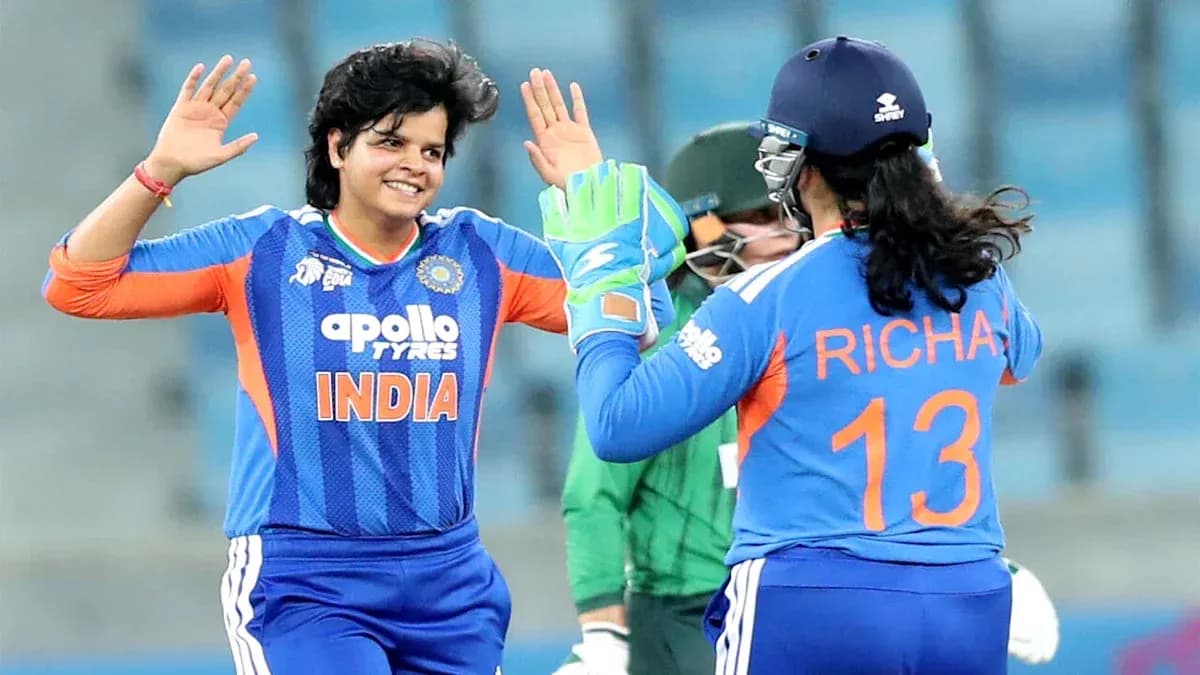
On the other end, Prema Rawat was just as ruthless. She picked up 3 for 9, hammering home the advantage every time Pakistan tried to rebuild. Deepti Sharma slipped in with 2 for 5, and Shafali’s early strike set the tone. Every bowler who got the ball contributed; no one let the pressure drop.
The most damning statistic for Pakistan? After that opening stand, they failed to put together a single meaningful partnership. Wickets fell in clumps, the scoreboard crawled, and the innings ended with 11 balls still unused – 55 all out in 18.1 overs.
A record they never wanted
This was not how Pakistan imagined their 200th T20I.
The occasion demanded a statement. Instead, it delivered a nadir. Their 55 undercut their previous lowest all-out total of 56, also in Dubai, against New Zealand in 2024. It now sits below the 60 against England in Taunton in 2009, the 63 against India in Guangzhou in 2012, and the 65 against West Indies in St Andrew’s in 2011.
The venue, the opponent, the milestone – everything combined to magnify the damage. This was not just a bad day; it was a historic collapse.
For India, it was another notch in a dominant recent record over their rivals. They had already won nine of the previous 10 T20I meetings, the only blemish in that run coming in the 2022 Asia Cup. This performance tightened that grip even further.
Harmanpreet’s landmark, India’s authority
There was another milestone in Dubai, one that belonged to India and spoke of longevity and authority. This was Harmanpreet Kaur’s 150th match as a T20I captain, making her the first cricketer – male or female – to reach that landmark.
Her bowlers marked the occasion perfectly. Clinical, relentless, and utterly unforgiving, they justified the confidence with which India had entered the contest. Two wins from two against Thailand and Hong Kong had already secured a semi-final berth; this display simply underlined why they are among the favourites for the title.
Pakistan, fresh from a win over Thailand, arrived hoping to test that status. Instead, they leave with a scoreline that will follow them for a long time.
A milestone match turned into a harsh mirror. The question now is simple: how quickly can Pakistan wipe this from their minds, and how many more such days will India’s bowlers script in this tournament?