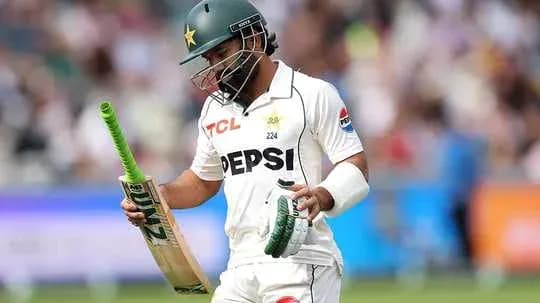
Pakistan’s tour of England has lurched from damage limitation to full-blown reset.
With the side 0-2 down in the Test series and losing five of their last six matches, the team management — backed by the Pakistan Cricket Board (PCB) — has taken a ruthless knife to both the dressing room and the backroom staff. Senior players have been sent home. Coaches have been pushed aside. The message is unmistakable: nothing and no one is safe.
Senior players cut loose
In the most dramatic move, three established names have been released from the touring party in England: former white-ball captain Salman Agha, Mohammad Rizwan and Imam-ul-Haq.
All three have struggled in the ongoing series, part of the current World Test Championship (WTC) cycle. With Pakistan already out of the race for a WTC final spot, the management has chosen disruption over continuity, opting to clear space for new blood rather than lean on experience.
For Rizwan and Imam, regulars across formats in recent years, the decision underlines the depth of frustration within the camp. For Salman Agha, once trusted with the white-ball captaincy, the call only sharpens the sense of a reset that cuts through status and seniority.
The reasons, insiders say, span the full spectrum: poor form, fitness concerns and disciplinary issues. It is not one problem, but a pile-up.
New faces on the way
Into that void step Saim Ayub and Abdullah Fazal, both summoned for the third Test starting September 9 in Birmingham.
If UK visas are cleared in time, they will not be alone. Fast bowlers Razaullah Khan and Mohammad Imran, left-arm spinner Arafat Minhas and wicketkeeper Rohail Nazir have also been lined up to join the squad in England. It is an entire shadow group, effectively a second wave of options parachuted into a faltering tour.
The selection calls signal a shift in priorities. With the WTC campaign already wrecked, Pakistan appear ready to treat the remaining fixtures as a proving ground, not a salvage mission.
Hesson steps in, Sarfaraz and Gul sidelined
The shake-up does not stop at the players’ balcony.
Mike Hesson, previously in charge of Pakistan’s white-ball side, has been told to take over the Test team. The New Zealander is understood to be already in England and will link up with the squad shortly, stepping into a dressing room that has just been dramatically reconfigured.
Hesson will lead the red-ball setup for the rest of Pakistan’s WTC commitments this cycle: two Tests in Sri Lanka in November and another two in New Zealand early next year. That tenure gives him enough time not just to patch holes, but to redraw the blueprint.
Current Test coach Sarfaraz Ahmed and bowling coach Umar Gul have been pushed to the margins. They will remain with the touring party, but stripped of frontline responsibility. Their presence without power only underlines how decisively the PCB has moved to back Hesson and his methods.
A series slipping away, a cycle being rewritten
On the field, the picture is bleak. Two Tests down in England, one win in six, and a WTC campaign already mathematically dead. Off it, the response has been anything but passive.
Pakistan have chosen upheaval over drift. Senior players cut. Coaching structure flipped. A cluster of uncapped or little-tested names rushed into contention. It is a gamble taken in real time, in the middle of a bruising away tour, under English skies that have rarely been kind to them.
The third Test at Birmingham now carries a different kind of weight. The series may be sliding away, but for Pakistan’s new faces — and for Hesson — it could be the first chapter of something far more consequential: a new red-ball order, written under pressure, with nowhere to hide.