The skies over Edgbaston were heavy. Inside Pakistan’s dressing room, the mood was darker still.
By lunch on the opening day of the third Test, a series that was supposed to be jolted back to life by sweeping changes from the Pakistan Cricket Board looked all but beyond resuscitation. The tourists limped to 100-7 in just 23 overs, their innings a slow-motion collapse that matched the gloom rolling in over Birmingham.
This was meant to be the defibrillator Test. Instead, it felt like the last rites.
A team unravelling
Former captain Ramiz Raja did not bother with soft edges. Watching Pakistan’s top order fold yet again, he called their "technique and mindset" "pretty ordinary", a brutal but accurate assessment of a side that looked drained and directionless.
"There's mental fatigue and turmoil in the dugout, I can understand that," he told Test Match Special. The sympathy stopped there. From the middle, he saw a team waiting to be beaten. "From an individual point of view, I think Pakistan have been waiting for the ball to come and damage them completely. They have not been proactive at all."
That lack of intent screamed through the numbers. Pakistan’s top five were back in the pavilion with only 48 on the Thwaite Memorial scoreboard. It was not just a bad start; it was historic for all the wrong reasons.
This was only the 12th time in Test history that a team’s top five all fell for single figures. Never before had it happened in a first innings.
The trend runs deeper than one bad morning. Across this series in England, Pakistan’s second wicket has fallen at 6 and 13 at Leeds, 16 and 7 at Lord’s, and now 14 at Edgbaston. That’s 56 runs in total for the first two wickets across five innings – an average stand of 5.6 for the first wicket and 11.2 for the second.
They are on course to undercut a record that has stood since 1888, when Australia averaged just 16 for the fall of their second wicket in England. This is not just poor form; it is a statistical nosedive into territory occupied by some of the most fragile batting line-ups the game has seen.
England ruthless, Pakistan reckless
England did their part. Joe Root won the toss under autumnal skies, handed the new ball to his seamers, and watched a four-pronged attack go to work with ruthless clarity.
The pitch, on the surface, did not look like a minefield. Ramiz was quick to point that out. "This is a flat pitch, it's not a demon-like pitch, like the third day at Lord's," he said. Yet there was enough in it to punish any misjudgment, and Pakistan supplied plenty.
CricViz’s bounce inconsistency rating had this surface at 5.7 – noticeably livelier than recent Edgbaston Tests: 2.6 against India in 2025, 3.2 against West Indies in 2024, and 3.3 against Australia in 2023. That uneven bounce, allied to English conditions and a confident attack, made life uncomfortable. But not impossible.
Former England captain Michael Vaughan saw a side that had already lost the contest in their heads. Pakistan, he said, were "clearly shot for confidence" after a tumultuous week off the field. "I feel for Pakistan because this is embarrassing with everything they've had to cope with in the last week," he added.
The numbers told their own story. Pakistan’s false-shot percentage in the morning session soared to 40% – the second highest in the first session of a Test since 2006. This was not a batting unit grinding through a tough spell. It was one lashing out, misreading length, flirting outside off, and paying the price.
Selection gambles and senior lapses
If there was any player who deserved a measure of compassion, it was Saim Ayub. Thrown into this Test as part of the PCB’s reshuffle, the opener arrived with almost no red-ball cricket behind him – this was his first first-class appearance since October 2025.
Facing Ollie Robinson in these conditions, with the ball wobbling and the slips waiting, his dismissal felt almost pre-ordained from the moment he marked his guard. A bold selection call quickly looked like a brutal exposure.
What followed, though, cannot be pinned on inexperience alone. There was an end-of-term looseness to Pakistan’s strokeplay, a casualness completely at odds with the discipline required to survive the new ball in England.
Four down, the responsibility should have shifted to Saud Shakeel and Babar Azam – two players in their thirties, laden with experience and entrusted with holding the innings together. Instead, both went the other way, flashing extravagantly outside off stump as if trying to hit their way out of a crisis.
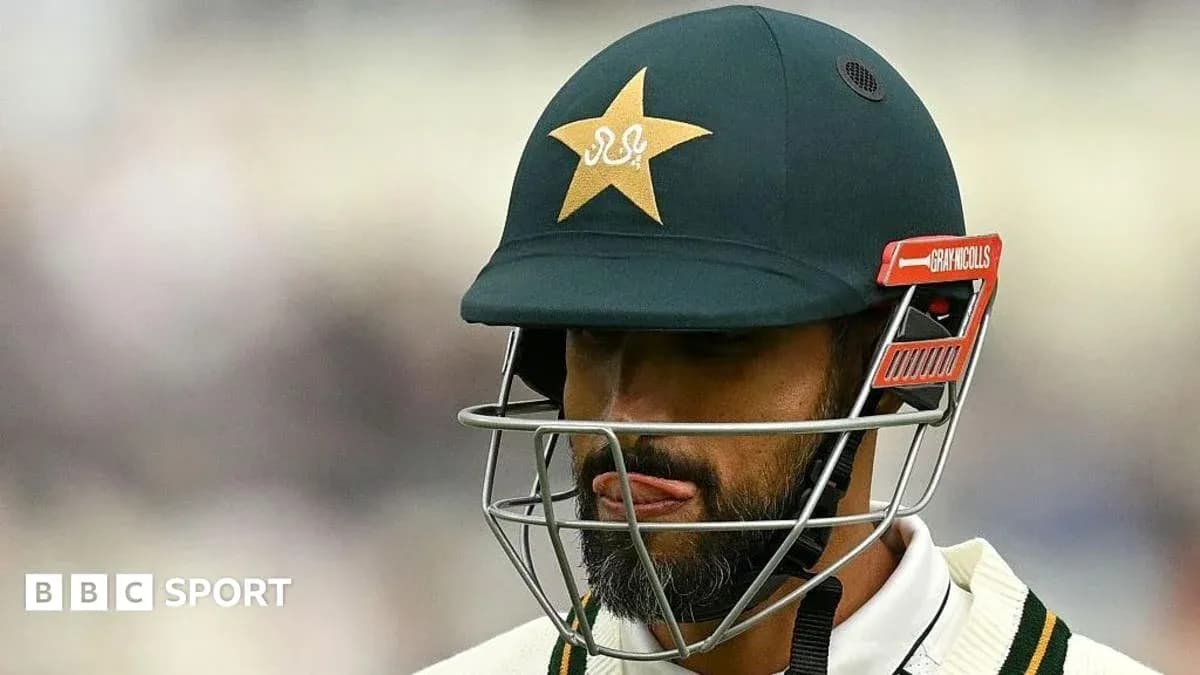
Saud survived until lunch, but Babar’s innings disintegrated 40 minutes before the interval. Bowled by Josh Tongue, he walked off gesticulating at the pitch, frustration pouring out in every step.
"He [Babar] disintegrated. It's tough for him," Ramiz said, cutting to the heart of the captain’s burden. "He's got to explain all this mayhem and then he has to look after himself and then he's got to work with the lot that are more T20 in nature than Test cricket."
It was a damning description of a dressing room out of sync with the demands of the format, and of a leader stuck between firefighting and self-preservation.
A series slipping away
By the time the players walked off for lunch, the scoreboard read 100-7, and Pakistan’s innings, in Ramiz’s words, was "in serious turmoil". The phrase could just as easily apply to their entire tour.
The PCB’s controversial reshuffle was supposed to jolt this side into life. Instead, the changes have only exposed deeper fractures: technical flaws at the top, muddled thinking in the middle, and a mindset that crumbles at the first hint of pressure.
If you hold a ticket for day three at Edgbaston, you might already be wondering whether to make other plans. The more pressing question, though, is this: where do Pakistan go from here, when even the defibrillator can’t find a heartbeat?