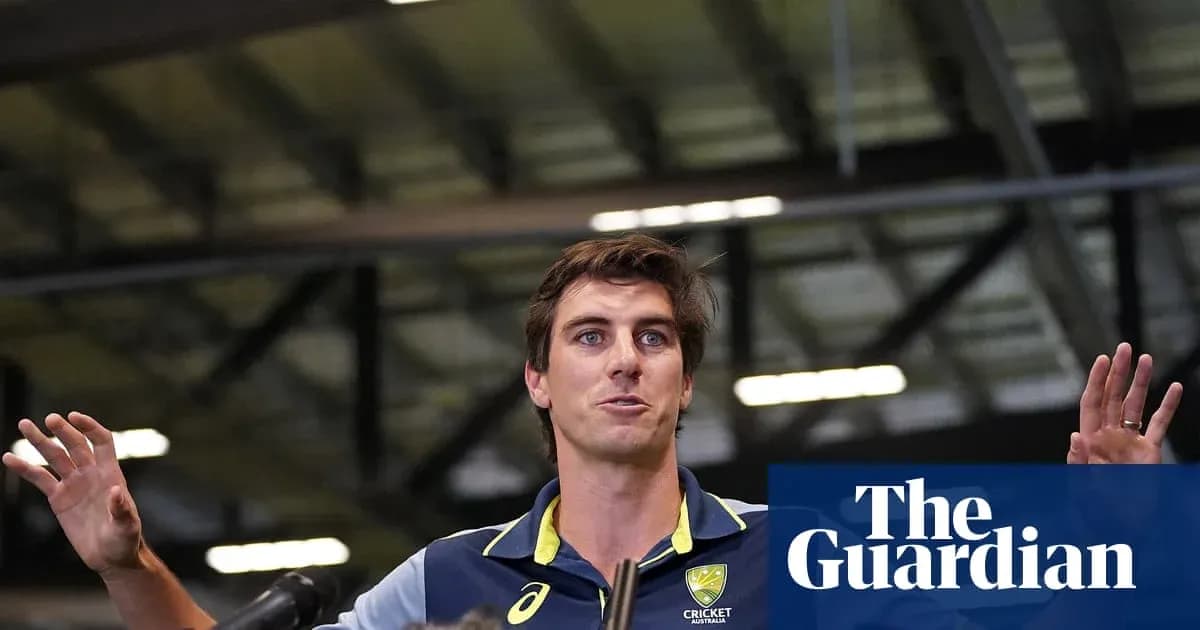
Pat Cummins walked into the room on Friday knowing exactly what waited for him. He stayed there for 70 minutes, took every question, and refused to duck a single one. For a topic that has festered for six years and fractured friendships in the process, that in itself felt significant.
This wasn’t a captain hiding behind statements and lawyers. It was Cummins, unflinching, going over the wreckage of Cape Town and everything around it, line by painstaking line.
A friend, a fracture, and a very public disagreement
The easy story now is Pat Cummins v Usman Khawaja. Two senior players. Two respected voices. One scandal. Draw the battle lines, pick a side, let the outrage feed itself.
Reality is more complicated, and far less convenient.
Both men have stressed their friendship, and you could hear the strain in Cummins’ voice when he spoke about Khawaja. This isn’t a cold feud; it’s a painful disagreement between two players who have shared dressing rooms, tours, and milestones for more than a decade.
Khawaja’s broad-brush picture of that Australian side – “It was all of us” – has never named Cummins directly. He has consistently stopped short of pointing the finger at anyone beyond the three sanctioned in 2018, preferring sweeping references to a culture, a team, a collective responsibility.
Cummins went the other way. No vagueness. No nod-and-wink. He called Khawaja’s framing “100% wrong” and “utter nonsense”, and argued that suggesting a team-wide scheme unfairly stains those who, in his view, had nothing to do with it.
“It’s something I’ve actually been grappling with the last couple of days – that Usman’s a friend, but I think the way he’s been quite casual and quite flippant with people’s lives, and Australian cricket, I don’t think that’s OK, and I don’t think that’s what friends do.”
That’s not the language of a media-trained deflection. That’s a line in the sand.
Inside the detail: sandpaper, seams and the stories between
Where Cummins really shifted the discussion was not in the emotion, but in the detail.
He went through the dark arts of ball tampering like a forensic examiner: bottle caps, foreign objects, roughing up one side, lifting seams. He said he’d heard of plenty of methods, as any professional cricketer would, but insisted he had never seen them used or agreed to their use in an Australian shirt.
The only instance he admitted witnessing in the professional game came in a Sheffield Shield match, where umpires intervened after a bottle cap was used. That, he said, was his one clear, first-hand sighting of tampering in real time.
He spoke, too, about the nets. About balls shredded on purpose in training, sandpaper included, as bowlers search for reverse swing and understand how a ball behaves when damaged. That’s normal practice across the cricket world. The leap, he argued, from that controlled environment to an international match remained unthinkable to him.
Then came the dressing-room dynamics. This was where Cummins tried to explain how players could live in the same team environment yet come away with wildly different memories.
Groups form. Conversations stay in corners. Plans are hatched in pockets. Some ideas never leave the small circles that birthed them. In that swirl, he said, he and several teammates he’d since spoken to had no recollection of Khawaja urging a collective assumption of responsibility in the rooms, or of anyone shutting that suggestion down.
On one point, though, their stories brushed against each other. Khawaja wrote about players lifting the quarter seam of the ball during the 2017-18 Ashes to gain movement. Cummins, playing his first home series then, recalled noticing a raised seam at times and assuming it was a manufacturing quirk – only later, with experience, wondering if he’d misread what he was seeing.
It’s the closest the two accounts come to touching: the same ball, the same series, very different conclusions.
Logic, doubt and the uncomfortable middle ground
There will always be people who simply do not believe Cummins. To them, the idea that a fast bowler – the “principal operator”, as the jargon goes – could be unaware of systematic tampering with his own ball is absurd. Bowlers, the argument runs, know every scuff, every mark, every imbalance on that leather. How could they not?
It’s a powerful logic. Cummins didn’t pretend otherwise. But he pushed back with a different kind of reality: cricket is full of anomalies, and the neat, rational version of events isn’t always the one that actually happens.
Batters still dominate ball management in most teams. They are the ones constantly catching, shining, and relaying it along that familiar arc from wicketkeeper to slip to cover to mid-off before it returns to the bowler. Batters have also traditionally dominated captaincy, and with it the strategic conversations.
Cummins is the outlier – Australia’s first specialist bowler to lead the side. That shift alone tells you how entrenched the old hierarchies were.
Under his watch, the environment has changed. Khawaja himself once offered one of the clearest examples. After a series win, Cummins quietly stopped the champagne spray when he realised it excluded his Muslim teammate. Khawaja later wrote that this “one little gesture” made him feel the team was “for everyone” and deepened his respect for his captain.
On Friday, Cummins revisited that memory with obvious sadness. “Uzzy’s said to me a few times how much he’s enjoyed being part of the team. That means more to me than any win.” For a moment, the argument over sandpaper and seams gave way to something more raw: the hurt of a friendship under pressure.
No villains, just contradictions
Public debate loves a simple villain. This saga refuses to provide one.
Khawaja has no obvious motive to fabricate his version. If anything, his loyalty to David Warner and his desire to protect a lifelong friend may colour how he frames events, but that’s human, not sinister. Yet his own narrative isn’t watertight.
In the same chapter where he laments not being handed Steven Smith’s captaincy after the scandal, he acknowledges that he, too, had allowed sandpaper use to happen. Smith lost the job for failing to stop it. Why, on his own evidence, would Khawaja have been a better choice?
Cummins pounced on that contradiction. The revelation that Khawaja knew what was going on, sat next to Cameron Bancroft, and told him to be careful was, Cummins said, news to him. “So maybe he’s been grappling with that for eight years.”
There, in a single line, is the core of this mess: different men, in the same room, carrying different burdens from the same moment.
After a decade of silence, at least the air is moving
Strip it all back and you’re left with a divided picture.
Some players worked on plans for reverse swing. Others insist they did not. Some assumed everyone shared the same understanding of how far they were prepared to go. Others only discovered, with a jolt, that lines had already been crossed without their knowledge.
Friendships are bruised. Fans are split. Many are simply exhausted by it all.
But one thing has finally shifted. For years, the story of Cape Town and everything around it has been smothered under press releases, legal caution, and carefully curated half-truths. Those involved have spent the best part of a decade saying almost nothing.
Now the positions are out in the open. The gaps between them are visible. The contradictions are on record.
The questions won’t stop here. They probably never will. But for the first time in a long time, Australian cricket is arguing about the truth in public rather than hiding from it in private – and that, however uncomfortable, is where this reckoning always had to go.