Pat Cummins wanted to talk about cricket. Real cricket. The kind being played outside in the Sydney sun as New South Wales and South Australia went about their Sheffield Shield business.
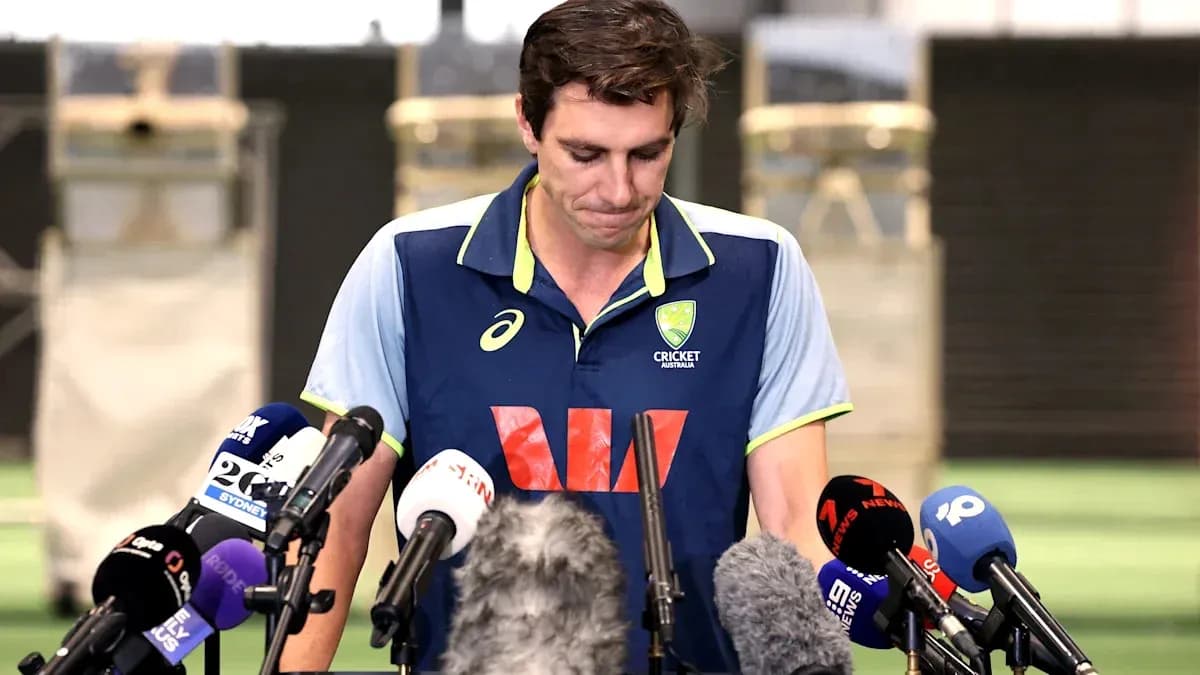
Instead, he stood under harsh indoor lights at Cricket Central, facing more than a dozen TV cameras and a wall of reporters, answering questions about sandpaper, Cape Town and a scandal that refuses to die.
He stayed there for more than an hour. He was prepared to stay all day.
“I don't want to talk about this again after today,” he said. “Even if it takes all day... I'll stay here until we have no more questions.”
Eight years on, the storm returns
The storm has a new trigger: a book. Usman Khawaja’s memoir, released last week, has dragged the events of 2018 back into the centre of Australian cricket.
In it, Khawaja writes that the entire Australian team knew about the plot to use sandpaper on the ball during the third Test against South Africa in Cape Town. Back then, three players – Steve Smith, David Warner and Cameron Bancroft – admitted involvement and copped heavy bans. The rest of the dressing room walked away officially untouched.
Khawaja’s version is different. He says that after Bancroft was caught on the field with sandpaper, he urged the side to take collective responsibility.
“I said: ‘Take this as a team. We did this as a team. We knew what was going on, and we have to take it as a team’.”
Those lines have detonated like a delayed explosive. They have dragged current captain Cummins into the blast radius, alongside others who played that day and have since rebuilt their reputations and careers.
Khawaja, now retired from international cricket, has declined to name names. He insists he does not want a “witch hunt” and has refused to spell out exactly who knew what, and when. The ambiguity has only fuelled the fire.
Cummins under the spotlight
So Cummins fronted up. Inside the nets, where he’d rather be bowling, he instead dissected his own integrity.
Over what one reporter suggested might be the longest press conference in Australian sporting history, the captain was cautious but not meek. He paused often, weighing his words, but he did not hide behind platitudes.
He rejected what he called the “vague” claims in Khawaja’s book and made it clear he was hurt that a close friend had dragged him into the mess.
“Friends aren't casual with each other's lives and reputations,” he said. “That's something I've been grappling with the last couple of days.”
Asked about calls for Cricket Australia to reopen its investigation, Cummins pushed the decision back to the governing body. He wasn’t there to rewrite the process, only to defend his own name and try, somehow, to draw a line under a saga that has stalked him since he took on what many jokingly call the country’s most important job.
By the end, as questions finally dried up, the frustration slipped through.
He gestured towards the Shield game outside, and to Friday’s one-day international against England in Perth, a match from which he and other key players are being rested.
“It's been eight years,” he said. “Hopefully today we put a line through it and we're done and we can all move on to much more fun topics, like actual cricket.”
Few in Australian cricket believe that line will hold.
Fans caught between anger and fatigue
Out in the stands, the mood is complicated. Some are furious. Many are simply tired.
Josh, 28, watching the Shield match, summed up a common feeling: “It's just a bit crazy that it's all blown up again... I think it is a bit ridiculous, after eight years.”
Another spectator put it more bluntly: “I'm a bit bored of it.”
There is irritation that Khawaja has chosen this moment – the start of a big summer and a pivotal year for Australian cricket – to reopen old wounds. But there is also a grudging acceptance that there was never going to be a “good” time. The man who has carried this version of the truth for nearly a decade is now retired. If he was ever going to say it, it had to be now.
Younger fans like 21-year-old James feel something closer to injustice.
“It's a bit of a stitch up,” he said. “Every country has done it... if it wasn't us, it was probably going to be someone else.”
That sentiment has echoed for years: ball tampering was, by many accounts from that era, a grubby open secret in international cricket. Yet it is Australia that remains chained to the scandal, its national team still defined in some eyes by a strip of sandpaper and a grainy TV replay.
A nation of ‘good sports’ under strain
The reason it still bites goes beyond a single Test or three banned players.
Australia has long liked to see itself as “a nation of good sports”. Prof David Rowe of the University of Western Sydney told the BBC that this self-image cuts in two directions.
“The idea of being a good sport is two things. One is being good at sport, so you actually win. But the other side is that you do it honourably and fairly,” he said.
“Many Australians would see themselves as above all that. That is: cheating is what other teams get up to... not the nation of good sports.”
Cape Town shattered that illusion. Rowe called the scandal a “nasty shock” that brought “collective shame” – a stain that, in his view, has never fully washed out.
He doubts the game can move on without a fresh response from Cricket Australia. To him, the governing body’s refusal to reopen the case only feeds suspicion.
“One of the best ways to fuel conspiracy theories and keep sandpapergate going is to essentially say 'there's no more to see here' – especially when that comes from the authorities,” he said.
Cricket Australia chief executive Todd Greenberg has already ruled out revisiting the investigation. The official line is clear. The public conversation is anything but.
Old wounds, new fractures
Inside the game, Khawaja’s book has opened fresh divisions.
David Warner, the man hit hardest by the original punishments, has backed Khawaja’s account, saying his former teammate “wrote the truth” and accusing Cummins’ press conference of throwing him “under the bus”.
Steve Smith, captain at the time and banned alongside Warner, is overseas and has yet to comment. Bancroft, the fall guy who was physically caught with the sandpaper, is also silent for now, despite having previously hinted that the bowlers knew more than they ever admitted.
Around them, former coaches and past greats have lined up with their own takes, some defending, some accusing, all adding more noise to a saga that refuses to settle.
The current Australian side, meanwhile, has more immediate concerns. The men’s team produced a flat performance in South Africa last month – their first Tests there since 2018 – and there is genuine anxiety about what this renewed scrutiny might do to their summer.
Every press conference, every selection, every dip in form now risks being viewed through the sandpapergate lens. Again.
No clean exit
As the cameras were finally packed away at Cricket Central, the cheers from outside grew a little louder. A boundary here, a wicket there. Real cricket, rolling on.
Inside, Cummins had done what he could: answered, clarified, pushed back, and tried to close the book on a scandal that predates his captaincy but shadows his leadership.
He called it “annoying” that sandpapergate still hangs over Australian cricket. Many fans agree. Some blame Khawaja for reopening it. Others blame Cricket Australia for not fully confronting it the first time.
James, the 21-year-old in the stands, doesn’t see an easy resolution.
“It's going to be hard to move on, given that there's two sides of the story and it doesn't look like either side is going to back down,” he said. “I don't know what the outcome will be.”
That’s the crux of it. Until someone blinks – a governing body, a former captain, a retired opener, or a dressing room that decides to speak as one – Australian cricket will keep living with the same question:
How do you move on from a scandal when nobody can agree on the full truth?