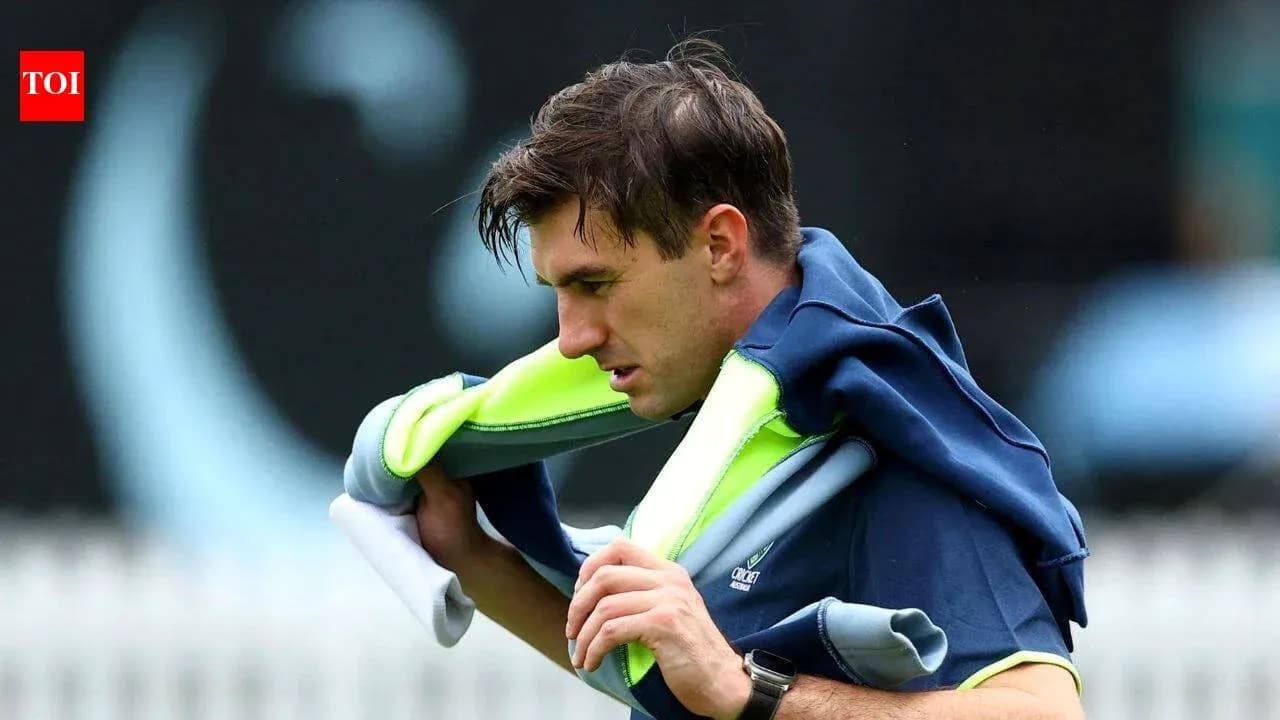
Pat Cummins’ first public sighting since the latest eruption of the Sandpaper scandal did not come at a press conference, a training session, or a sponsor event. It came on a Sydney street.
The Australian captain was filmed in what appeared to be a tense, animated exchange with his wife, Becky, before the pair disappeared into a nearby property, footage published by The Australian showed on Wednesday. Cummins, dressed down in a T‑shirt and shorts, looked more listener than talker as the conversation unfolded, his body language relatively restrained while Becky did most of the gesturing.
On any other week, it might have passed as a private moment caught on a long lens. This week, it lands in the middle of a fresh storm.
Old scandal, new claims
“Sandpaper‑gate” has never truly left Australian cricket, but Usman Khawaja has dragged it back to the front page.
In his new autobiography, Sabr, released on Tuesday, the former Test batter claims the entire Australian dressing room knew about the plan to tamper with the ball during the 2018 series in South Africa. David Warner, already central to the original affair, has backed Khawaja’s account, sharpening scrutiny on who knew what, and when.
Those claims cut across the carefully contained version of events that led Cricket Australia to suspend Steve Smith, Warner and Cameron Bancroft after the infamous Cape Town Test. That investigation drew a line, at least officially. Careers were rebuilt. A new leadership era began. The team rebranded itself on “values”.
Now, the questions are back.
Cummins stands by the past – and moves on
Before this latest footage surfaced, Cummins had already been asked about the possibility that Khawaja’s story might diverge from the official findings.
“It’s obviously a long time ago. All the investigations, everything was done back then. Answered every question a million times,” he said. “It was dealt with then, all I can say is as a group we’ve moved on. Very happy with the last eight or nine years, how we’ve been as a group and evolved. He didn’t go into too much detail . . . As always it was ‘no worries, you can tell your story, that’s fine’.”
It was a captain’s answer: firm on process, keen to close the door, respectful of a former teammate’s right to speak. But Khawaja’s book, and Warner’s support of it, have prised that door open again.
For now, Cummins is officially on rest, sitting out Australia’s two white‑ball series against England as he prepares for four looming Test matches against New Zealand. The plan was a quiet reset before another heavy red‑ball workload. Instead, the off‑field noise has surged.
Khawaja talks, then goes quiet
Khawaja’s own position has grown more complicated by the day.
He fronted ABC’s 7.30 and was pressed directly on whether he felt let down that the bowlers had not admitted knowing about the plan to rough up the ball with sandpaper. The line of questioning went straight to the heart of his implication: if “the whole dressing room” knew, that includes the attack.
Khawaja did not bite.
“I’ll say again, I’ve given my statement about what happened the game before,” he said. “I was very open and honest to what I saw and what conversations I had. Sometimes I’m very specific on things, and sometimes I’m a bit vague on things, and I do it on purpose because I’m trying to tell a story.”
When pushed again on the bowlers’ involvement, he drew a hard boundary.
“I’m just not going … I’m not going to entertain that,” Khawaja replied. “I’m not going to really speak on any more of it at this moment.”
Soon after, he cancelled his remaining media appearances for the book. The story he wanted to tell is now out there. The details he does not want to share, for now, will stay locked away.
A leadership test with no ball in sight
The timing is awkward for Cummins. He has built his captaincy on a calmer, more considered image of Australian cricket, one that distances itself from the win‑at‑all‑costs edge that framed the 2018 scandal. Under his watch, the team has stacked up trophies and goodwill.
Yet the past keeps walking back through the door.
A brief, heated conversation on a Sydney street would usually be a non‑event. In the shadow of Khawaja’s claims and Warner’s backing, it becomes another frame in a broader picture: a captain trying to keep his present from being dragged into someone else’s version of the past.
The Tests against New Zealand will arrive soon enough. The questions about Cape Town, and who truly knew what, are not going anywhere.