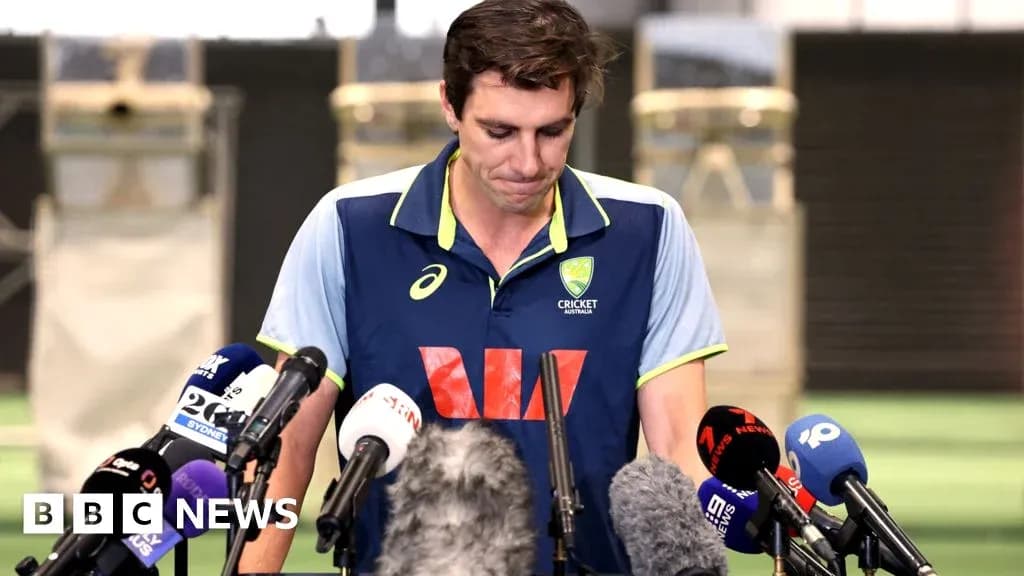
Pat Cummins stood under the harsh white lights at Cricket Central, flanked by cameras, notebooks and suspicion. Outside, proper cricket was beginning – New South Wales against South Australia in the Sheffield Shield – the sort of game he’d far rather talk about.
Inside, the past had walked back in.
For more than an hour, the Australia captain absorbed questions about sandpaper, Cape Town and trust. He knew why he was there. He also knew what he wanted.
“I don’t want to talk about this again after today,” he said early, setting his own field. “Even if it takes all day... I’ll stay here until we have no more questions.”
The questions kept coming. So did the echoes of 2018.
A scandal Australia cannot outrun
Sandpapergate was supposed to be settled history: three players banned, reputations scorched, a team rebuilt under a new captain and a new culture. Australia had moved on. Or so it liked to believe.
Usman Khawaja’s book has torched that illusion.
In his memoir, the recently retired batter claims the entire Australian team knew about the plan to use sandpaper on the ball during the third Test against South Africa in Cape Town. That assertion cuts straight across the official version, which ring-fenced responsibility around three players: David Warner, Steve Smith and Cameron Bancroft.
Khawaja writes that when Bancroft was caught with the sandpaper, he pushed for collective responsibility.
“I said: ‘Take this as a team. We did this as a team. We knew what was going on, and we have to take it as a team’.”
Those words have detonated years after the fact, dragging old wounds back into the light and putting current heroes under the microscope – none more so than Cummins, now the face of Australian cricket and, as many joke, the holder of the country’s “most important job”.
He flatly rejected any suggestion he knew about the plot. He also made it clear he resented having to do so at all.
Khawaja, for his part, has since insisted he doesn’t want a “witch hunt” and has refused to spell out precisely who he believes knew what, and when. The vagueness has only deepened the anger and confusion.
Dressing-room fault lines and old scars
The book has sliced through generations of Australian cricket figures. Warner, who copped the heaviest penalty back in 2018 and has lived with the “mastermind” tag ever since, has backed Khawaja’s account, saying his former team-mate has written the truth. He also accused Cummins of throwing him “under the bus” with his public denial.
Smith, the captain in Cape Town, is overseas and silent. Bancroft, who once hinted that the bowlers knew more than they let on, has also gone quiet. Around them, half of Australian cricket’s old guard has weighed in, some of them facing their own accusations from that era.
Cricket Australia, caught again in the crossfire, is being urged by some to reopen its investigation. Chief executive Todd Greenberg has already said that will not happen.
That refusal only feeds the sense of unfinished business. Prof David Rowe of the University of Western Sydney calls sandpapergate a “nasty shock” that delivered “collective shame” to a country that sees itself as “a nation of good sports”.
In Australia, “good sport” means two things: win, and do it the right way. Cheating, Rowe notes, was always supposed to be what “other teams get up to… not the nation of good sports.”
That myth died in Cape Town. The fallout clearly hasn’t.
Rowe doubts the game can truly move on without a fresh, transparent response from Cricket Australia.
“One of the best ways to fuel conspiracy theories and keep sandpapergate going is to essentially say ‘there’s no more to see here’ – especially when that comes from the authorities,” he told the BBC.
Cummins, asked whether he wanted the case reopened, padded the question away. That, he said, was a matter for Cricket Australia.
Fans caught between fatigue and fury
Out in the stands, the mood is more weary than bloodthirsty.
Josh, 28, summed up a common feeling: “It’s just a bit crazy that it’s all blown up again... I think it is a bit ridiculous, after eight years.”
“I’m a bit bored of it,” said one woman watching the Shield match, eyes on the middle rather than the headlines.
There is irritation that Khawaja has chosen this moment – on the eve of a home summer and a big year of cricket – to reopen the debate. Yet there’s also the nagging sense that there was never going to be a “good” time for a story like this to resurface, particularly from a player who only retired from international duty in January.
Younger fans like 21-year-old James feel a different kind of injustice.
“It’s a bit of a stitch up,” he said. “Every country has done it... if it wasn’t us, it was probably going to be someone else.”
For them, the grievance isn’t that Australia cheated, but that Australia can’t stop paying for it.
There is also anxiety about what this means for the current side. Australia’s recent Test tour of South Africa – their first there since 2018 – was underwhelming. Now, as they prepare for a home summer, their captain is burning emotional and mental energy revisiting a scandal from eight years ago.
Cummins in the firing line
Through it all, Cummins worked hard to stay composed. He paused often, picked his words carefully, and tried to close down every angle.
He called Khawaja’s accusations “vague”. He admitted frustration that a friend had put him in this position.
“Friends aren’t casual with each other’s lives and reputations... That’s something I’ve been grappling with the last couple of days,” he said, a rare glimpse of rawness amid the media management.
The marathon nature of the press conference – one reporter suggested it was the longest in Australian sporting history – underlined how deeply sandpapergate still cuts. This was not a quick denial and exit. It was an attempt, perhaps a final one from Cummins’ perspective, to draw a line under the saga.
As the questions finally dried up, he gestured toward the cricket actually being played outside, and to Friday’s one-day international against England in Perth, from which he and other senior players are being rested.
“It’s been eight years... Hopefully today we put a line through it and we’re done and we can all move on to much more fun topics, like actual cricket.”
That hope may be optimistic.
James, the young fan in the stands, captured the grim reality.
“It’s going to be hard to move on, given that there’s two sides of the story and it doesn’t look like either side is going to back down.”
Until someone blinks – a player, a governing body, or perhaps a future inquiry – Australian cricket will keep living with a scandal it cannot quite finish, and a question it cannot quite answer: how does a “nation of good sports” forgive itself when the ball still feels rough in the hand?