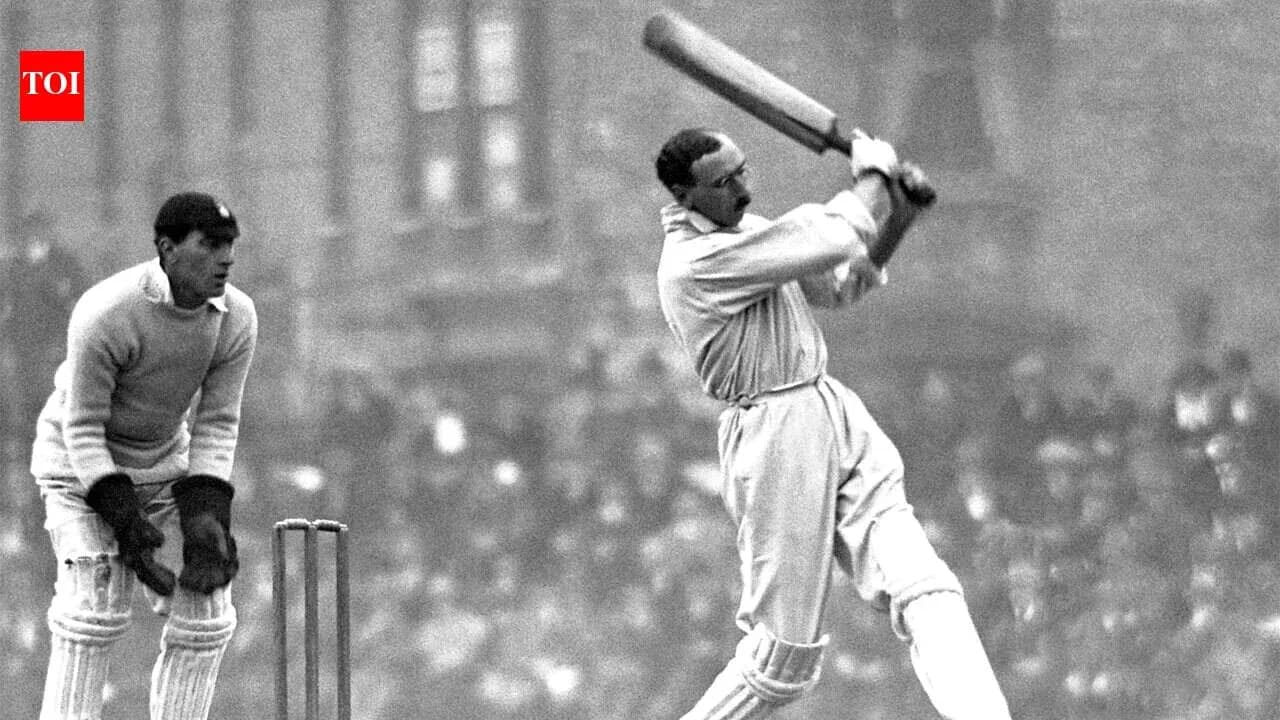
More than a century has passed since Percy Fender walked out at Northampton, four days after his 28th birthday, and tore into Northamptonshire’s bowling with a violence that still echoes through the record books. In an era of T20 pyrotechnics and 200-plus chases, his hundred in 35 minutes for Surrey on August 26, 1920, remains the benchmark. Others have gone quicker on paper. None have truly caught him.
The key is context. Cricket has always drawn a line between a genuine assault and a contrived spectacle. Fender’s innings belongs firmly in the first category.
A county game turns into a storm
The day began like any other County Championship fixture of its time. Northamptonshire posted 306 in their first innings, anchored by 128 from Fanny Walden. Fender, already a prominent all-rounder, made his mark with the ball, collecting three wickets.
Surrey’s reply started shakily. At 160 for four, with Andy Sandham gone for 92, they were wobbling. The match felt balanced, maybe even tilting towards the hosts.
Then the mood changed.
Andy Ducat and Alan Peach seized control, transforming the innings and the game. They added 288 in just 135 minutes, a partnership that ripped the tension out of Northampton’s bowling and set the stage for something extraordinary. Ducat finally fell for 149, and with his dismissal came a new figure at the crease.
Fender.
Nineteen minutes to fifty, thirty-five to immortality
From almost the moment he took guard, Fender batted like a man in a hurry. Not reckless, but utterly uncompromising. He drove long and hard, carved fierce cuts, pulled anything short, and unfurled the slashing strokes that would become his signature.
Northamptonshire had no answer. Fielders chased leather; bowlers searched for length and line and found neither. The clock, not the scorecard, told the story.
Fender’s fifty arrived in 19 minutes. That alone would have been a talking point. But he kept going, accelerating through a stunned attack that could not slow him, let alone stop him.
Gilbert Jessop’s 40-minute century against Yorkshire at Harrogate in 1897 had long stood as the fastest in first-class cricket by time at the crease. It was a record steeped in legend. Fender went past it with five minutes to spare.
He reached his century in 35 minutes. No trick fields. No part-time lobs set up to be hit. Just relentless, authentic hitting under normal first-class conditions.
Boundaries, then more boundaries
The landmark did not bring restraint. Fender simply kept swinging.
He finished unbeaten on 113, made in 42 minutes. The numbers are almost absurd: 16 fours, five sixes. Of his 113 runs, 94 came in boundaries. More than 83 per cent of his score arrived in fours and sixes, a ratio that would look extreme even on a modern T20 scorecard.
At the other end, Peach reached his own milestone. Surrey declared when Peach completed his double-century, closing on an unbeaten 203. The sixth-wicket stand between Peach and Fender was worth 171 runs in only 42 minutes, a blur of scoring that turned a once-delicate position into a rout.
It is easy, in an age obsessed with balls faced, to misread the nature of Fender’s achievement. His record is not about deliveries. It is about time. The stopwatch, not the strike-rate column.
That distinction matters.
When 35 minutes doesn’t really mean 35 minutes
For 63 years Fender’s mark stood alone, unchallenged in any serious sense. Then, in 1983, Steve O’Shaughnessy of Lancashire appeared to join him.
On paper, the story looks similar: a century in 35 minutes against Leicestershire. In reality, it could hardly have been more different.
Bad weather had mangled the match, delaying play and squeezing the available time. By the final day, both captains needed to force a result and were prepared to bend the contest to make it happen. After Leicestershire declared, O’Shaughnessy and Graeme Fowler walked out against an attack that, for a spell, barely resembled a competitive first-class unit.
David Gower and James Whitaker, both frontline batters, took the ball. What followed was described at the time as farcical. Full tosses, long hops, and a short boundary turned the innings into a hitting exhibition rather than a genuine contest between bat and ball.
Fowler crashed 100, launching 10 sixes. O’Shaughnessy also raced to three figures, reaching his hundred in 35 minutes. The numbers matched Fender’s. The circumstances did not.
The innings served a purpose: it created time and manufactured a chase. But it also underlined why statisticians and historians refuse to treat it as a true equal to Fender’s feat.
The centuries that don’t quite count
O’Shaughnessy’s innings is not the only one to have outstripped Fender’s pace on a stopwatch while falling short in authenticity.
Glen Chapple hammered a century in 21 minutes for Lancashire against Glamorgan in 1993. Mark Pettini reached three figures in 24 minutes for Essex against Leicestershire in 2006. Michael Goodwin and Tom Moody produced centuries in 25 and 26 minutes respectively.
The pattern is familiar. Weather interruptions. Time running out. Captains colluding in rapid declarations. Part-time bowlers serving up hittable fare to clear the way for a result. The scorebooks record the runs, but the context strips those innings of their claim to the pure “fastest” tag.
For decades, such contrived passages of play were part of the fabric of three-day county cricket. With limited time to produce a result, captains sometimes had to manufacture drama. That might have made for entertaining afternoons, but it also muddied the waters of the record books.
So the line holds. Officially, those centuries stand. Historically and competitively, they sit in a different category. That separation is what keeps Fender’s 1920 effort on its own pedestal.
What “fastest” really means
There is another layer to the debate. “Fastest century” can mean very different things depending on how you measure it.
If the metric is balls faced, Percy Fender is not the man at the top.
In first-class cricket, that distinction belongs to David Hookes, who smashed 102 from just 34 balls for South Australia against Victoria in 1982. In Test cricket, the record sits with Brendon McCullum, whose hundred from 54 balls against Australia in Christchurch in 2016 redefined what a farewell innings could look like.
Those feats speak to modern aggression, to the rise of power hitting and fearless batting. They are landmarks in their own right.
Yet by elapsed time at the crease, under genuine first-class conditions, Fender remains untouched.
More than 100 years on from that afternoon at Northampton, no legitimate innings has bettered his 35-minute hundred. Others have gamed the clock, played with the field, or turned the contest into a negotiated exhibition. No one has walked out in a proper match, faced a proper attack, and scored a century faster in real time.
That is why Percy Fender’s 35-minute hundred from 1920 still stands as the gold standard: the fastest authentic first-class century by time, and a reminder that some records are not just about numbers, but about how they were made.