Rashid Khan has lived every chapter of the India–Afghanistan story. From the days when Afghanistan turned up hoping to compete, to this new phase where they arrive expecting to win. The rivalry has grown. So has his gaze. It now stretches well beyond the next game.
On the eve of the third and final ODI against India, the legspinner cut through the noise. The results matter, of course, but his mind is fixed on something more fundamental: how Afghanistan grow from dangerous outsiders into a side that knows how to close the gap on giants like India.
Powerplay problem, mindset gap
For Rashid, the lesson from this tour is brutally clear. Afghanistan are leaking the game in the first 10 overs – with bat and ball.
“The learning is about how we are going to use the powerplay as a batting unit,” he said, highlighting the contrast with India’s top order. He’s watched India’s batters pile up runs in Delhi, a venue that demands a big-score mindset. Afghanistan, he insists, still don’t quite own that mentality.
He wants his team to learn how to “score big runs under any condition, in any situation, and against any bowler.” That’s the standard he sees on the other side. Indian players don’t just get quick 20s and 30s; they take the game deep and convert.
On the bowling front, the numbers in the powerplay are non-negotiable in his eyes. Concede 70–80 in the first six, and it hardly matters if you’re defending 200 or 230. That, he says, is where Afghanistan must find answers – collectively. Plans, skills, and nerve under fire. Without that, the belief of beating big teams risks becoming just another slogan.
India’s fearless new wave
Rashid has faced several iterations of India’s T20 side. This version, led by Shreyas Iyer and loaded with young, explosive talent, unsettles even a seasoned campaigner like him.
“It is a very dangerous side, a destructive side,” he said. One hitter after another, all capable of going big, all with hundreds in T20 cricket. That, for him, is the real threat – not cameos, but match-defining innings stacked through the order.
They play fearlessly. They have the skills to back it. That blend, Rashid believes, is what separates this Indian group from the rest.
Two names, though, sit front and centre in his mind.
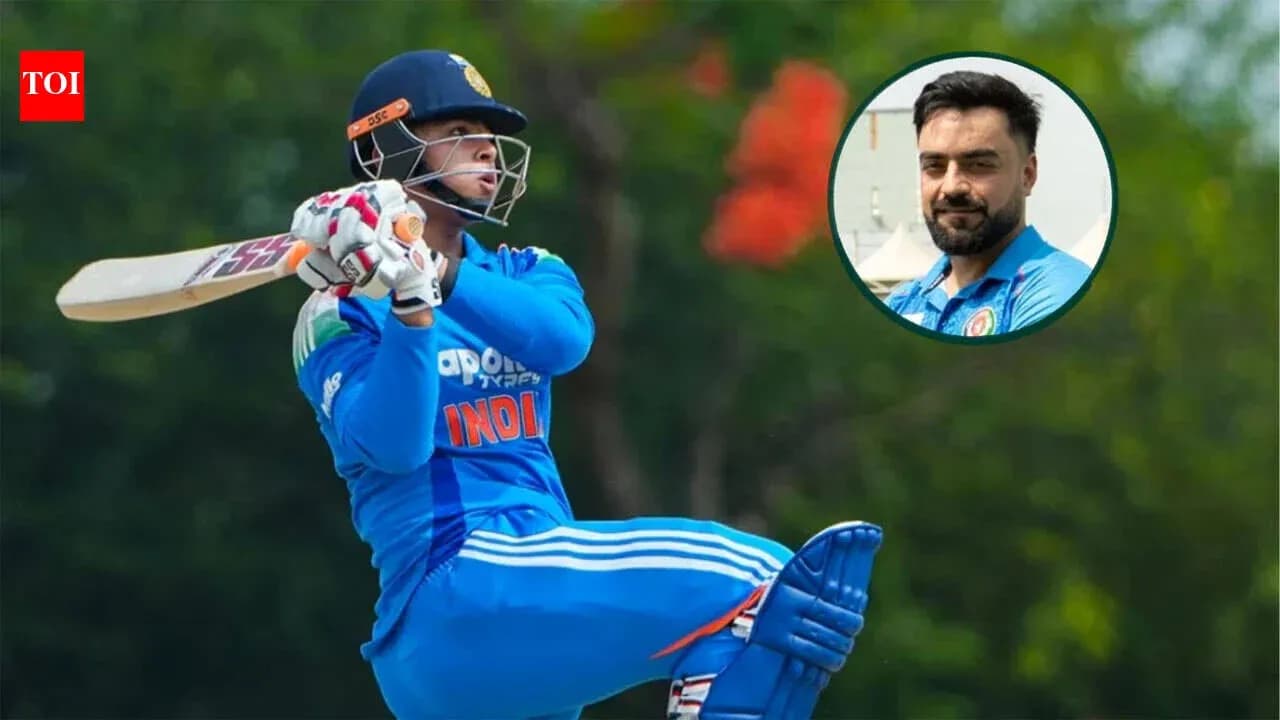
Abhishek Sharma: India’s next “big package”
Abhishek Sharma is not a surprise to Rashid. He saw the left-hander up close at Sunrisers Hyderabad, saw the work, the talent, the temperament.
He always “had that kind of ability and skill,” Rashid recalled. The batting is there for everyone to see now, but Rashid is adamant that Abhishek’s bowling is being underrated. In his view, Abhishek can quietly become a key middle-overs option, a genuine all-rounder who offers balance and flexibility.
“He is the one who is going to be a very big package for Team India in the future,” Rashid said. Coming from one of the game’s premier T20 all-rounders, that’s not casual praise. It’s a projection.
Vaibhav Sooryavanshi: a 15-year-old phenomenon
Then there is Vaibhav Sooryavanshi, the teenager who has already made his international debut at 15 and faced Rashid’s best from close range.
What strikes Rashid is not just the talent – plenty of youngsters have that – but the clarity. The fearlessness. The ownership of his game.
He talks about Vaibhav’s shot selection, his ability to know his options “against any side, any bowler, anytime.” That kind of tactical maturity usually takes years. Vaibhav, somehow, has it now.
The power, the hand-eye coordination, the way he swings freely yet with control – Rashid calls it “god-gifted talent”. You “hardly see that in any other player,” he says, and he means it.
Does Vaibhav remind him of a young Rashid? He laughs that off. The skill was there in his own youth, he admits, but not this kind of ball-striking. Not those sixes at that age. Vaibhav, to him, is something else: a unique talent who has already proved himself in the IPL and now in India colours.
From underdogs to contenders
Rashid’s own journey mirrors Afghanistan’s rise. He has been there from the days when beating a major side was a dream, to a period where it became a target, to now, where it feels like an expectation.
He traces the turning point. The bilateral T20 series win over Pakistan. The 2023 World Cup in India, where Afghanistan stunned England and then beat Pakistan and Sri Lanka. The run to the semi-finals at the 2024 T20 World Cup in Australia and New Zealand.
Those results changed something deeper than rankings. They changed belief.
The team now sees itself in the bracket of sides that can beat anyone. The challenge, as Rashid frames it, is not to slip back. To manage this new status, to sustain it, to make it normal rather than exceptional.
Ibrahim Zadran’s time
That next step will unfold under new T20I captain Ibrahim Zadran. Rashid, who has led Afghanistan through multiple cycles, is clear about what makes Ibrahim the right man.
He points to the opener’s hard work, his desire to lead from the front, and his consistency. Ibrahim is “very straightforward,” Rashid says, someone intent on setting standards for the younger players by example, not just by talk.
Rashid stands beside him as a senior pro, a sounding board, but he stresses that Ibrahim’s honesty and work ethic give him the tools to grow into the role and lift others with him.
From his own captaincy days, Rashid offers one key lesson: don’t drown under the weight of responsibility. He admits he once tried to take everything on himself, piling on pressure until it hurt his own game. The fix, he says, lies in returning to the basics – focus on your skills, your process, not the result. Keep the mind on how, not what.
The next Afghan wave
Rashid has become the face of Afghan cricket worldwide, but he insists he will not be the last. The pipeline is real.
Noor Ahmad, the left-arm wrist-spinner, is already making his presence felt. Rashid believes Noor has the game to go “to the next level” and deliver big performances consistently.
He is equally encouraged by the fast-bowling stocks, an area he feels Afghanistan must strengthen. Abdollah Ahmadzai, now in the squad and bowling with serious pace, stands out. If managed correctly, Rashid says, Ahmadzai can become a genuinely quick bowler and a pillar for Afghanistan’s future.
A body rebuilt, a career recalibrated
Rashid’s own game has evolved under the strain of a heavy global schedule and the reality of injury and surgery.
In his early years, he chased cricket everywhere – leagues, tours, different conditions, different roles. That constant travel and workload, he believes, gave him priceless experience and knowledge of pitches and environments around the world.
But surgery changed the equation. The body pushed back. He had to cut down, choose his cricket more carefully.
A visit to the Red Bull Athletic Performance Centre in Austria proved pivotal. There, he underwent extensive testing and came away with a “very clear image” of his body – what needed strengthening, what needed protection, what to avoid, and where and how much he should play.
It was a reset. A new map for the second half of his career.
One unfinished line in the story
For all the personal milestones, the global recognition, the franchise success, Rashid’s eyes remain fixed on one missing piece.
“The one unfinished thing,” he says, is to win a World Cup for Afghanistan.
The 2024 T20 World Cup semi-final run brought them close enough to taste it. Close enough to feel the weight of the missed opportunity. They reached the final four, but not the final. That, for Rashid, still stings – and still drives.
He wants an ICC trophy in Afghanistan’s name before he is done. T20 or 50-over, it doesn’t matter. He wants that line in his story, and in his country’s.
The rivalry with India will roll on. New kids like Abhishek Sharma and Vaibhav Sooryavanshi will write their own chapters. Noor Ahmad and Abdollah Ahmadzai will try to carve theirs.
Rashid Khan, though, has already picked his final scene: an Afghan team lifting a World Cup, and a journey that began as underdogs finally ending with the game’s biggest prize in their hands.