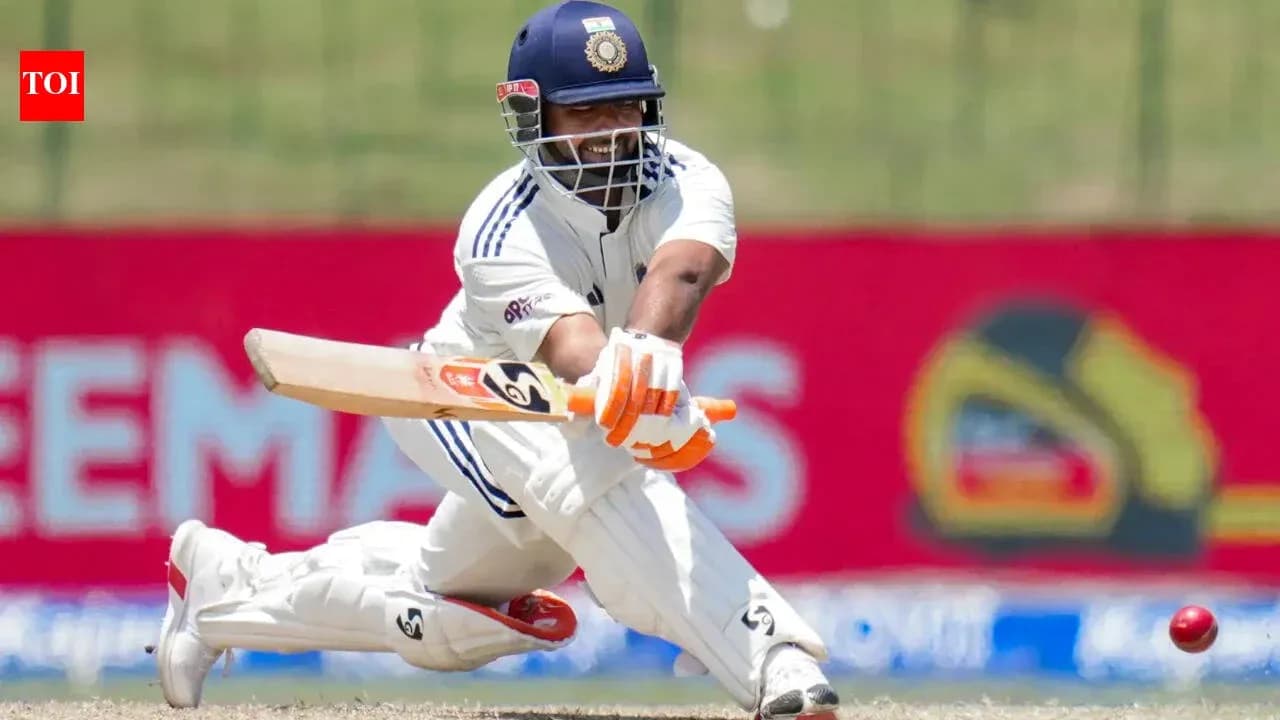
Ravichandran Ashwin has never been one to hide behind polite platitudes. When he talks cricket, he talks in absolutes, in demands, in expectations. And this time, the subject under the scanner is a player he openly says he loves watching: Rishabh Pant.
Pant has just walked away from a respectable Test series against Sri Lanka – 168 runs, two half-centuries, a presence that always seems to tilt the camera and the crowd his way. On paper, those numbers look solid. To Ashwin, they are incomplete.
For him, the issue is no longer about Pant’s talent. It is about what he does with it when the game is on the line.
Numbers on the board, questions in the air
Pant’s return in the two-Test series would satisfy most selectors. He scored runs, he scored them quickly, and he did what Rishabh Pant usually does – took on bowlers, took on fields, took on risk.
Ashwin, speaking on his show ‘Ash Ki Baat’, cut straight through the glow around those statistics. He wants more judgement, more situational awareness, more responsibility from a player who has now played 50 Tests.
“My expectation from Rishabh Pant hasn't been fulfilled till now. I am very sorry,” Ashwin said, making it clear that this is not a rookie he is talking about, but a senior pro in the Test set-up.
The concern is not new. Pant’s attacking instincts have been dissected for months, particularly the moments where his aggression has tipped into recklessness. Ashwin went back to one such flashpoint: Guwahati, last year, against South Africa. Pant, captaining India in Shubman Gill’s absence, charged down the track to Marco Jansen and edged to the wicketkeeper. It was a shot that looked like a statement. It also looked like a misread of the situation.
For Ashwin, that is the heart of the debate. Not the style. The timing.
No free pass for a “once-in-a-generation” talent
The counter-argument is familiar: Pant is different. He wins you games others cannot. He turns dead sessions into chaos. You live with the risk because the reward is so rare.
The host on Ashwin’s show pushed that line, pointing to Pant’s unforgettable knocks in Sydney and Brisbane. Ashwin didn’t dismiss those innings. He contextualised them.
“Rishabh played a class knock in Sydney and Brisbane, but you couldn't have won that match without Washington Sundar and Shardul Thakur,” he said. One man may light the fuse, but a Test win is built across five days, 11 players, countless small acts of discipline.
And that is where Ashwin drew a hard boundary around the “once-in-a-generation” label that so often surrounds Pant.
“It takes 11 cricketers to build a Test and win it in the last session of the game, but it takes only 1 moment of foolishness to lose a Test,” he warned.
The message was sharp: no player, however gifted, gets to be above the demands of the moment.
Aggression is fine. Blind risk is not.
Ashwin went out of his way to stress that he is not asking Pant to turn into a blocker. He invoked two of the game’s great attacking trailblazers – Virender Sehwag and Adam Gilchrist – to make that point.
“I am just talking about the times when these chances are being taken when the game is on the line,” he said. “Sehwag and Gilchrist played high brand of cricket, but these two don't get edged out while dancing down to Marco Jansen when your team is trailing by 500 runs.”
That comparison cut through the romance around “this is how Rishabh plays”. Sehwag and Gilchrist hit on their terms, but they rarely confused bravado with responsibility when their side was buried under a mountain of runs.
Ashwin’s irritation with the marketing of Pant as an untouchable maverick came through clearly: “Don't place these marketing lines in front of me ever again.”
In other words, call genius what it is, but do not use it as a shield for poor decision-making.
Time for straight talk
Pant’s story has another layer now. He is, at this point, a Test-only cricketer for India, having slipped out of favour in both ODI and T20I formats. For Ashwin, that is not a coincidence; it is a consequence.
“Don't give one player special treatment. This once-in-a-generation player backing, then give it to everyone. Jaiswal is also such a player,” he said, widening the lens to the broader ecosystem of Indian talent.
The core of his argument is blunt. Pant has played 50 Tests. That is not a young prodigy learning the ropes. That is a seasoned international cricketer, and with that experience comes a non-negotiable demand: responsibility.
“All I'm saying, Rishabh, is that he is experienced; he has played 50 Tests. He needs to take responsibility. Don't come up with this ‘once-in-a-generation’ argument,” Ashwin said.
Then came the line that will echo beyond this series: “It is because of his decision-making that he's not playing the other two formats. The day you tell him the truth, he will be an all-format player for India.”
It was not a public takedown. It was a public challenge.
A crossroads for Pant
Pant still sits at the heart of India’s Test plans. His presence changes fields, forces bowlers off their lengths, shifts the emotional temperature of a game. That is not in doubt.
What Ashwin has done is strip away the comfort around that aura. He has framed Pant’s future not as an inevitability, but as a choice. Adapt, read the game better, pick your moments, and the door to all three formats opens again. Keep leaning on the “that’s how Rishabh plays” narrative, and that door stays half-shut.
For a player who thrives on pressure and big stages, the question now is not whether he can thrill. It is whether he is ready to own the boring, brutal truth Ashwin has laid out – that genius, at the highest level, only truly lasts when it learns when not to swing.