At the long-off rope, Mohammad Nabi shuffled left, sprang just enough, and cupped the ball inches from disaster. Any higher and it was sailing for six. Instead, he turned, signalled ‘out’, and Rashid Khan checked the only thing that mattered: the feet. Once the confirmation came that no part of his boot had kissed the boundary cushion, Rashid allowed himself a rare roar. Second wicket of the over. Sanju Samson gone.
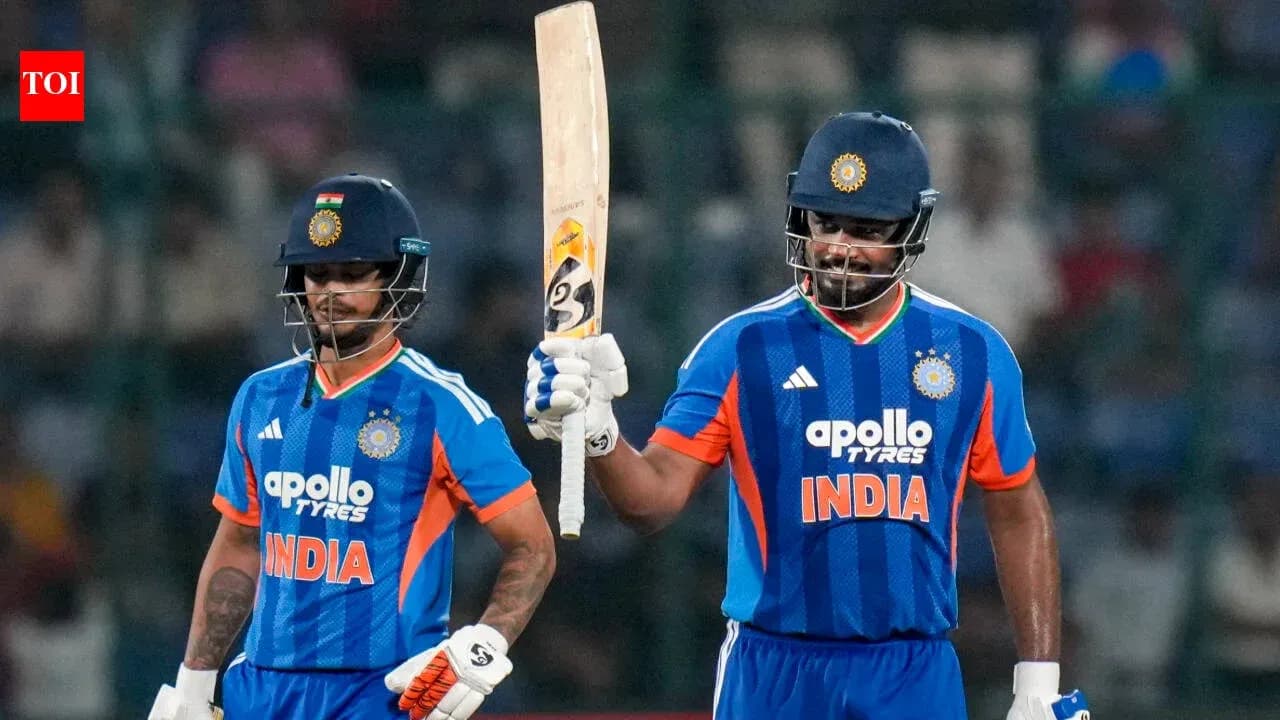
Samson walked off with 57 from 22. Seven fours. Four sixes. Fifty-two of those runs in boundaries. A cameo on the scoreboard, a statement in the selection room.
Samson’s counterpunch
This was not just another brisk T20 knock. This was Samson pushing back at a narrative that has stalked him for years.
He has lived a curious international existence, locked in a game of musical chairs with Vaibhav Sooryavanshi. One gets a chance, the other sits. One misfires, the other is parachuted in. In that contest, Samson has often looked like the one drawing the short straw.
He had just delivered a stellar T20 World Cup, playing a major role in India lifting the trophy. Then came a poor outing against Ireland and, almost without ceremony, he found himself on the bench. Sooryavanshi stepped in, and his first steps in international cricket were far from assured. Samson returned for the last two T20Is against England, only to be left out of the squad that flew to Zimbabwe. There, Sooryavanshi exploded, went hammer and tongs, and walked away with a Player of the Match award.
The carousel spun again when Afghanistan arrived. For this series, India turned to Samson at the top, pairing him with Abhishek Sharma. He started with just 10 in the opener. In New Delhi, at the Arun Jaitley Stadium, he finally bit into the series.
Azmatullah Omarzai and Nabi copped the worst of it. Omarzai’s 10 balls to Samson disappeared for 23. Nabi’s seven went for 22. The numbers only hint at the violence.
What truly separated Samson’s innings was the ease with which he cleared the in-field. It is the trait that keeps pulling selectors back to him, no matter how often he is shuffled out.
Omarzai began the fifth over with a gift: overpitched, in Samson’s arc. The ball sailed over mid-on. Next delivery, short and drifting down leg, was whipped over fine leg. The third, pitched up again, was flayed over cover, one bounce into the hands of the volunteers beyond the rope. To close the over, Samson took a low full toss, presented the full face of the bat, clipped the non-striker’s stumps on the follow-through and still threaded it past the fielder for four. Chaos and control in a single motion.
Even Rashid Khan, Afghanistan’s problem-solver, was not spared. Samson cracked him for a four and a six, forcing a rare recalibration from a bowler who usually dictates terms. Only when Nabi’s leap at long-off stuck did Afghanistan finally exhale.
Batting under noise
Samson spoke later about what it takes to bat like this when every failure becomes a debate show.
"It’s about just watching the ball and trying to get maximum out in the powerplay. Sometimes it works out well, sometimes it doesn’t. After a few failures, you definitely go through a lot. Being an Indian cricketer, it’s not easy to face failures, but that’s where my experience comes in," he said at the post-match press conference.
He did not pretend the scrutiny doesn’t sting.
"I try to shut out the noise, try to be confident and come out and still keep scoring at a high strike rate, even taking the chances, even knowing that if I fail again, I will be facing a lot of noise. But I think that’s the way we are built here in Indian cricket. I just go out there and try to score maximum and contribute."
That is the tightrope he walks. The very aggression that keeps him in the conversation also keeps him one low score away from the firing line.
The selection fault line
When Samson strode out for the first T20I of this series and not Sooryavanshi, the arguments began instantly.
Kris Srikanth felt Sooryavanshi "wasn't being treated properly". R Ashwin urged the decision-makers to "understand his position". The noise was not just about who opened; it was about what the choice said about India’s planning.
Samson, though, has seen enough from the inside to know how messy these calls can be.
"It’s a very challenging place to be in. Right from the whole team management, the captain, coach and selectors. It’s a very tough choice, actually. All of them (himself, Sooryavanshi and Abhishek Sharma) are really good, all of them are performing, and all of them have to be given the right opportunity to keep performing at the international level," he said.
He leads an IPL franchise. He understands the other side of the table.
"It’s a very tough decision. I totally understand. I lead an IPL franchise, so I know how hard these decisions are, and everyone has been performing really well."
So he has learned to live in the grey.
"I have been in this kind of space for quite a few years, so I just know how to balance it out. Just think about what is in my control and try to be very positive with your competitors as well."
"I think they are competitors for the outside world, but we are a team and we are playing for a country. We want to win the game first, and then it comes down to the other individuals.
"We try to be as positive as possible, and whoever is playing, we want them to do well. We just have to be ready for our own opportunity. We can’t sulk or be in a negative frame of mind, thinking, 'Yaar, mujhe nahi mila, usko kyun diya?' Those kinds of mindsets don’t work here."
A debate delayed, not dead
For one night in New Delhi, Samson’s bat quietened the arguments. Fifty-seven off 22 is the kind of innings that forces even hardened sceptics to pause.
He has not settled the debate. He has only delayed it.
The next time the selectors sit down with a squad list, his name and Sooryavanshi’s will still be side by side. The question is simple and ruthless: has this knock earned Samson a longer rope, or just another spin on the carousel?