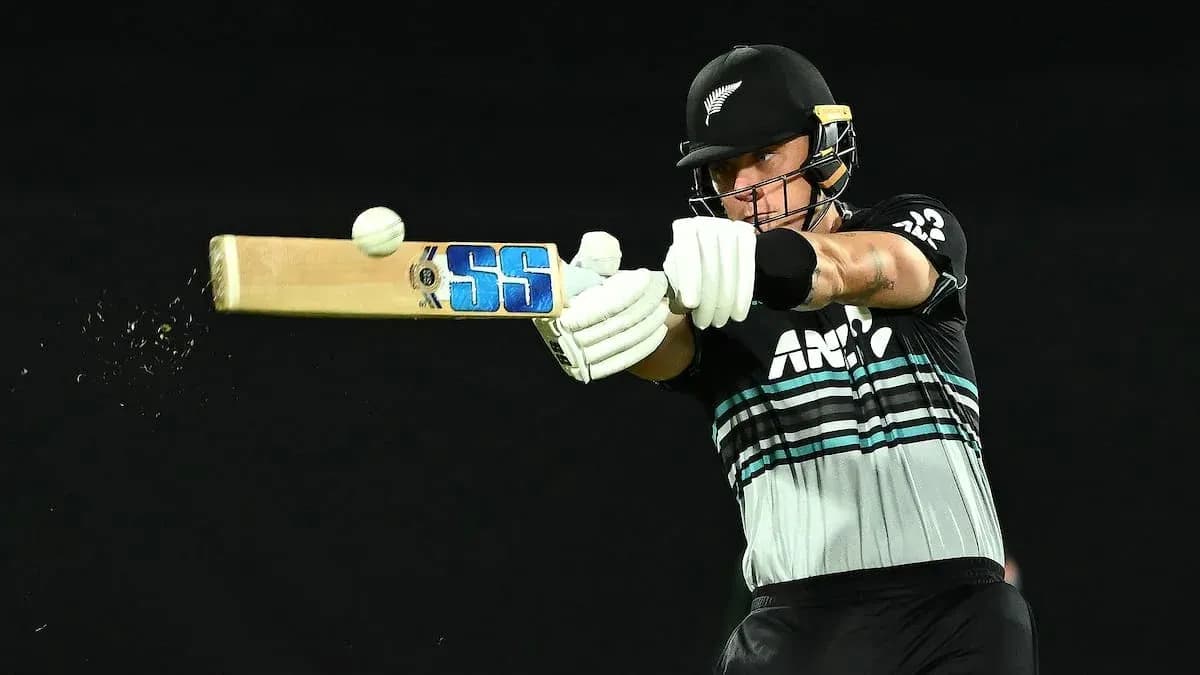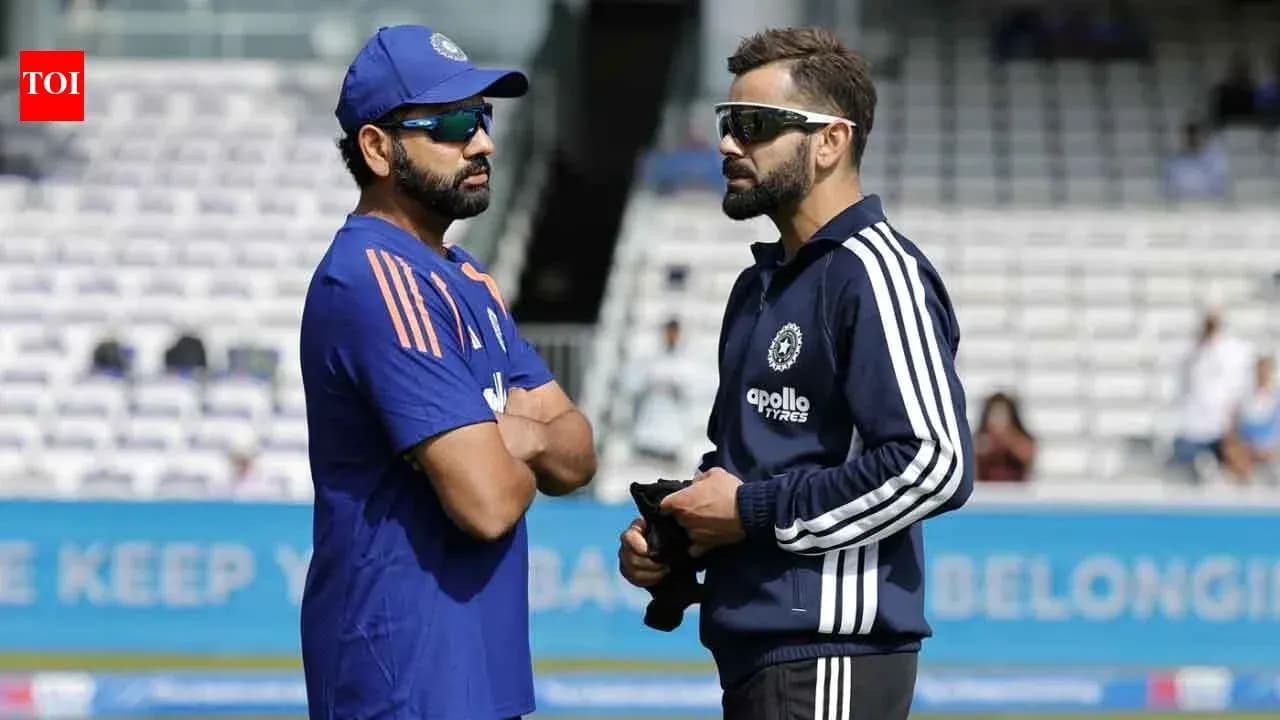
Mitchell Santner knows exactly what is coming. And he is under no illusions about how hard it will be when two of ODI cricket’s biggest modern heavyweights – Virat Kohli and Rohit Sharma – land in New Zealand later this year.
Kohli and Rohit, now operating as one-day specialists, will be back in blue for India’s tour in October-November: five T20Is, five ODIs, two Tests. A long, demanding stretch. A lot of India. A lot of pressure.
And two men who have already done serious damage on New Zealand soil.
Santner braced for Kohli–Rohit return
“It is going to be a challenge,” Santner told PTI, laying it out without fuss. He called them “masters of the ODI game” and admitted they have “taken a liking to some New Zealand pitches in the past”.
That last part stings a little in Kiwi memory. India’s senior pair have often looked at home on the hard, true surfaces at Eden Park, Seddon Park and Wellington. Santner is hoping history doesn’t repeat.
“Hopefully, not this time around,” he said.
The series has a clear edge already. It is not just about a high-profile bilateral contest; it feeds straight into World Cup planning. The next ODI World Cup looms in October next year, and teams have limited 50-over cricket to get their combinations right.
“It is going to be a great series, no doubt. It is all a lead-up for the World Cup next year in ODIs. Everyone is trying to figure out their best team; what that might look like for October next year with limited games,” Santner said.
Every match suddenly looks like an audition.
Beating India at home the first target
Before New Zealand think about England and World Cup fine-tuning, Santner has a more immediate ambition: take down India in their own backyard.
“We’ve got five (matches) against India, three against Sri Lanka at home and then it is World Cup prep in England (in September 2027), right before the World Cup,” he said, mapping out a long-term build-up.
Then he cut straight to the point.
“(But) first things first, you want to win a series against India at home, which would be an awesome thing. Then it is (about) trying to find what the make-up might look like come October next year.”
The Blackcaps’ home season is stacked: India for five ODIs, Sri Lanka for three more, then off to English conditions to sharpen up before the global event. But nothing will be bigger, commercially or competitively, than hosting India.
The schedule underlines that status. India’s tour stretches from October 22 to early December 2026:
- 5 T20Is across Christchurch, Wellington, Auckland and Hamilton
- 5 ODIs split between Auckland, Wellington, Hamilton and Mount Maunganui
- 2 Tests at Basin Reserve and Hagley Oval
It is a full tour, but the red-ball slice is deliberately small.
Memories of 3–0 and a changing India
The last time these two sides clashed in a Test series, the result was seismic. New Zealand walked away with a 3–0 win in India, snapping a home unbeaten run that had lasted more than 12 years and 18 series.
Santner was at the heart of that upset. His figures in the second Test at Pune – 7/53 and 6/104 – turned the series and etched his name into New Zealand’s modern Test folklore.
That history shapes his view of what awaits India’s new-look Test side in November.
“I think what we spoke about before is trying to adapt quickly,” he said, reflecting on those conditions and what lies ahead.
“For a new-look India side, it is probably going to be the first time some players have been playing red-ball (cricket) in New Zealand, where the pitches will be a little bit foreign. They will probably do a bit more than they might do back home.”
Green seams, overhead conditions, and a Dukes or Kookaburra moving around – it is a different kind of examination from the dust and turn of the subcontinent. India’s next generation will be asked to learn fast.
A “well-rounded” India still looms large
Santner is not mistaking transition for weakness. He likes what he sees in India’s current Test squad.
“If you look at their squad, it is a very well-rounded squad,” he said. The names roll off the tongue with the respect of a man who has bowled to most of them and knows what they can do.
“You throw (Jasprit) Bumrah back into the bowling attack, you have got (Mohammed) Siraj, (Prasidh) Krishna with the bounce. You have got (Ravindra) Jadeja and (Manav) Suthar to bowl spin. You have got probably a fourth seamer in there as well.”
That mix – high pace, hit-the-deck seam, and high-class spin – gives India options in any conditions, including New Zealand’s.
“It is shaping up nicely. I think it is going to be a great series. Traditionally, it can do a little bit in New Zealand at that time of the year,” Santner said.
For all the talk of adapting, there is a quiet admission: if the ball moves, both sides have the weapons to exploit it.
‘Fight fire with fire’ in New Zealand Tests
How do you bat in New Zealand when the ball swings and seams, when the cloud hangs low and the slips cordon feels like a magnet?
Santner believes there is no single template.
“It could be trying to fight fire with fire, playing your shots,” he said, hinting at a more proactive approach that has crept into Test cricket globally.
“There might be times we need to sit back and let the bowlers go for a bit, try to get the shine off the ball. There is a lot that can go on in the Test matches in New Zealand. It is going to be an exciting series and one that we can’t wait for.”
Attack, then absorb. Absorb, then attack. The rhythm of a New Zealand Test can flip in a session, and Santner expects this India side to test that volatility.
Why only two Tests?
For all the anticipation, one question lingers: why only two Tests in a marquee India–New Zealand contest?
Santner did not dodge it. He pointed to history and hard numbers.
“For a long time, New Zealand played two-match series. There’s obviously the money side of it as well,” he said.
“I know it costs a lot to play Test cricket. (It is about) timing as well; white-ball brings in the crowds in New Zealand, it brings the money. That’s why I guess it is the 10-2 split.”
Ten white-ball games. Two Tests. The financial reality is stark: T20Is and ODIs pay the bills; Tests fight for space.
Even so, the value of those two red-ball matches is not lost on New Zealand’s left-arm spinner.
“Whenever India come, even if it is only two Test matches, it is going to be exciting. Everyone wants to challenge themselves against the best in the world and they are up there. For us, it is going to be an important series like it is for India with the (World Test Championship) points that are on offer.”
Kohli and Rohit will headline the white-ball leg. Bumrah, Siraj, Jadeja and a new generation will test New Zealand in the longest format. World Cup plans, World Test Championship points, and the memory of 3–0 in India all swirl into one tour.
New Zealand want to beat India at home. India want to reclaim that lost aura from their last Test meeting. Something has to give.