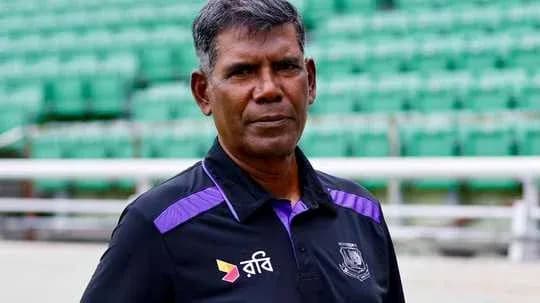
Sarowar Imran sits on the outside now, watching a team he once helped launch into Test cricket move on without him. And he believes he knows exactly why.
The former Bangladesh women's head coach, whose contract was not renewed by the BCB after the Asian Games in October 2026, says he has paid the price for trying to drag players out of what he calls a damaging comfort zone.
The board has already moved on, appointing David Hemp as head coach and quietly shelving Sarowar. Officially, concerns over his temperament were cited. Unofficially, senior players had gone to the board, complaining about his behaviour and expressing unease with his methods.
For a coach who has been part of Bangladesh cricket for decades and guided the men's side in their inaugural Test against India in 2000, the manner of his exit has clearly stung.
‘This is all the communication I had’
Sarowar says he never got the chance to explain himself.
"BCB did not communicate with me after the Asian Games and Asia Cup. I got a letter that I am not going to the Australia tour as another coach will go. This is all the communication I had with BCB," he told Ekattur TV on Tuesday (November 10).
The tension had been brewing. He had already admitted there was unrest in the dressing room after Bangladesh’s exit from the Asian Games, a situation serious enough for the BCB to prepare a show-cause notice. That notice never arrived; the board pulled back, citing his long service to Bangladesh cricket. The relationship, though, was clearly damaged.
From Sarowar’s perspective, the core issue was not his temper, but a culture he found too soft, too accommodating, too accepting of mediocrity.
‘They cannot improve living in this comfort zone’
When he walked into the women’s setup, Sarowar says he saw a support staff that stayed silent and a group of players who were rarely challenged.
"As far as my ill temper is concerned when I entered the women's team, what I saw was that there from bowling coach to spin bowling coach, batting coach, trainer, physio all were very quiet. They listen to whatever the women cricketers say and they cannot improve living in this comfort zone. That is the reason our team is still the same as it was five years back."
He paints a stark picture: a spinner stopping after 30 balls in the nets and the coach simply agreeing; one or two batters occupying the crease all day in practice while others watch on. To him, that was not preparation, it was indulgence.
"A spinner after bowling 30 deliveries tells the coach that she won't bowl any more and the coach agrees. One or two batters bat for the whole day and after seeing all these I started interfering. I also interfered regarding their fitness. When I needed to scold them I did that and if you say this is ill temper in that case I don't feel Bangladesh cricket can improve."
He insists results under him did not justify such a brutal cut.
"I felt I could improve them and had seven to eight tours and everything ended just because of failing in one or two tours."
‘I am a coach and I am not their friend’
Sarowar’s defence of his own methods is unflinching. He refuses the label of an uncontrollable hothead and instead frames his approach as professional hardness.
"I have my own dignity and I am aware of what I am capable of and I don't work to show off. I don't have any problem and there is no reason to feel that my prestige has gone down because I know my work.
"If anyone says that I am ill-tempered that is wrong because in life I can have temper but when I am coaching I am not ill-tempered because I am a professional and I know what needs to be done. A coach cannot be a friend of a player because if I am a friend of a player I cannot drop the player. I am a coach and I am not their friend."
In his view, others within the setup chose the opposite route: adapting to the players’ wishes to stay safe in their jobs.
"I think whoever worked with them (women cricketers) adjusted with them but the women cricketers won't improve if they are in the comfort zone and I felt foreign coaches also did the same. I feel a coach ensures his job by doing this (adjusting and remaining silent)."
That is a serious accusation: that self-preservation among coaches has come ahead of pushing players to international standards.
Fitness under the microscope
If his words on attitude were sharp, his assessment of fitness levels cut even deeper.
"I am telling you more than half of the first XI cricketers do not have the required fitness level. Most of them are below average (in fitness) while some of them are medium while a couple have standard fitness level."
For a team trying to compete with the world’s best, that is a damning verdict.
"Fitness is a big issue and when the fitness test is conducted the trainer can say how many of them match international fitness level. They don't have that (fitness level). If I feel that I will be world champion only by bowling 30 balls, that will never happen."
It is a simple message: without a higher baseline of physical conditioning, tactical plans and technical drills will always hit a ceiling.
A divided dressing room?
On the delicate subject of team unity, Sarowar stops short of confirming open factions, but he hints at an uneven dynamic around captain Nigar Sultana.
"I cannot say about grouping but some were close to the captain while some others were not close to the captain."
It adds another layer to a picture of a squad wrestling with internal issues just as results dipped and the coach’s methods came under fire.
The BCB has chosen a different voice and a different style in David Hemp. Sarowar Imran, meanwhile, walks away convinced that his refusal to bend, to stay quiet, cost him his job. The real test now is not of his reputation, but of whether Bangladesh’s women can climb out of that comfort zone he railed against, or whether his warnings will linger over their next chapter.