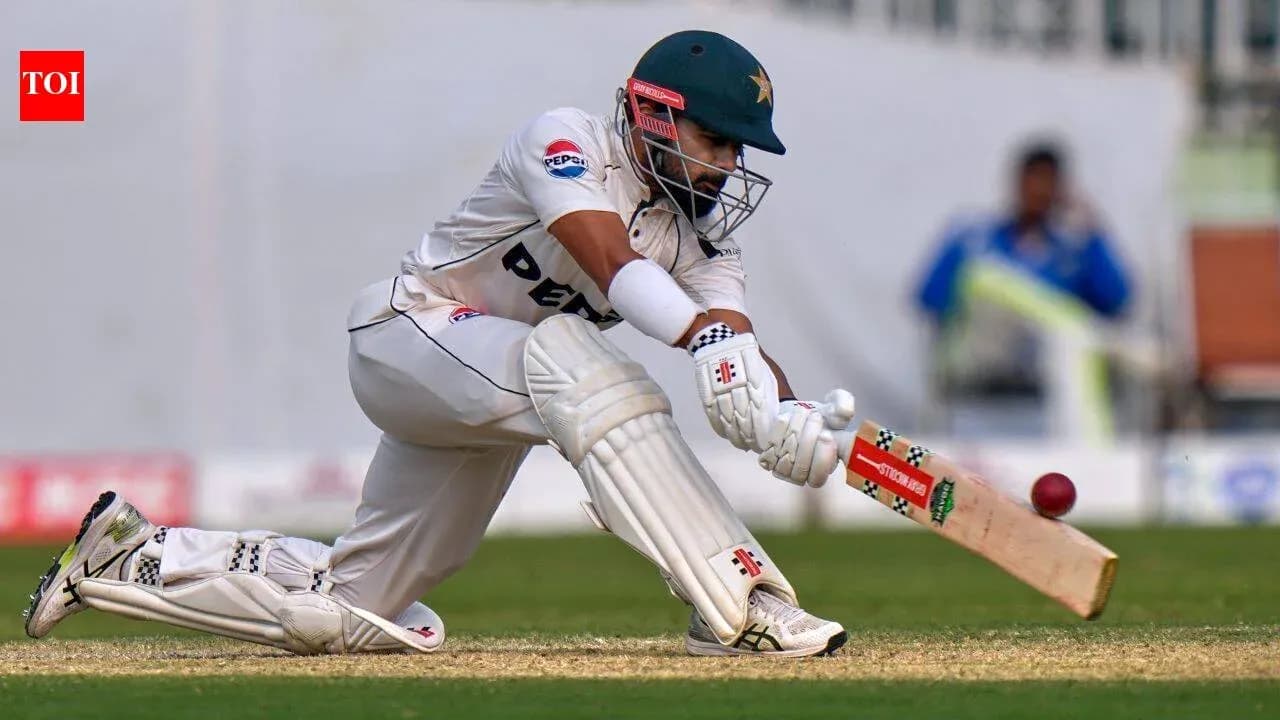
RAWALPINDI – Saud Shakeel walked off the Rawalpindi turf twice in this Test to a standing ovation and a hollow feeling. Two innings, two masterpieces of control and temperament. And twice, heartbreak in the 90s.
On Friday, his 97 on the final day against Sri Lanka did not bring the hundred he so richly chased, but it did bring Pakistan what they desperately needed: safety. The match ended in a draw, the series opener left delicately poised, and Shakeel left stranded on the threshold of a rare personal landmark and a rarer statistical oddity.
A Lone Anchor on a Fraying Final Day
Pakistan began the fifth day under pressure. The pitch had slowed, but the tension hadn’t. Sri Lanka had enough time, if they could slice through the middle order, to push for a result. Pakistan needed someone to shut the door.
Shakeel did more than that. He bolted it and welded it shut.
The left-hander settled in early and simply refused to be shifted. He soaked up 210 balls, leaving late, driving sparingly, picking off anything loose. The innings was not a blaze; it was a siege. Every over he survived drained Sri Lanka’s belief and thickened Pakistan’s grip on the draw.
As partners came and went, Shakeel stayed. By the time Lahiru Kumara finally threaded one through to bowl him, Pakistan had moved to 284/8. The overall lead stood at 272. With the light fading and the clock almost done, any realistic prospect of a result disappeared. Hands were shaken. The game was called. Pakistan had their first draw of the current World Test Championship cycle.
The Century That Never Came
For Shakeel, though, the story ran deeper than the scoreboard.
He had already made 93 in Pakistan’s imposing first-innings 434/9 declared, another innings built on calm judgment and patience. That knock looked then like the prelude to a maiden or statement hundred in the second dig. Instead, it became the first half of a cruel symmetry.
Dismissed for 93 in the first innings. Dismissed for 97 in the second.
Those twin scores dragged him into one of Test cricket’s strangest and most painful statistical lists: batters dismissed in the 90s in both innings of the same match. Only five men had ever worn that scar before him.
Clem Hill was the first, way back in 1902, scoring 98 and 97 for Australia against England in Adelaide. Frank Woolley followed in 1921 with 95 and 93 for England against Australia at Lord’s. Gordon Greenidge, one of the most feared openers in history, suffered it twice – 91 and 96 against Pakistan in Georgetown in 1977, then 91 and 97 against New Zealand in Christchurch in 1980. Mahela Jayawardene was the most recent name before Shakeel, with 92 and 96 for Sri Lanka against New Zealand in Colombo in 2009.
Now the roll call reads: Hill, Woolley, Greenidge, Greenidge again, Jayawardene… and Saud Shakeel in Rawalpindi in 2026.
It is an “unwanted distinction,” as the statisticians like to call it, but look at the company. Hill, Greenidge, Jayawardene – giants of their eras. Shakeel’s misfortune sits alongside greatness.
Pakistan’s Fragile Cycle, a New Mainstay?
For Pakistan, this result carries a different kind of weight.
This was their first draw in the current World Test Championship cycle. Before Rawalpindi, their last nine matches had produced only stark outcomes: seven defeats and two wins. No middle ground, no stalemates, just a team veering between promise and collapse.
Shakeel’s twin 90s offered something they have lacked: stability. When the game slowed and the pressure rose, he did not chase glory, he managed risk. His batting turned what could have become another painful entry in that lopsided record into a hard-earned share of the spoils.
Sri Lanka pressed. Pakistan wobbled. Shakeel held.
Rawalpindi Again, and Another Chance
The series stays in Rawalpindi. The second Test will be played at the same stadium from next Tuesday, the venue shifted from Lahore because of rising smog levels in the city.
Same ground. Same dressing rooms. Same view when Shakeel looks out from the balcony and sees the strip where he twice came so close.
He has already etched his name into the record books in a way no batter truly wants. The question now is simple and sharp: after 93 and 97, does Rawalpindi owe Saud Shakeel a hundred?