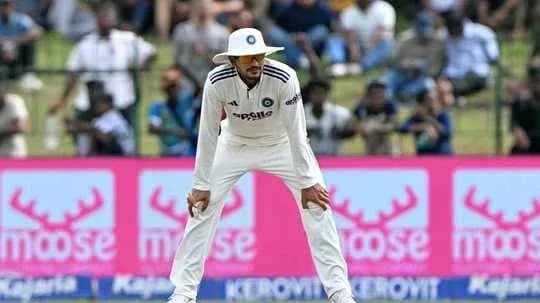
An hour into Day 5 in Colombo, Shubman Gill stopped dead on the pitch. Drinks had been called, but he wasn’t really thirsty. He stared at the surface instead, looking for answers in the cracks and scuffs, searching for a way to break a partnership that refused to die. Electrolytes could wait. Only a wicket would do.
India had been here before. Galle had offered its own version of this tension, when Dhananjaya de Silva and Sonal Dinusha dug in for an hour and a half before India finally broke through and drove the Test to its rightful conclusion. Colombo, though, came with extra layers. This wasn’t just “take ten wickets and go home.” This was “take wickets, then chase, while watching the sky and the clock.” Attack too much, and Sri Lanka’s tail would bleed runs, inflating the target. Ease off, and the overs would disappear. Every decision carried a shadow.
Sri Lanka, effectively 16 for 6 at the start, were not playing for glory. They were playing for time. Over by over. Spell by spell. The plan was simple: drag India into the late afternoon and see what survived. A lot of that hope was wrapped up in one man. Sonal Dinusha, still there, batting as if his career depended on every forward press.
Gill emptied his captaincy toolkit early. His spinners came on in short, sharp bursts, their fingers protected for maximum revolutions on a surface that was offering turn but not always bite. His quicks were told to go short, with a helmeted cordon on the leg side – short leg, leg gully, waiting for a fended pull or a hurried poke. Gill barely stood still. He walked with his bowlers, spoke between balls, shifted fielders a yard this way, two yards that way. It was the kind of morning where a captain tries to win the Test with his feet as much as with his bowlers.
Yet as the session wore on and Sri Lanka’s resistance thickened, Gill’s shoulders began to tell a different story. The longer Dinusha and the tail batted, the more the game seemed to slip into that grey Test-match zone where plans blur and doubt creeps in. India still chased the win, but the body language hinted at a team wrestling with the possibility that this one might get away.
Then the pattern broke. Just after Lunch, in the first over of the session, Manav Suthar finally found an edge. Nuwantha pushed at one outside off, and Dhruv Jurel at second slip did the rest. A release. Brief, but real.
What followed until Tea was pure Test-match trench warfare. India versus Dinusha, with Prabath Jayasuriya cast as the reluctant shield at the other end. India had seen enough of the left-handed No.6 to know the obvious truth: the cleanest route to a result ran through the man not named Dinusha. So they went after Jayasuriya with everything they had.
Fields were ripped up and redrawn almost ball by ball to drag the No.8 onto strike. Bowlers targeted him relentlessly. When Dinusha found himself facing the fifth or sixth ball of the over, the quicks even went wide of leg stump, turning delivery into denial, starving him of the chance to keep the strike. It became a tactical duel over something as basic as who would face the next ball. Dinusha, calm and stubborn, usually won that battle.
India refused to blink. Suthar tried something that looked almost theatrical: coming over the wicket on a diagonal, running in between the umpire and the stumps, angling the ball from an awkward, almost disorienting line. It caught the eye, not the edge. When plans and angles failed, the game drifted into the realm of ritual and superstition. Mohammed Siraj walked up to the stumps and performed the now-familiar bail switch, hoping a tiny change in wood would trigger a collapse in resolve.
Sri Lanka, though, had earned a thick slice of fortune to go with their grit. The ball was turning big, but not viciously. Jayasuriya and Lahiru Kumara kept their outside edges just out of trouble, playing and missing by centimetres, surviving on the thin margin that separates a heroic rearguard from a routine defeat. Jayasuriya lasted 28 balls. Kumara went even deeper, facing 90 deliveries alongside Dinusha, a partnership that slowly eroded India’s belief.
The pitch played its part. The turn was slow, almost lazy off the surface, which gave Dinusha time to plan his sweeps in advance, to commit early and still trust the ball to arrive where he expected. For the tail, it meant they could press forward with more confidence, knowing the ball wasn’t going to spit or rear unpredictably. Every over they survived frayed India’s patience a little more.
“It gets very frustrating,” Gill admitted later, reflecting not just on the day but on the strain it puts on a Test captain’s mind. The questions had swirled in his head long before he voiced them. Had enforcing the follow-on been the right move? Should India have batted again, shut the door, and taken time out of the equation? He answered himself in the only way a captain can live with. You judge the call by the information you had then, not the outcome now. In that moment, he believed it was the best decision. Once that’s accepted, there is nothing left but to keep trying, over after over, until the game tells you it’s done.
This wasn’t a story of India’s bowlers losing their edge, nor was it a fairytale pitch that turned into a minefield or a road. The truth sat somewhere in the messy middle. For every Oval or Galle, where a final day bends obediently to the stronger side, there will always be a Colombo – a day when the surface slows just enough, the tail hangs in just long enough, and one opposition player reads the conditions a fraction better than everyone else.
On days like this, captains must put the tactics, the regrets, and the noise to one side and recognise what unfolded in front of them. Gill did that. He walked off not just with questions about what he might have done differently, but with a quiet acknowledgement of the man who had kept India at bay.
Sometimes, the hardest part of leadership is knowing when to take off the captain’s hat and simply tip it to the player who refused to move.