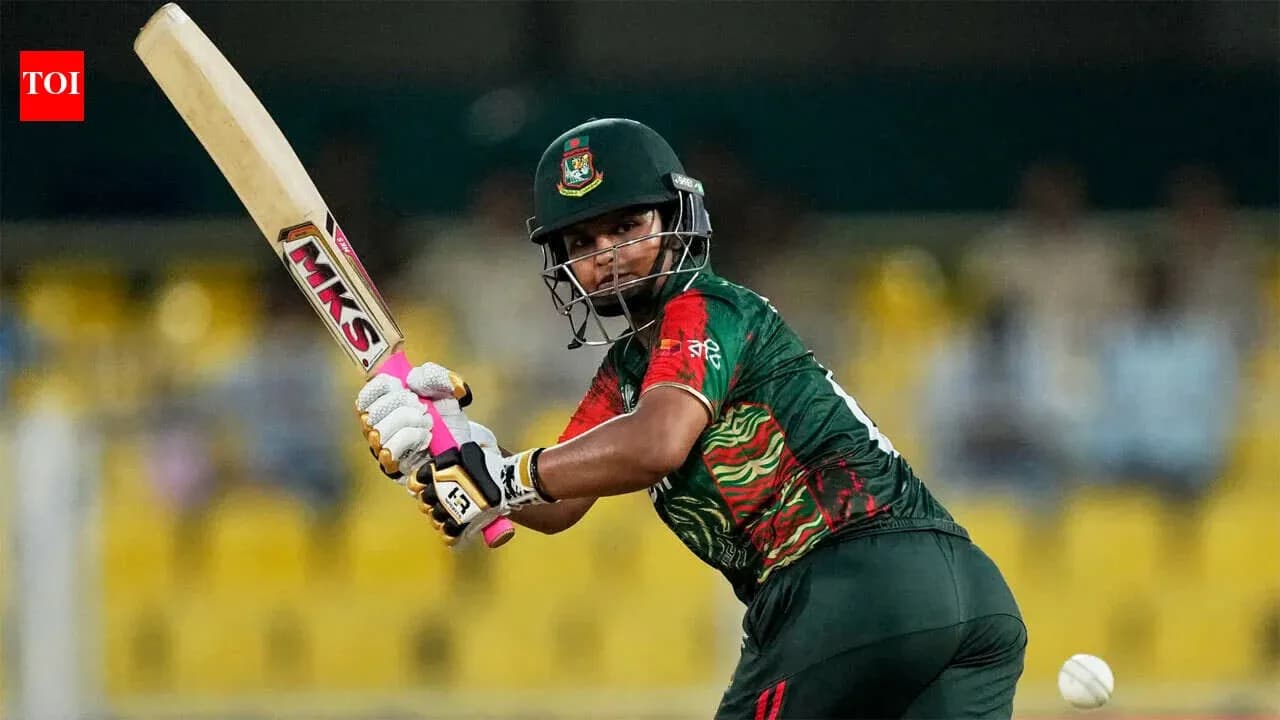
Sobhana Mostary still remembers the noise.
Not the roar in Kuala Lumpur when Jahanara Alam sprinted back for the second run, arms aloft as Bangladesh toppled India in the 2018 Women’s Asia Cup final. Not the fireworks, the photos, the sudden rush of cameras that had rarely turned towards the women’s team before.
She remembers the noise back home.
Phones that wouldn’t stop ringing. Streets where strangers suddenly knew their names. A cricket board that, almost overnight, started treating them like professionals.
“After 2018, we beat India and won the Asia Cup, so it was a huge change in Bangladesh women's cricket. Everything changed. They started giving us lots of facilities, money, everything. There was a lot of change,” Sobhana told TimesofIndia.com ahead of the 2026 edition.
For Bangladesh, that last-ball heist in Kuala Lumpur was a trophy. For Sobhana, it was a turning point in an entire sport.
The night everything shifted
The story has already entered Bangladesh cricket folklore.
In 2018, Bangladesh didn’t just win the Asia Cup. They went through India to do it. Twice.
They stunned the defending champions in the group stage with a seven-wicket win, then came back for more in the final. India posted 112/9. A total that looked competitive on a slow surface, a total Bangladesh had never before hunted down in a match of that magnitude.
The chase went to the last ball. Two needed. Jahanara Alam ran, dived, and history followed.
Bangladesh Cricket Board responded with a Bangladeshi Taka 2 crore reward for the squad. For a team that had often existed on the fringes of the country’s cricketing conversation, it felt like validation.
For Sobhana, the echoes of that night still shape how she sees this tournament.
“We think this Asia Cup, we fight for the title, because if we beat India, so maybe we own the Asia Cup,” she said.
The equation is simple in her mind. Beat India, and everything else starts to fall into place.
A new campaign, a familiar target
The 2026 Women’s Asia Cup brings a different landscape.
Bangladesh sit in Group B with Sri Lanka, Indonesia and the UAE. India, as ever, headline Group A alongside Pakistan, Thailand and Hong Kong. The scriptwriters will have to wait: any meeting between Bangladesh and India can only happen in the knockouts.
That suits the narrative just fine. Bangladesh know the path. They’ve walked it before.
The difference now is expectation. Back then, they were the disruptors. Now, they walk into Asia Cups with a history, a standard, and a generation of players who grew up believing that beating India on a big stage is not a fantasy, but a reference point.
Sobhana is one of the faces of that generation.
From village academy to the national jersey
Her journey began far from the bright lights.
As a child, she played everything she could get her hands on – football, badminton, cricket. The ball kept pulling her back to the crease, though, and when she was 10, her father took her to a small cricket academy in their village.
Six months later, her life changed.
She attended a trial for the Bangladesh Krira Shiksha Pratisthan (BKSP), the country’s elite sports institute. She was selected. The village kid packed her bags and moved to Dhaka, without her parents, to chase a game that still didn’t guarantee a future.
International cricket came quickly. Too quickly, perhaps.
Sobhana debuted for Bangladesh at just 16. A dream on paper, a test of patience in reality. For the next three to three-and-a-half years, she travelled with the national side but rarely made the XI.
“It was very difficult. I always travelled with the team, but couldn't play. I just waited and thought that someday the opportunity would come and I could show my strength,” she said.
Those years built something that doesn’t show up in scorecards – resilience, stubbornness, the ability to keep training hard when the team sheet keeps saying no.
‘Day by day, I improve’
Recognition finally started to catch up.
By 2023, the ICC had begun to describe Sobhana as a bright future prospect. The label sits lightly on her shoulders.
“I don't think I have fulfilled my dream and that bright future yet, but day by day, I improve,” she said.
That line could double as a motto for Bangladesh women’s cricket itself. A team that once fought for basic facilities now walks into continental tournaments talking openly about titles.
The growth is visible. So is the gap they still want to close.
Harmanpreet on the wall
For all the rivalry, one of Sobhana’s biggest inspirations wears India blue.
Her childhood idol is Harmanpreet Kaur, the India captain whose bat has scarred bowling attacks across the world. One innings, in particular, is etched in Sobhana’s memory: the unbeaten 171 in the 2017 Women’s World Cup semifinal against Australia.
“That match inspired me a lot, I followed her batting, everything how she controls the match, and now the time how she captains. I just followed everything,” Sobhana admitted.
That’s the paradox of modern sport. The player you study, imitate, and admire is also the one you dream of beating.
Playing India, for Sobhana, is not a burden. It’s theatre.
“For Bangladeshi fans, playing India is a very good match. They are crazy fans and lots of supporters come to watch. It is a normal match, but normally playing India is very interesting and always very exciting for us,” she said.
She doesn’t just look across at India’s batting. She studies their bowlers too. Asked which Indian bowler she would most like to face, she didn’t hesitate: Deepti Sharma.
“Deepti Sharma is always the top bowler in the Indian side, she has played consistently for so many years and improved day by day. I love her bowling,” Sobhana said.
There’s admiration in that answer, but also a hint of challenge. To want to face the best is to believe you belong at that level.
A session with Wolvaardt, a dream delayed
Harmanpreet may be the childhood idol, yet the player Sobhana most wants to train with comes from another continent.
“I want to practise with Laura Wolvaardt, I really like her batting, and she's also a good human being,” she said.
Wolvaardt’s calm, technical precision at the top of the order has become a template for young batters worldwide. Sobhana sees that and wants to tap into it, to refine her own game as she moves from “prospect” to “pillar” in Bangladesh’s batting lineup.
Those ambitions sit alongside another life she might have lived.
There was a time when cricket was not the obvious path. When asked what she might have become had she not chosen the sport, Sobhana’s answer came quickly.
“Maybe a doctor, because my mother wanted me to be a doctor,” she said.
Medicine’s loss has been Bangladesh cricket’s gain. The teenager who once left home at 16 to chase a fragile dream now stands as a regular international, with years of struggle behind her and a major tournament in front of her.
“I struggled for three or four years, but now I have improved,” she said.
The 2026 Women’s Asia Cup offers another familiar storyline. India, again, stand somewhere on the horizon. The groups keep them apart for now, but knockout cricket has a way of pulling old rivals back together.
Bangladesh know what that kind of meeting can do for a team, for a country, for a young batter still chasing her ceiling.
They’ve lived it once.
The question now is simple: can Sobhana Mostary and this Bangladesh side script another night that changes everything?