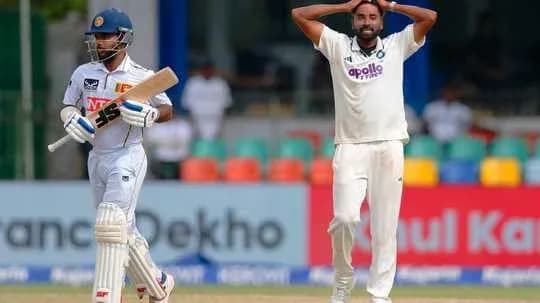
Sonal Dinusha walked off the SSC outfield with his bat raised and his shirt soaked, not in triumph, but in something almost as valuable for a young Test side: survival.
Across seven hours in Colombo, the left-hander turned what looked like a formality into a slow, stubborn unraveling of India’s plans. Asked to follow on, Sri Lanka were expected to fold. Dinusha’s unbeaten 133 said otherwise, dragging his team to safety and snapping India’s perfect record of eight wins from eight when enforcing the follow-on against Sri Lanka.
A chase that never came
India began the final day with the script in their hands. Four wickets. A wearing pitch. A deep, varied attack. One good burst and they would be padding up for a modest chase.
Instead, they spent the morning watching the game drift away.
Dinusha and Keshara Nuwantha, the overnight pair, settled in and stayed there. The second new ball arrived within half an hour, seamers and spinners rotated, fields were tweaked, but the partnership refused to crack. On a surface offering some turn but honest pace and bounce, Sri Lanka’s seventh-wicket duo trusted their defence and their patience.
The stand crept to 88, spread over more than 40 overs. It wasn’t pretty. It didn’t need to be. Every leave, every dead bat, every nudged single chipped away at India’s advantage and, crucially, wiped out the first-innings deficit.
Only after lunch did India finally pry it open. Manav Suthar found the bite he had been searching for, ripping one sharply back at Nuwantha. The outside edge flew to second slip and India had their breakthrough at last.
India keep pushing, Sri Lanka keep breathing
With the deficit erased, Sri Lanka’s mission shifted from repair to resistance. Prabath Jayasuriya, no stranger to long days with the ball, now had to offer them with the bat. He lasted 28 deliveries, a small but valuable contribution in the context of time, before Ravindra Jadeja drew the edge and Dhruv Jurel accepted another catch at second slip.
By then, Sri Lanka’s lead had stretched past 150. India still had time and incentive. Two wickets, almost a session and a half, and a target that could still be chased briskly. The fielders closed in again, the bowlers circled.
Dinusha did not flinch.
He had already soaked up hundreds of balls. Now he found a new ally in Lahiru Kumara, a fast bowler by trade, a blocker by necessity. Together they turned the final act into a test of endurance.
Kumara digs in, Dinusha rises
Kumara’s technique was simple but effective. He trusted the sweep against the spinners, getting low, rolling his wrists, smothering the turn. Dinusha, at the other end, mixed stout defence with calculated release shots, always aware that the clock was his real partner.
The pair put on just 47 runs. On paper, it looks modest. In reality, it was suffocating. They consumed 169 deliveries, each one another small cut to India’s hopes.
During that stretch, Dinusha’s innings moved from admirable to exceptional. He brought up his century in the middle of that attritional stand, raising his bat after hours of graft. No wild celebration, just a quiet acknowledgement that the job was not done.
Kumara almost undid some of that work with one rush of blood, slog-sweeping a chance out to deep midwicket soon after the hundred came up. Jurel charged in, but the ball dipped in front of him. A half-chance, and a reminder that even the most disciplined resistance can wobble.
When Kumara finally fell for 12, inside-edging to short leg where Yashasvi Jaiswal snapped up the catch, India sensed one last opening. The lead was healthy, but not monstrous. Time, though, was slipping.
India’s last push, Dinusha’s last word
From there, Dinusha shut the door. No late collapse, no drama. Just calm, controlled batting as the overs ticked away. The bowlers kept coming, the fields stayed attacking, yet the scoreboard’s most important number was the one that kept shrinking: balls remaining in the match.
By the time the final overs drifted into formality, India’s chance of a whitewash had disappeared with the light. Sri Lanka, battered earlier in the series, had found a spine when they needed it most.
Dinusha walked off unbeaten, 133 not out next to his name, having carried Sri Lanka through a day that began with anxiety and ended in quiet satisfaction. India, so used to finishing these jobs once they’ve enforced the follow-on, were left with a rare blemish and a reminder that in Test cricket, one man’s vigil can rewrite an entire narrative.