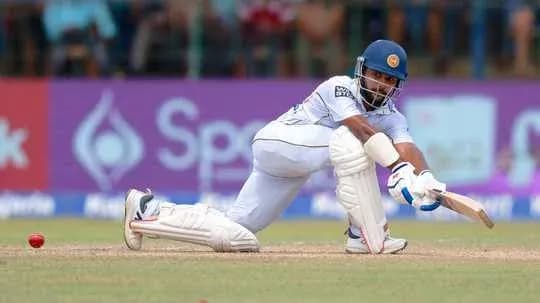
Sonal Dinusha walked into this India series with three caps, a modest reputation and no hiding place. Four innings later, he walked out with 420 runs, three centuries and the look of a batter who has already worked out how to live in the deep end.
The series did not give him a win. It gave him something more durable: proof that his game, and his temperament, belong at this level.
Owning the toughest length
On Sri Lankan pitches, spinners live in the 3-5m zone. That’s the length that makes batters grope, push, second-guess. Handle it, and you survive. Dominate it, and you dictate terms.
Dinusha did more than handle it.
He scored 182 runs off good-length balls from spin, averaging 91 at a strike rate of 58.89. The series baseline for that length sat miles below him – an average of 26.42, a strike rate of 45.36. Nobody on either side scored more runs from that band. Only Niroshan Dickwella, in a much smaller sample, scored faster.
Even Player of the Series Devdutt Padikkal, the most polished Indian batter on show, could not quite match those numbers on that length, averaging 69.50 at 49.82. Against the hardest questions, Dinusha’s answers were the most emphatic.
The secret was where he chose to meet the ball. His average interception point against good-length spin was 2.64m from the stumps – the farthest of any batter in the series. Padikkal, who often preferred to sit back, was at 2.02m. Dinusha went looking for the ball, not waiting for it to ambush him.
Only 43.4% of good-length deliveries to him were met in the so-called danger zone between 1.5m and 3.5m. That was the lowest figure among Sri Lankan batters and bettered by only three Indians: Padikkal, Rishabh Pant and Ravindra Jadeja. While others were trapped in that indecisive corridor, Dinusha was either well forward or decisively back, taking the uncertainty out of the equation.
Front foot, small frame, big methods
Among batters who faced at least ten overs of spin, Dinusha played 73.6% of balls off the front foot. Only Shubman Gill, at 77.3%, went forward more.
Gill can lean on his height and reach. Dinusha cannot. Listed at five foot six, he had to manufacture his range, and he did it with two weapons: the charge and the sweep.
He advanced to 12% of the balls he faced, second only to Pant’s 13.3%. His sweep percentage climbed even higher – 21.6%, the highest in the series. Those are not garnish numbers. That is a game plan.
He attempted 120 sweeps, including reverse and slog-sweeps, and scored 173 runs from them. Both figures are the highest ever recorded in a Test series of any length, eclipsing Joe Root’s famous sweepathon in Sri Lanka in 2021. Against all four of India’s frontline spinners, he scored at better than a run a ball through that one family of shots.
The 4-5m band, which troubled so many others, barely laid a glove on him. That length produced 27 wickets at 21.14 across the series. Dinusha faced 212 balls there, scored 125 runs and fell only once. He did not retreat into his shell. He attempted 53 sweeps for 87 runs from that band and came down the track to 32 deliveries. When the ball landed in the most dangerous area, he responded with his boldest options.
Taking on Jadeja, and winning the argument
Doing this against Ravindra Jadeja made the method stand out even more. Jadeja’s pace, angle and relentless trajectory often bully visiting batters into submission. Dinusha refused to be pinned.
He attempted 34 sweeps against Jadeja – the most sweeps any batter has played off him in a single series in the subcontinent. He also advanced down the pitch to 36 of Jadeja’s deliveries, a figure that almost matches Michael Clarke’s tally of 38 across five innings in India in 2013.
This was not a young player slogging in panic. It was a calculated attempt to rip Jadeja out of his preferred length, to force a bowler renowned for control into uncertainty.
Eighteen of Dinusha’s 30 boundaries against spin came through sweeps or their variants, most of them in front of square on the leg side. He mixed in paddles, conventional sweeps and reverse sweeps, and on four separate occasions he opened a new session with a slog-sweep to the midwicket boundary. That is a statement, not a flourish.
Those strokes did more than decorate the scorecard. They pushed fielders into awkward spots, dragged midwicket deeper, pulled fine leg finer, and made captains rethink their plans. Once that happened, once the fields and lengths began to bend around him, Dinusha moved into his most efficient mode.
Runs without fireworks
With gaps opening, he did not chase glory balls. He nudged, pushed, worked the angles. Singles and twos came in a steady stream. The scoreboard never felt stuck.
His innings were not built on a blur of boundaries. Only 4.98% of the balls he faced went to the fence, the second-lowest boundary percentage among specialist batters who faced a substantial volume in the series. Only Jadeja, a man known for attritional accumulation, sat below him.
The contrast was striking. A batter sweeping more than anyone else, stepping out as much as almost anyone else, yet scoring in a way that rarely relied on repeated fours and sixes. Risk where it counted, restraint where it didn’t.
Perhaps the most revealing detail lies in what he refused to play. Across pace and spin, Dinusha did not hit a single boundary through the front-of-square off side. The drive through cover and extra-cover, the glamorous TV shot, simply did not feature. He cut that option out, along with the edges, the misjudged reaches and the airy wafts that so often accompany it.
It was a young player stripping his game down to what works in these conditions, against this attack, at this moment in his career.
Sri Lanka did not find a series win against India. They may have found something more precious: a batter who already understands how to bend world-class spin to his will, and who is willing to leave entire scoring zones untouched if that is what survival and dominance demand.