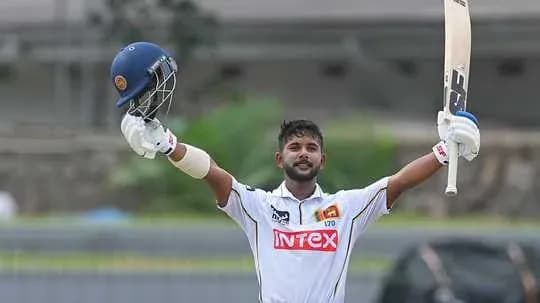
Sonal Dinusha was getting bounced out of his comfort zone.
Darwin, July 2025. Sri Lanka A against Australia A. A tall, hostile pace unit – Mitchell Perry, Liam Scott, Henry Thornton – hammering the short ball into a surface that seemed to rise with them. Dinusha, diminutive and pinned on the back foot, looked stuck.
The response told you more about him than the struggle.
"They were bowling bouncers, he was kind of struggling. So we just went, threw a few balls, had a chat with him, just sorted out what he was going to do, the tactical part of it. And then he went on," recalls Avishka Gunawardene, then Sri Lanka A coach.
He did more than “go on”. A 145-ball 105 in the first unofficial Test. A 191-ball 88 in the second. First time batting in Australia, first time dealing with that kind of relentless short-pitched assault. The adjustment was swift, clinical, almost cold-blooded. It fit the pattern. This is the Dinusha template: find the flaw, fix it, move forward.
Built in the schoolyard furnace
Dinusha is not a product of chance. He is a product of Sri Lanka’s school cricket machine, that sprawling, fiercely competitive structure that has fed the national team for generations.
He began at De La Salle College in Colombo, a young boy with a bat and an unusual intensity. From there, he moved to the more illustrious Mahanama College, the same institution that shaped his current Test captain, Dhananjaya de Silva. At both schools, he found a mentor who shared not just his first name, but his obsession.
"Dinusha began playing cricket there [De La Salle College] at the age of 12, and I worked with him from that time onwards. I was drawn to the enthusiasm he showed at such a young age," says coach Sonal Dulshan Elwalage, an SLC Level 2 coach whose own playing career had been cut short by family hardship. Coaching Dinusha became his way back into the game.
Dulshan watched him grow from a keen schoolboy into a match-shaping presence. One innings from 2020 still glows in his memory. Under-19 Division 1, against Richmond College, Galle. Two-day game. Pressure heavy, scoreboard ugly.
Dinusha walked in at 20 for 3 in the eighth over. By the time he walked off, he had 159* off 227 balls, with 15 fours and four sixes, and Mahanama had secured a first-innings win in the 82nd over. He batted through the innings, through the tension, through the traps. The ability to bat time that the world has seen over the last fortnight didn’t come from nowhere. It was forged in days like these, when staying in was the only way out.
He also showed something else that day: game sense. With the No.11 at the other end, he managed the chase with ruthless clarity, shielding his partner without strangling the scoring. Colombo Cricket Club’s Nisal Akash, batting last, faced just 11 balls across a last-wicket stand that stretched 7.3 overs. Dinusha controlled the tempo, the strike, and ultimately, the result.
A club debut that told a story
Still at Mahanama, he stepped into first-class cricket with Colombo Cricket Club in 2018. Another seasoned voice, Ashan Priyanjan – player, captain, coach at CCC – had a front-row seat to his early steps in the senior game.
"I still remember he batted out of position at No.3. He's a No.6 batter but for the team's balance he batted at No.3 and got a half-century against a good bowling attack," Priyanjan says.
It sounds like a small detail. It isn’t. Young players often cling to batting positions like life rafts. Dinusha moved up two slots without fuss, absorbed the responsibility, and produced runs. The adaptability that now defines his Test batting was already there, quietly embedded.
His cricket education became a relay of mentors: Kalum Gangodawila, Felix Dias, Alan Rodrigo, Tharanga Dhamika. Different voices, same verdict. They talk about his runs, his wickets, his fielding. But they always circle back to the same core.
Work ethic.
"The main thing that I saw in him was he was a very organised cricketer. He was very methodical. He works hard, he knows exactly what he wants. He knows what areas he needs to work on," says Gunawardene. "If there's any doubt, then he'd come and ask me. But if not, he knows exactly what he needs to do in training. He's a very smart cricketer."
The sweep that bent a series
That organisation now has a signature shot. Across two Tests against India, Dinusha has scored 173 runs from one stroke alone: the sweep. Not a novelty, not a party trick. A weapon.
Asked about it after Day 4, he stripped the answer of any romance. "I am good at sweep shot, so I play it. That's all."
Of course, it isn’t “all”. Priyanjan remembers the unseen hours.
"He loved playing the sweep shot. He'd train separately in the nets for it. He would finish batting and then take throwdowns just to play the sweep shot," he says.
Repetition built confidence. Confidence bred clarity. Against India, that clarity turned into control. Bowlers aimed at the stumps or the rough, and he kept dragging them off their lengths, rolling them into the gaps, turning pressure spells into damage limitation for his side. The shot was not just scoring runs; it was rearranging the field and the contest.
Winning over Gary Kirsten
Sri Lanka’s head coach Gary Kirsten saw enough in one series to file Dinusha under a different category.
"The first time I really watched him bat properly was in the first innings in the West Indies. He came in at seven and we were 110 for five. And he put on a hundred (99) with the captain. And I thought, ‘jeez, this guy can play.’ And then in the second match he got 92," Kirsten says.
Those are the kind of knocks that earn you trust in a dressing room. Under pressure, away from home, with the game tilting the wrong way. Dinusha didn’t just survive; he stitched the innings back together.
Kirsten likes what lies beneath the numbers even more.
"I love the way he plays Test cricket. He thinks about it. He plays to his strengths. And he is a smart cricketer. So he understands what the bowlers are trying to do to him. And then he uses his skillsets to communicate that," the South African explains.
Then came the 133 off 264, an innings Kirsten believes "would go down in Sri Lankan Test cricket history as one of the great saves." It was the kind of rearguard that countries remember. Not flamboyant, not reckless. Just stubborn, calculated resistance, backed by hours of preparation and a mind that refuses to panic.
No pause button
The temptation after a series like that is to breathe, to bask. Dinusha doesn’t seem wired that way. Even as he moved towards his third century in four innings, his thoughts were already drifting to the next tournament, the next practice session, the next set of problems to solve.
That is what should excite Sri Lanka Cricket most. They do not just have a precocious talent; they have a worker. A player who comes from a robust system, has been tested at school, club, A-team and now Test level, and keeps responding the same way – by going back to the nets, going back to the drawing board.
Sri Lanka’s structure has done its job in shaping him. The question now sits squarely with SLC.
They have a gem on their hands. Will they give Sonal Dinusha the room, the backing and the continuity to turn this promise into an era?