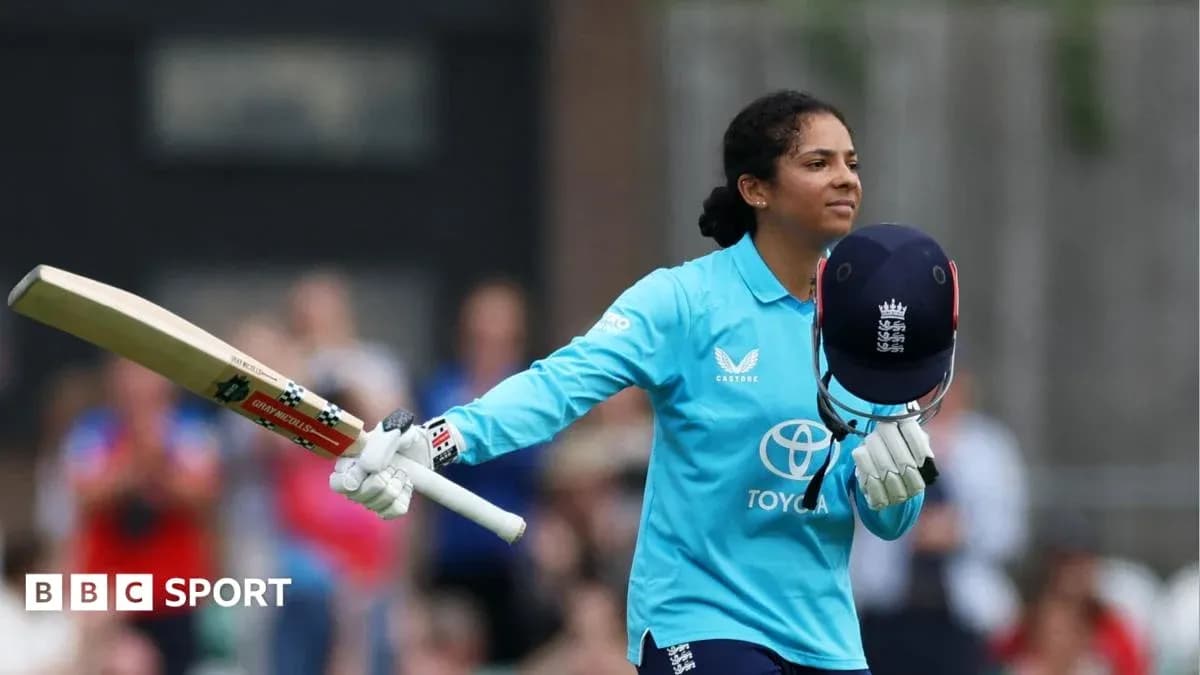
On a grey Worcester afternoon, Sophia Dunkley batted in full colour.
Her run-a-ball 119 at New Road powered England to 291 and set up a commanding 114‑run victory over Ireland in the third ODI, wrapping up a 3-0 series sweep and closing the international summer with authority, if not perfection.
England were bowled out with seven balls unused, their last six wickets tumbling for 31 runs. It barely mattered. The damage had already been done.
Dunkley and Bouchier answer the opening question
This has been a curious series for England: key names such as Lauren Bell, Sophie Ecclestone and Nat Sciver-Brunt rested, a schedule light on 50-over cricket, and an Ashes summer already looming on the horizon. Somewhere in the middle of that, they needed answers at the top of the order after Tammy Beaumont’s retirement.
Dunkley and Maia Bouchier have provided them.
Having threatened in the first two games – 73 at Leicester, then run out in Derby after a mix-up with Bouchier – Dunkley arrived at Worcester looking due. She left with her second international hundred and, more significantly, with a far more rounded game on show.
She began quietly, letting Bouchier dictate the early tempo in a 73-run opening stand. Her fifty came in 63 balls, measured and controlled, before the gears shifted. The next fifty took just 37 deliveries, the innings transforming from steady to commanding.
The most striking change lay in where the runs came from. Dunkley, long tagged as a leg-side player, scored almost evenly on both sides of the wicket. She drove crisply through the off side, pierced gaps square, and forced Ireland to rethink their fields. When they went short and pushed sweepers back, she picked them off, rotating calmly until the bad ball came.
Her dismissal – brilliantly caught by Orla Prendergast at deep square leg in the 36th over – finally removed the anchor. By then, England were 260-4 and eyeing 300-plus.
Middle-order promise, then a late stumble
Bouchier’s own contribution, 39 at the top, continued a quietly impressive run of form. She again looked assured before falling, another start not fully cashed in but part of a partnership that suddenly feels like more than an experiment.
Jodi Grewcock, one of those fringe players given a chance in this series, again showed promise with 35 before being caught and bowled. Alice Capsey’s 10 ended in frustration, run out backing up, a dismissal that will sting given her fight for a permanent spot in the XI and, potentially, the gloves ahead of Amy Jones.
For a while, England’s middle order threatened to turn a strong platform into a statement total. Freya Kemp’s 23 included intent down the ground, Dani Gibson’s 41 – her best in ODIs – hinted at a powerful late-order option.
Then the collapse.
Kemp holed out to long-on and the innings buckled. From 260-4, England slid to 291 all out, a string of single-figure scores following as Ireland finally found a foothold. Leg-spinner Cara Murray led that fightback with 4-56, changing the mood of the innings and restricting England to just seven boundaries after Dunkley’s exit.
For all that late-innings waste, the scoreboard still felt heavy. On this pitch, with this attack, 292 to win was never going to be a gentle chase.
Ireland outgunned as Filer and Villiers close it out
Ireland needed a bright, almost fearless start. What they found instead was a slow squeeze.
Amy Hunter top-scored with 39 from 58 balls, but no batter managed a strike-rate over 100. The chase never caught fire. The required rate crept, then climbed, then disappeared over the hill.
Lauren Filer and Mady Villiers did the bulk of the damage with three wickets apiece, Filer’s pace and bounce too much at times, Villiers’ control tightening the noose through the middle overs. Ireland battled to 177 in 44.2 overs, but the contest had long since drifted from them.
This was the pattern of the series: Ireland spirited, Murray again impressive with the ball, but outmatched across 50 overs. The gulf in depth, power and experience showed.
An experimental summer, a clearer picture
Strip away the margin of victory and this series has carried a strange sort of tension for England. They are experimenting with personnel while knowing they have precious few ODIs to do it in. Their next confirmed fixtures are at the Champions Trophy in February, with a multi-format series against West Indies and three ODIs against Sri Lanka pencilled in but not yet dated. Their next home ODI? The Ashes next summer.
So every innings, every spell, has carried a little extra weight.
The opening partnership looks closer to settled. Dunkley and Bouchier have both made centuries in this series, both taken their chance in Beaumont’s old role. The caveat is obvious: Ireland’s attack is not Australia’s. No one in this dressing room will pretend otherwise. But you can only play what’s in front of you, and England’s new pairing have at least put down a marker.
Further down, the questions remain more complex. Sciver-Brunt will walk straight back in at number three when available. Capsey’s role is more fluid. Does she keep the gloves and offer balance, or does Amy Jones reclaim them and push Capsey into a more specialist batting and spin role? Gibson’s rise, Kemp’s power, Grewcock’s promise, Tilly Corteen-Coleman’s exposure to international cricket – all of it feeds into a puzzle that coach Charlotte Edwards must solve with limited pieces of evidence.
What Worcester did provide was clarity on one front. England needed a statement from someone at the top of the order. Dunkley delivered it, with a bat that looked more complete than at any point in her international career.
The international summer ends with a clean sweep, a refreshed depth chart, and a top order that suddenly feels less like a problem and more like a platform. The next time England walk out for a home ODI, it will be against Australia.
By then, we will find out just how much this September in Worcester really meant.