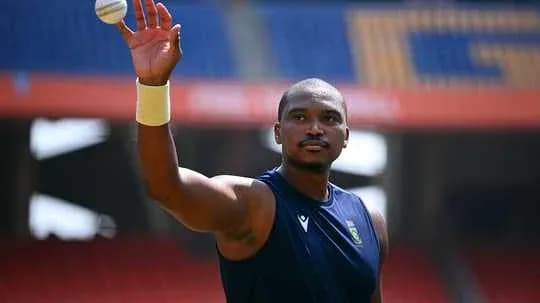
Lungi Ngidi has limped into a club no fast bowler wants to join. The roll of honour is short, exclusive and expanding far too quickly for South Africa’s liking. Its common entry requirement? A damaged hamstring.
Ngidi on Friday became the latest quick ruled out of the ODI series against Australia, which starts at Kingsmead on Thursday. He joins Kagiso Rabada, Ottneil Baartman and Lutho Sipamla on the treatment table with the same injury. Only Nandré Burger is there for a different reason, an aggravated back problem that refuses to go away.
Four hamstrings, one back. One big headache.
A pattern South Africa didn’t need
This isn’t freakish bad luck, says Shuaib Manjra, Cricket South Africa’s former chief medical officer and long-time national men’s team doctor. It’s timing.
“It’s not surprising, because if you look at any sport there are two peaks in hamstring injuries — the beginning of the season and the end of the season,” Manjra told Cricbuzz.
At the start of a campaign, players go from downtime to full tilt. The load spikes, the intensity jumps, and bodies that have enjoyed a break are suddenly asked to sprint, twist and explode again. Late in the season, the same muscles are simply tired. Fatigue bites, and fibres go.
“So it’s not surprising,” Manjra said. The science is cold. The consequences are anything but.
Ngidi’s injury came in Centurion last Friday, in the opening round of first-class fixtures, turning out for the Titans against the Dolphins. CSA have not put a date on his return, just as they have stayed silent on whether Rabada will be ready for the Test series against Australia starting in Durban on October 9.
That silence speaks loudly. The Tests matter. A lot.
Tests over ODIs, every time
On paper, this is an ODI series against a major rival. In reality, it’s a staging post on the road to something far more important.
South Africa are defending World Test Championship winners, their only senior global title, earned by beating Australia in the final at Lord’s in June last year. That status colours everything. A “relatively random” ODI rubber, as some inside the camp privately describe it, cannot compete with a home Test series against the same opponents.
Which is why a five-second social media clip of Rabada bowling this week – a gentle spell off a short run-up – has been treated like a small national event. No snarling pace, no full rhythm, just the sight of South Africa’s spearhead back at the crease. For a cricket public suddenly obsessed with soft-tissue injuries, it felt like a sliver of daylight.
But the issue now isn’t only whether these bowlers can bowl. It’s whether they can bowl enough.
Rabada hasn’t played any form of cricket since May. Burger last turned out in June. Sipamla only returned to action last month after being sidelined since July. Baartman, before last week, had also been out since July. They’re not just injured; they’re undercooked.
To get them back, South Africa need to do what fast-bowling coaches have preached for generations: build workloads, spell by spell, over by over. Get “overs in the legs”, as the old line goes. Except when the hamstring has already gone once, every extra stride carries a question.
The danger of coming back too soon
“The other risk for a hamstring injury is a previous injury,” Manjra said. “You’re more likely to pick up another injury if you go back too early.
“Doctors have a saying that the highest risk of an injury is a previous unrehabilitated injury. So we have to ensure that the player is fully rehabilitated, otherwise they are vulnerable.”
That warning hangs over all of South Africa’s quicks, but Ngidi’s case sits slightly apart.
He has not been easing into the season. He played six ETPL games for Glasgow Cosmic between August 27 and September 6, sending down 120 of a possible 144 balls. That’s a solid workload without being extreme, a steady runway into the domestic summer. He was not short of game time. He was not short of rhythm.
Yet his hamstring still went.
Franchise cricket and the fine line
That reality fuels a familiar argument. Should Ngidi have been in franchise cricket at all so close to a packed international schedule that includes eight Tests? Was he cashing in at precisely the time he ought to have been on a carefully managed pre-season programme?
The counterpoint is just as blunt. Would those questioning his choices be willing to pay him what he would have lost by skipping the ETPL? Ngidi is a professional cricketer, not a centrally contracted robot. Careers are short. Opportunities are finite. The balance between workload management and earning power is not theoretical for the men in the middle.
For CSA and the national selectors, theory has given way to emergency practice.
Nqobani Mokoena has been drafted in to replace Ngidi in the ODI squad. Gerald Coetzee comes in for Rabada. Duan Jansen covers for Baartman. Sipamla and Burger were not in the original ODI plans, but both would have been front of mind as back-up options had their bodies held up.
Instead, South Africa will face Australia with an attack led by Marco Jansen, the left-arm allrounder suddenly elevated from supporting act to headline seamer. Corbin Bosch and teenage quick Kwena Maphaka are also in the frame, promising talent asked to grow up quickly against one of the most ruthless batting line-ups in the world.
The hamstring club keeps growing. The question now is whether South Africa’s next wave of fast bowlers can keep the season from unravelling before the real battle – those home Tests against Australia – has even begun.