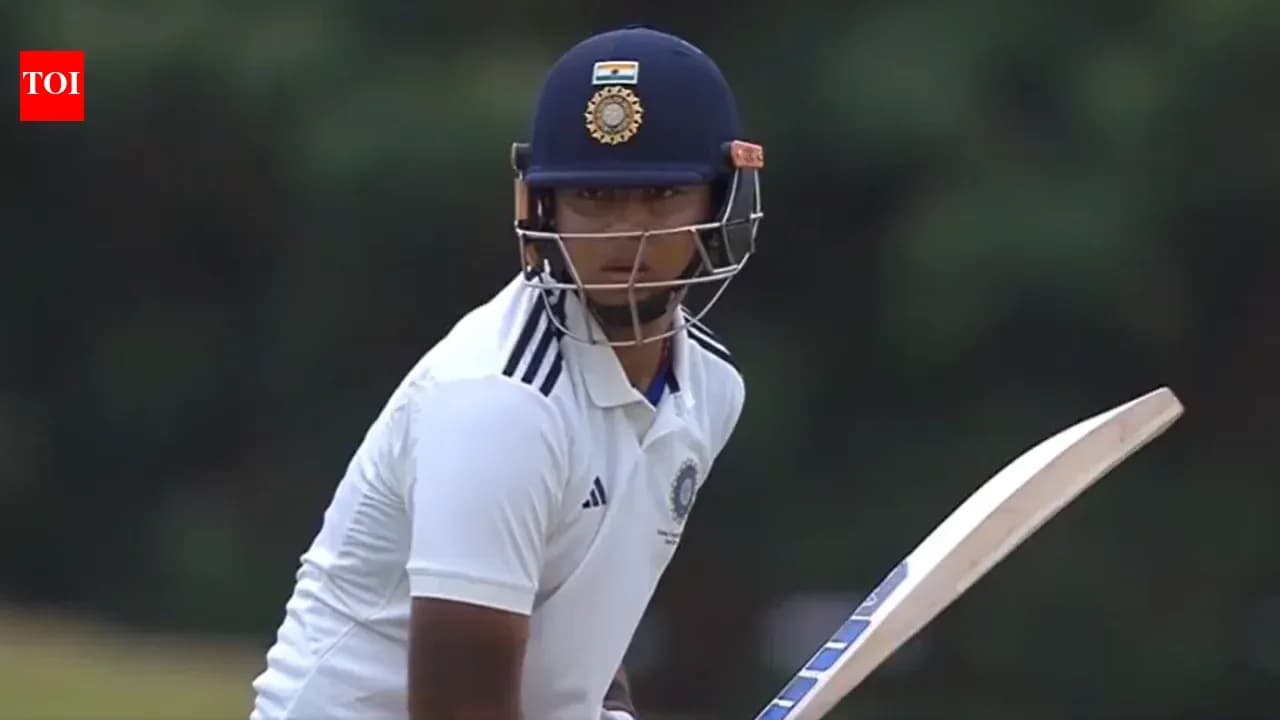
In Bengaluru, under the hard afternoon light and the weight of 57 years of history, a 15-year-old walked out and batted as if none of it applied to him.
Vaibhav Sooryavanshi, all of 15 years and 175 days, has become the youngest batter ever to score a half-century in the Duleep Trophy, rewriting a record that had stood since 1969. He didn’t just sneak past it. He tore into it.
His fifty came in a blur – 42 balls, raised with a six – in East Zone’s semi-final against Central Zone in the 2026 Duleep Trophy at Bengaluru. He kept going, too, racing to 92 off 81 deliveries before falling agonisingly short of a century. The numbers tell part of the story. The manner of it told the rest.
A record that outlived generations
For more than half a century, Laxman Singh’s name had sat untouched in the Duleep Trophy record books. Singh was 16 years and 23 days old when he made his fifty in 1969. Piyush Chawla followed decades later, reaching his Duleep Trophy half-century at 16 years and 307 days in 2005.
Sooryavanshi has pushed them both down the list.
Youngest to hit Duleep Trophy fifty
– Vaibhav Sooryavanshi: 15 years 175 days
– Laxman Singh (1969): 16 years 23 days
– Piyush Chawla (2005): 16 years 307 days
The gap is stark. A full year younger than Singh, nearly a year and a half on Chawla. This isn’t just a nudge of a record; it’s a statement about how early his game has matured.
His 92 was built on aggressive strokeplay and sharp game sense, arriving at a point when East Zone needed someone to seize control of the semi-final. He did not bat like a passenger in a strong side. He batted like the driver.
A teenager with the armband
The semi-final had already handed him an unusual responsibility before he picked up the bat.
On Day 1, East Zone captain Ishan Kishan left the field in the morning session after being struck on his right wrist. In the kind of scene that usually belongs to seasoned pros, not school-going hopefuls, Sooryavanshi stepped in as stand-in captain for roughly an hour on either side of lunch.
He didn’t just wear the armband. He used it.
In the 40th over of Central Zone’s first innings, opener and wicketkeeper Aryan Juyal was on 46, feeling set and looking dangerous. Mukesh Kumar found the outside edge with a ball outside off, East Zone went up in appeal for caught behind, and the umpire stayed unmoved.
Most 15-year-olds would look around, wait for a senior’s call. Sooryavanshi backed his own reading of the moment and went upstairs. The DRS told the story he believed it would: UltraEdge showed a faint spike as the ball passed the bat, the decision was overturned, and East Zone had a crucial breakthrough.
It was a small passage of play in the scorebook. It felt much bigger in the context of the match – and in the context of a teenager’s rise.
Bowlers set it up, batters take over
East Zone’s position of strength began with the ball. After Kishan won the toss and chose to field, his attack responded with a disciplined, incisive performance that never really let Central Zone breathe.
Mukesh Kumar and Abhijit Sarkar shared the new-ball responsibility and finished with three wickets each, prising out early inroads and chipping away whenever Central tried to rebuild. Mohammed Shami, the senior spearhead, added two wickets of his own, while off-spinner Md Kounain Quraishi also struck twice as Central Zone were bowled out for 266 in 80.1 overs.
Central’s innings flickered rather than roared. Rinku Singh top-scored with 60 off 88 balls, fighting hard to drag his side to something competitive. Juyal’s 46 had given them a decent start before that DRS intervention cut him off. When Central slipped to 125 for 5, the innings threatened to unravel completely.
Rinku found some resistance in Harsh Dubey. The pair stitched together a 55-run stand for the sixth wicket, Dubey contributing 27 and helping drag the total towards respectability. Quraishi broke that partnership in the 60th over, trapping Dubey lbw and triggering another slide.
From there, it was scraps. Saransh Jain made 13, Aryan Pandey 22. Yash Thakur swung late, punching 30 off 26 balls to squeeze out a few more runs. But each time Central hinted at recovery, East Zone’s bowlers cut them back down. The innings ended on 266 – a total that looked more like a platform for East Zone than a target to fear.
And that’s exactly what it became.
A semi-final he won’t forget
By the time Sooryavanshi walked out to bat, he had already left his fingerprints on the game as a stand-in captain and decision-maker. A day later, he added the kind of innings that will follow him around for years.
He started briskly, then accelerated. The fifty came in 42 balls, the milestone raised with a six that underlined his intent. He kept pressing, turning a promising start into a commanding 92 off 81 balls, peppered with attacking strokes and an authority that belied his age.
For East Zone, it was exactly what the situation demanded: a young batter taking advantage of the bowlers’ work, turning a good position into control of the semi-final. For him, it was something even more significant – a record-breaking performance in a marquee domestic tournament, delivered under pressure, with the eyes of selectors and seasoned pros on him.
Only one thing was missing. The century.
He fell eight short of three figures, the only blemish on an innings that otherwise felt like a coming-of-age. The disappointment will sting. It should. That’s what makes players come back for more.
But on a semi-final stage, at 15 years and 175 days, with a captain’s armband briefly on his arm and a 57-year-old record now behind him, the question isn’t what he missed.
It’s how far, and how fast, he’s going to go from here.