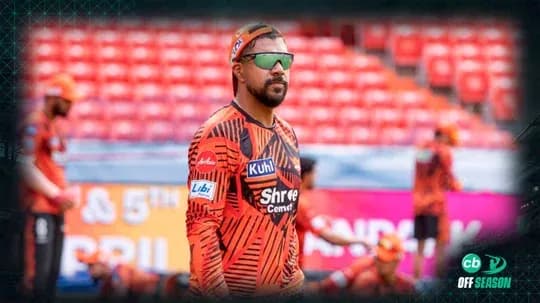
Varun Aaron wasn’t looking for a job when the phone rang. He was 35, freshly retired, happy behind a microphone, not a dressing-room door. Coaching, at least in any formal sense, was something other people did.
The call was from Daniel Vettori.
One conversation later, Aaron’s life had shifted from commentary boxes to the Sunrisers dugout.
From self-coached survivor to franchise coach
Aaron’s playing career was shaped as much by scans and rehab rooms as it was by wickets. Stress fractures, long layoffs, technical tweaks – all of it forced him to study his own body and action in forensic detail.
"I think I've coached myself quite a bit because of the amount of injuries I've had," he says. The line lands with the weight of experience, not self-pity.
Even while he was still playing for Jharkhand, teammates would drift towards him, asking for a look at their run-up, a thought on their wrist position, a word on how to hold pace through a long spell. He found that he liked it – the quiet satisfaction of helping someone else find an extra yard, an extra option.
Coaching, then, was never a declared ambition. It was just something that kept happening around him.
That instinct eventually took shape in brick and mortar. The new MRF Pace Foundation High Performance Center was his project from the ground up – design, protocols, programme, even the redevelopment of the ground and gym. It was his way of paying back the academy that had once polished him. A stint as bowling consultant with the Jharkhand State Cricket Association followed.
Still, there was no masterplan.
"After retiring, I really was not setting out any targets," he says. No five-year roadmap, no “next chapter” slogans. "All I wanted to do was enjoy myself after retiring, and whatever came about after that just happened on its own. And then one day, Dan rang me up and asked me if I was interested to coach Sunrisers."
He said yes.
Building a bowling group from scratch
Year one with Sunrisers came with a clear brief: help shape a bowling unit and prepare the young quicks. Crucially, Aaron had a voice at the auction table.
Praful Hinge and Sakib Hussain were two of the names he pushed. Not because of what they were, but what they could be.
"What I saw was not what they were doing, but what they could do," he explains. He believed there was a version of their bowling they hadn’t yet accessed. "I'm glad it just worked out."
It worked out quickly. Against Rajasthan Royals, both Hinge and Sakib ripped through the opposition, each taking four wickets in their first IPL game. It looked like a breakout. It was also the end product of weeks of preparation that had to be squeezed into an unusual schedule.
Aaron was still broadcasting the T20 World Cup at the time. So he improvised. Some days he’d bring Sakib to Mumbai, talk into a mic in the morning and into a bowler’s ear in the evening. On other days, he’d coach first, then dash to commentary.
As the World Cup calendar tightened and travel ramped up, he needed help. He sent Hinge and Sakib to the Rao Cricket Academy, into the care of SS Rao – his former Jharkhand captain and someone he trusted to follow the plan, not rewrite it.
"Me and SS Rao have a brotherly relationship," Aaron says. He laid out a clear set of instructions. Rao stuck to them. The experience and presence of the older man did the rest, adding a layer of energy and authority that young quicks tend to respond to.
Hinge and Sakib were the headline acts, but not the only finds.
"I think Shivang [Kumar] was unbelievable as well," Aaron notes. Then there was Onkar Tarmale, who didn’t get to show himself after an ill-timed injury but, in Aaron’s words, is someone who can “move 145”. The phrase says enough: serious pace, serious potential.
"We had some really good, interesting picks."
Freedom, trust and a ‘free hand’
Plenty of coaches talk about alignment. Aaron actually felt it.
"When you're empowered by the head coach and the team owner in that fashion, I really feel your job becomes all that much easier," he says. In his first year, he was given what he calls an almost free hand. That sort of latitude is rare in the IPL, especially for a rookie coach.
He used it.
"Through that, I just felt I could express myself creatively in whatever I did and it was a lot of fun."
Fun is an odd word in a world of spreadsheets, match-ups and pressure, but it fits the way he thinks about fast bowling. Strip away the jargon and, for him, the craft is built on clarity.
"Fast bowling is really simple, but I think as a player you complicate it a lot," he says. Young quicks chase magic balls, new grips, different angles. Aaron keeps dragging them back to the basics.
At the core, he believes, are a few non-negotiable principles. Get those right and the game becomes lighter, more enjoyable, more repeatable.
One method? No chance
Simple doesn’t mean uniform. Aaron rejects the idea of a single template.
"There's no set method to coaching. It completely depends on the individual," he insists. The first job is to find what’s unique about a bowler and turn the volume up on that trait. Then, quietly, you iron out the inefficiencies.
Some bowlers arrive with a “beautiful action” and the ability to execute what they see in their head. Others carry a medical file and a body that fights their ambition. Those are the ones who need more work – technical, physical, sometimes mental.
"Everybody's different. Every bowler presents differently," Aaron says. For him, the future of coaching lies in treating every bowler as a separate project – different musculature, different mind, different coordination, different biomechanics.
The same nuance runs through the way he looks at performance.
He doesn’t like lazy labels.
"I genuinely think that you can't look at somebody's performance and be like, 'Oh, that was a bad performance' or 'that was a good performance'." For a coach, the job is to dig out the reasons. If it’s a good day, make sure the bowler knows why. If it’s a bad one, find the lesson.
The danger, he warns, is drifting: "If you just meander along day after day, just bowl, go home, bowl, go home, then it doesn't really add up to anything."
The lure – and limit – of the speed gun
Few Indian quicks know the pull of the speed gun like Varun Aaron.
His own career took off when he clocked 153kph in the 2010/11 Vijay Hazare Trophy final, at a time when genuine pace in India was still a rarity. Young fast bowlers still bring up that number when they meet him. They want to know how to hit it, how to go beyond it.
He gives them an answer that sounds more like batting theory than fast-bowling bravado.
"Fast bowling is all about timing," he says. Just as a batter needs to time the initial movement into a balanced, stable position, a bowler’s timing before release has to be immaculate. Get the sequencing right and you unlock three things: maximum pace, control over where the ball lands, and a reduced risk of injury.
"If your timing and the sequencing of your action is right, I think you've won the battle," he says. You will bowl as fast as your body allows. Not as fast as the speed gun demands.
That tension – between what the mind wants and what the body can sustain – haunted his own journey. After his Ranji debut in 2008/09, three stress fractures of the back stalled his rise. A Test debut in 2011 was followed by another long break, almost three years between his first and second Test because of more back trouble.
Now he stands on the other side of the rope, trying to help the next crop chase speed without breaking themselves.
Between commentary boxes and nets
His calendar is brutal. Coaching assignments, IPL, domestic work, plus broadcasting gigs that take him across formats and continents.
"How do I balance that? That's a question you have to ask my girlfriend because she's not the happiest customer – I'm hardly at home," he says, half-joking, half-admitting the cost. He is trying to carve out more time for her and his family. For now, the game still wins most of the arguments.
The double life has its advantages.
Coaching has sharpened his eye as a commentator. "When you coach them, you know the inner depths of their mind," he says. You learn what a bowler reaches for under pressure, which field he wants for which delivery, what his “get-out-of-jail” option is.
That knowledge makes him more predictive on air, less speculative. It’s not guesswork when you’ve seen the training ground version up close.
The flow runs both ways. Broadcasting keeps him plugged into players and trends across competitions. He’s constantly watching, cataloguing, comparing – information that feeds back into his coaching.
A job he never planned, and doesn’t want to leave
For someone who never set out to be a coach, Aaron talks like a man who has found his place.
"What it has taught me about myself is that coaching gives me immense happiness," he says. The joy, for him, isn’t in the highlight reel but in the debrief – that conversation after a session when a bowler tells him they’ve hit every target they set.
For a fast bowler whose own career was a battle between talent and time, there’s a certain symmetry in that. He once chased the perfect spell for himself. Now he chases it through others.
And with franchises trusting his eye, young quicks buying into his methods, and a sport that always needs more pace, the real question isn’t how he got here.
It’s how far this second act can go.