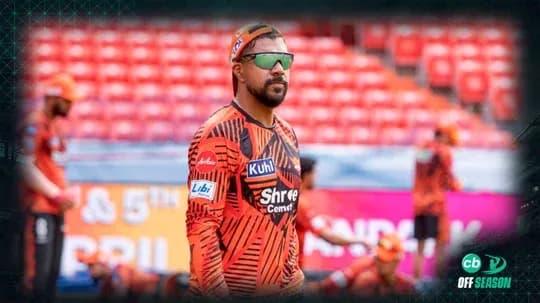
Daniel Vettori’s phone call found Varun Aaron at peace for the first time in years.
He had walked away from professional cricket earlier in 2025, 35 years old and finally free of the grind that had defined his career. Broadcasting suited him. A microphone, a monitor, no stress fractures to manage, no long spells in the sun. Coaching was something he dipped into for friends and teammates, not a roadmap for the next decade of his life.
Then the Sunrisers job landed in his lap.
From self‑repair to shaping a quicks’ room
Aaron spent most of his playing days as both fast bowler and mechanic. Every injury – and there were plenty – forced him to strip his action down, understand his body, and rebuild.
“I think I've coached myself quite a bit because of the amount of injuries I've had,” he says. That self‑study bled naturally into helping others. Jharkhand teammates, younger quicks, anyone who asked. He would watch, tweak, explain. No title, no designation. Just a fast bowler trying to keep others from making the same painful mistakes.
There was structure too, even if he didn’t initially label it as coaching. The new MRF Pace Foundation High Performance Center was his project from the ground up – design, protocols, programme, even the ground and gym redevelopment. It was his way of paying back the academy that had shaped him. A stint as bowling consultant with the Jharkhand State Cricket Association followed.
Yet retirement arrived with no five‑year plan. No whiteboard of targets.
"I really was not setting out any targets," he says. "I was not thinking, 'I want to coach, I want to commentate.' After having a journey which was hampered by injuries throughout, all I wanted to do was enjoy myself after retiring, and whatever came about after that just happened on its own."
Then came Vettori. One call. One question: would he like to coach Sunrisers?
Building an attack from a blank sheet
Aaron’s first season with Sunrisers started not in the nets, but in the auction room. He wasn’t just a bowling coach; he was a selector of raw material.
Praful Hinge and Sakib Hussain were two of the quicks he pushed for. Not because of what they already were, but because of what he could see beneath the surface.
"What I saw was not what they were doing, but what they could do," he says. “I had a feeling that we could achieve what I could envision they could do, which they weren't doing. I'm glad it just worked out."
It worked out spectacularly. Against Rajasthan Royals, Hinge and Sakib both ripped through line-ups with four-wicket hauls in their first IPL game. A debut statement, but not an accident.
By then, Aaron had already put in the hard yards with them. The catch: he was juggling it with a second job. During the T20 World Cup, he was on commentary duty, so coaching sessions were squeezed into the gaps. Some days he’d bring Sakib to Mumbai, broadcast in the morning and coach in the evening. Other days, the order flipped.
When the World Cup schedule tightened and travel spiked, he needed trusted hands. He sent Hinge and Sakib to Rao Cricket Academy, to SS Rao – his former Jharkhand captain and a man whose methods he knew inside out.
"He was captain when I played for Jharkhand and I wanted them to go to somebody who I trust," Aaron says. He passed on a clear set of instructions. Rao followed them to the letter, then added his own presence, experience and energy to the mix.
Hinge and Sakib were the headline acts, but not the only finds. Shivang Kumar impressed him. Onkar Tarmale, who missed out through injury, sits in his mind as a 145kph prospect who slipped under the wider radar. “We had some really good, interesting picks,” Aaron says.
The freedom to make those picks mattered. Vettori and the franchise hierarchy backed him, and he felt it.
"When you're empowered by the head coach and the team owner in that fashion, I really feel your job becomes all that much easier," he says. In his first year, he was handed something close to a free hand. That rare licence allowed him, in his words, to “express myself creatively in whatever I did.”
The gospel of simplicity – tailored, not templated
Aaron talks about fast bowling with the clarity of someone who has lived through its extremes. He insists the craft is simple. Players, he says, are the ones who make it complicated.
"You try different things. But at the end of the day, it just boils down to a few very basic principles," he explains. If a coach can strip the noise away, the journey becomes “a whole lot more enjoyable and easy.”
That doesn’t mean a one‑size‑fits‑all manual. Far from it.
"There's no set method to coaching. It completely depends on the individual," he says. The first job is to spot what makes a bowler unique and amplify it. The second is to iron out inefficiencies without erasing identity.
Some arrive with a beautiful, repeatable action. Others bring a history of injuries, unusual biomechanics, or awkward coordination. Those are the ones who demand more work, more creativity. For Aaron, modern coaching has to accept that “everybody's got different musculature, everybody's got different minds, everybody's got different coordination, everybody's got different biomechanics."
His view on performance follows the same logic. Numbers alone don’t satisfy him.
"I genuinely think that you can't look at somebody's performance and be like, 'Oh, that was a bad performance' or 'that was a good performance'," he says. A coach’s job is to dig into the why. If a bowler has a good day, he wants them to understand exactly what clicked. If they struggle, the failure becomes a data point, not a scar.
The danger, in his eyes, is drifting. “If you just meander along day after day, just bowl, go home, bowl, go home, then it doesn't really add up to anything."
Speed, timing and the limits of the body
Few Indian fast bowlers know the seduction of the speed gun like Aaron. His own rise accelerated after he hit 153kph in the 2010/11 Vijay Hazare Trophy final, a time when genuine pace in India was still a novelty. Young quicks still corner him with the same question: how do I bowl faster?
His answer isn’t about gym numbers or brute strength.
"Fast bowling is all about timing,” he says. He compares it to batting: get your initial movement and balance right, and the rest follows. In bowling, if the timing and sequencing of the action sync perfectly before release, everything flows – speed, accuracy, and durability.
"If your timing and the sequencing of your action is right, I think you've won the battle," he says. You’ll bowl as fast as your body allows, stay on the park, and hit your areas. The key line follows: "You can only bowl as fast as you can. You can't bowl faster than your body is going to allow."
That ceiling defined his own career. After a Ranji debut in 2008/09, three stress fractures of the back stalled his progress. Test cricket brought more of the same. There was a gap of almost three years between his first Test in 2011 and his second in 2014, again thanks to his back.
Now, as a coach, he stands on the other side of the same dilemma – young bowlers hungry for speed, bodies that must last.
Between commentary boxes and practice pitches
His calendar reflects that balancing act in another way. Coaching has made his schedule brutal.
"How do I balance that? That's a question you have to ask my girlfriend because she's not the happiest customer - I'm hardly at home," he jokes. He is trying to carve out more time for her and his family. For now, the reality is simple: it’s hectic, but he loves it.
The dual role has unexpected benefits. Coaching gives him a deeper read on players’ minds, which feeds straight into his commentary.
When you work with a bowler, you learn what they do under pressure, their go‑to delivery, the field they prefer for a particular ball. That knowledge sharpens his analysis on air. At the same time, commentary keeps him plugged into tournaments and players across formats and competitions, feeding ideas back into his coaching.
The two jobs loop into each other, each sharpening the other.
A reluctant coach who found his calling
For someone who never sat down and mapped out a career in the dugout, Aaron now speaks like a man who has found his lane.
"What it has taught me about myself is that coaching gives me immense happiness," he says. The joy is not in the title or the travel, but in the quiet end to a training day – a bowler walking off, having ticked off every goal they set for that session.
For a fast bowler who once lived by the speed gun, his new measure of success is far more subtle: the look in a young quick’s eyes when everything finally clicks.