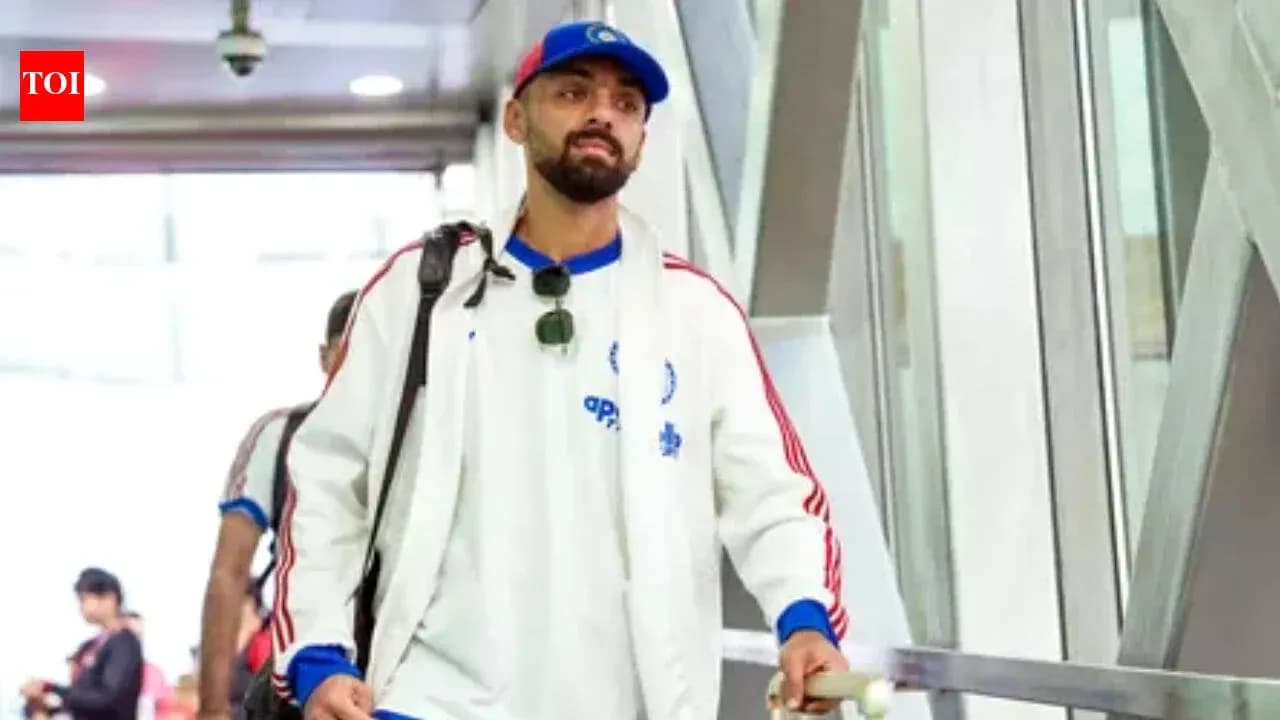
For most cricketers, 35 is a point to start counting backwards. For Varun Chakravarthy, it feels like the halfway mark.
He debuted for India at 29, an age when many have already been judged, labelled, and filed away. Yet in the last year alone he has lived a career’s worth of extremes: a T20 World Cup win on home soil as India’s joint-highest wicket-taker with 14 wickets, an IPL season played with hairline fractures in his left hand and toe, and then the first muscle injury of his life, a Grade 2 hamstring strain that stopped him cold.
Ask him where that leaves him, and there is no drama, no nostalgia. Just a simple line that sums up his worldview.
"At this stage of my career, I still feel I'm in my first half of my career because I started cricket very late. So I still feel there's a long way to go," he told TimesofIndia.com in an interaction facilitated by equipment manufacturer ASICS.
For a man who came to professional cricket from architecture, it fits. He has never chased headlines or grand five-year blueprints. In a format as unforgiving as T20, he prefers the next tweak, the next small edge, over the next milestone.
Now fully recovered from the hamstring injury picked up during the England T20I series, he walks back into a packed schedule: three T20Is against Afghanistan, a historic one-off international against Japan, and then the Asian Games in Aichi-Nagoya, where defending champions India start straight from the quarterfinals.
The clock says mid-30s. His mind says phase one.
Learning to Live With a Different Kind of Pain
Until this summer, Chakravarthy’s relationship with pain had been simple. Impact. Collision. Freak incidents. Something hits you, something breaks, you strap it up or fix it, and you go again.
A torn muscle was something else entirely.
"This is actually my first ever muscle injury. So all of my injuries have been impact injuries and other accidents that have happened on field," he explained.
The diagnosis sent him to the BCCI Centre of Excellence in Bengaluru, where the real battle was as much mental as physical. Muscle injuries linger in the mind. Spinners live on rhythm, on trust in their body at the crease. If that trust wobbles, the deception goes with it.
"The expertise at CoE helped me and people helped me to gain my confidence. Every person working there helped me," he said. The days were long, repetitive, and demanding.
"Definitely, I spent a lot of time there and did a lot of running and did a lot of strength training, which helped me."
The work went beyond ticking medical boxes. He had to convince himself he could still push off, still pivot, still bowl with the same freedom that made him such a puzzle for batters.
"Yeah, it will take some time to gain confidence. But once you gain confidence, you just start becoming more expressive and that's how it is," the 35-year-old reasoned.
Most players talk about injury lay-offs as lost months. Chakravarthy flips it.
"When you're away, you can start sharpening your skills. You can upskill yourself, which you don't get much time to do when you're playing continuously."
Time off, in his world, is not dead time. It is design time.
The Spinner Who Starts With His Feet
Mystery spin usually starts in the fingers, or in the wrist. With Chakravarthy, it starts somewhere far more prosaic: his shoes.
His association with ASICS may now be official, but the relationship began long before the contract. He says he shifted to their footwear around 2022, years before the formal deal arrived in January 2026.
The way he talks about shoes is the way an architect might talk about foundations.
"For a bowler, shoes are the biggest equipment they can have. Batters, they have many other equipments, but for a bowler, it's the shoes only," he said.
Then he gets into the specifics that only someone who has studied his craft from the ground up would notice.
"As a spinner, your feet start becoming little broader as in it starts changing shape once you pivot because the spinners have to pivot more after landing. So broad shoes in the toe area that is very important," he added.
Add a solid heel counter. Strip away unnecessary weight. That, for him, is the real toolkit.
It is a window into his evolution: from drawing plans on paper to building spells on a cricket field. Analytical. Detail-obsessed. Always searching for marginal gains that others might miss.
Beyond the Boundary: A Curious Mind Heads to Japan
The Asian Games, starting September 19, offer Chakravarthy something that even a T20 World Cup cannot: a village full of athletes who don’t play cricket at all.
"It's my first time in Japan. I've never been to Japan and any games also. So all I've played is ICC tournaments and ACC tournaments," he said, the excitement clear.
The cricket is important. The experience might matter just as much.
"I'm very much looking forward to meeting other athletes also from other different sports and all those things."
He is not talking about selfies or ceremony. He wants to watch. To learn.
"I want to see how a 100-metre athlete prepares himself, how a badminton professional prepares himself or herself," he went on to state.
In India’s crammed cricket calendar, players move from hotel to stadium to airport, sealed off from other sporting cultures. The Asian Games crack that bubble open. For someone wired like Chakravarthy, that exposure is fuel.
On the field, too, Japan will not be a copy-paste of home. The pitches at Korogi Sports Park are expected to behave differently from typical Indian surfaces. The conditions will ask questions that stock plans may not answer, and he knows it.
Adaptability, he believes, will matter more than any pre-written script for the bowling group.
For a late starter who still insists he is only halfway through his story, it feels fitting. New country. New conditions. New athletes to watch.
And a spinner who measures time not by age, but by how much better he can still get.