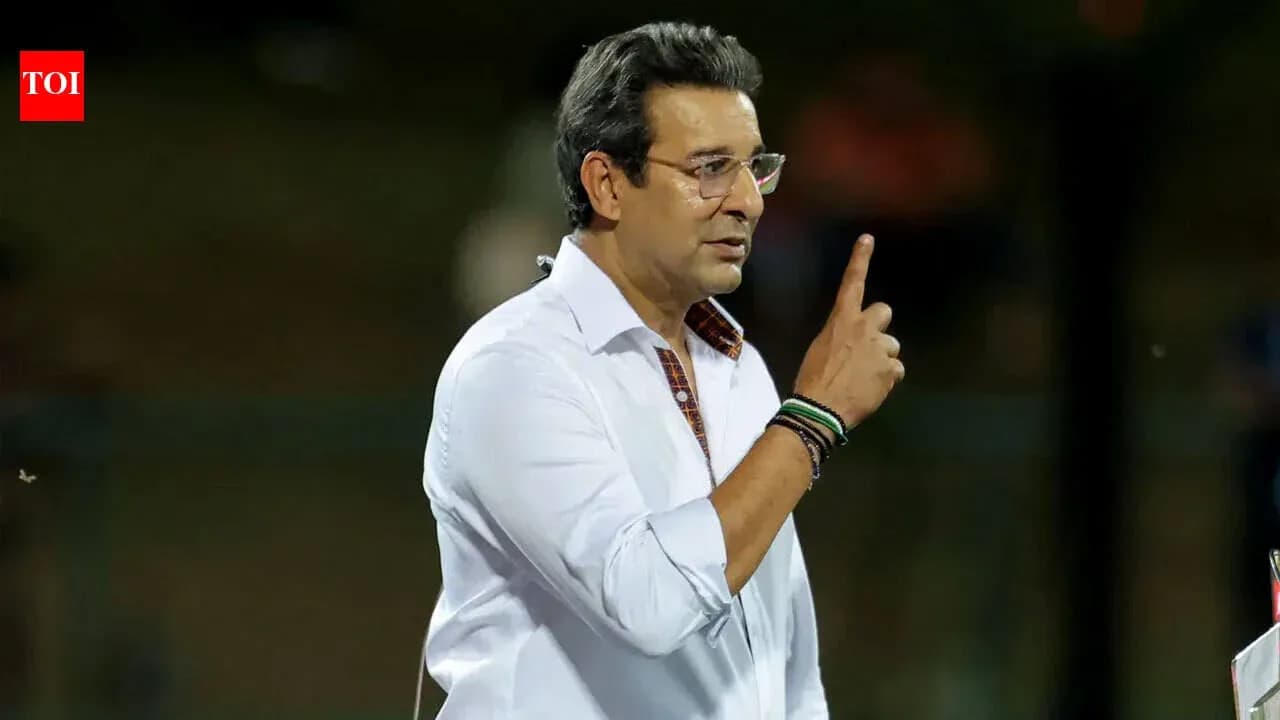
Wasim Akram has lived the India–Pakistan rivalry from the middle of the pitch, with a ball in hand and a stadium roaring for blood. Now, years after he last bowled in anger, he wants everyone else to calm down.
“It’s only a frikkin game,” the Pakistan great said on the 1 Mint podcast, cutting through decades of noise around cricket’s most charged contest. One of the sport’s sharpest minds has grown tired of seeing old wounds dragged into every new fixture.
‘Revenge is so 1970’
Akram has seen the rivalry at its peak: Sharjah thrillers, World Cup pressure cookers, bilateral series that felt like diplomatic missions. He understands the weight. He just refuses to carry it anymore.
“People have too much time. Why can’t they understand? It’s only a frikkin game. At the end of the day, it’s just a match. Somebody has to win, somebody has to lose. And move on to the next one,” he said.
Then came the sting.
“What happened many moons ago still lingers. Revenge and all is so 1970. It’s the classic ‘an empty mind is a devil’s workshop’ thought process.”
His frustration is aimed less at players and more at the ecosystem around them — a space where every India–Pakistan fixture now explodes online long before the first ball and long after the last handshake. The rivalry has migrated from packed stands and tense dressing rooms to timelines and comment sections, where nuance rarely survives.
For Akram, the equation remains brutally simple: one team wins, one team loses, both move on. The rest is baggage fans choose to carry.
A young fan in Australia
Amid the heavy talk, Akram’s story about Irfan Pathan offered a reminder of a softer, more human side to the rivalry.
The year was 2004. India were touring Australia. Akram, newly retired and in the commentary box, met a young left-arm seamer who had grown up watching him terrorise batting line-ups.
“Irfan met me in 2004 on his first tour to Australia; I was commentating. He was a big fan. Grew up watching us. I gave him a few tips here and there, but he did well early on in his career,” Akram recalled.
Pathan’s action always drew comparisons with Akram. The Pakistani legend didn’t try to rebuild the youngster; he tried to sharpen him.
“His action was similar to mine from the very beginning. But when players ask you about something, what you tell them is mostly about the mindset. Action and all is fine, because at that stage, you have reached that level where you’re representing the country,” he said.
So Akram went to work on the details that separate good fast bowlers from great ones: “Things like wrist position and how to suss out a batsman. When to use variations, when not to. So yeah, it was good fun. Irfan is a good boy; he still keeps meeting me.”
Those conversations helped shape one of India’s most effective left-arm quicks of the 2000s. Pathan’s ability to swing the new ball and move it late made the Akram parallels inevitable. His batting turned him into a genuine all-rounder. The rivalry, in that sense, produced not just tension but also a kind of cross-border cricketing lineage.
Pathan, Pakistan and the social media era
Pathan’s numbers against Pakistan underline just how much he relished those contests. Across formats, he took 67 wickets in 36 internationals against them — 27 in Tests, 34 in ODIs and six in T20Is.
One spell stands out above all. Karachi, 2006. First over of the Test. Pathan ripped through Salman Butt, Younis Khan and Mohammad Yousuf to claim a hat-trick, only the second by an Indian in Test history. In the cauldron of Pakistan’s backyard, a left-armer who once sought advice from Akram produced a moment that will live forever in Indian cricket folklore.
Retirement has not softened Pathan’s voice. If anything, it has amplified it. He has become one of India’s most outspoken former cricketers on television and social media, often weighing in on India–Pakistan clashes and occasionally taking aim at Pakistan and its players.
Akram, though, responded with a mix of amusement and realism.
“It’s a different thing that he keeps tweeting some or the other thing against Pakistan. But our fans are ready too. They don’t have the tendency to ignore either. They just have to reply,” he said, half exasperated, half amused.
That single line captures the modern rivalry as sharply as any scorecard. One comment, one tweet, one clip — and the digital stands fill up. The argument rarely stays on cricket. Old narratives flood back in.
Drawing the line
Akram isn’t asking for the rivalry to be diluted. He knows better than anyone that India vs Pakistan, stripped of its edge, would not be the same. What he wants is perspective.
He wants the game to stop serving as a proxy battlefield for history and politics. He wants fans to argue about tactics and selection, not revenge and resentment. He wants the outcome of a match to remain just that — an outcome, not a referendum on identity.
“Somebody has to win, somebody has to lose. And move on to the next one,” he repeated, almost as a mantra.
The question now is whether anyone is listening in an era where every ball is clipped, shared, dissected and weaponised. As the next India–Pakistan clash looms, will it be cricket that takes centre stage — or the noise that drowns it?