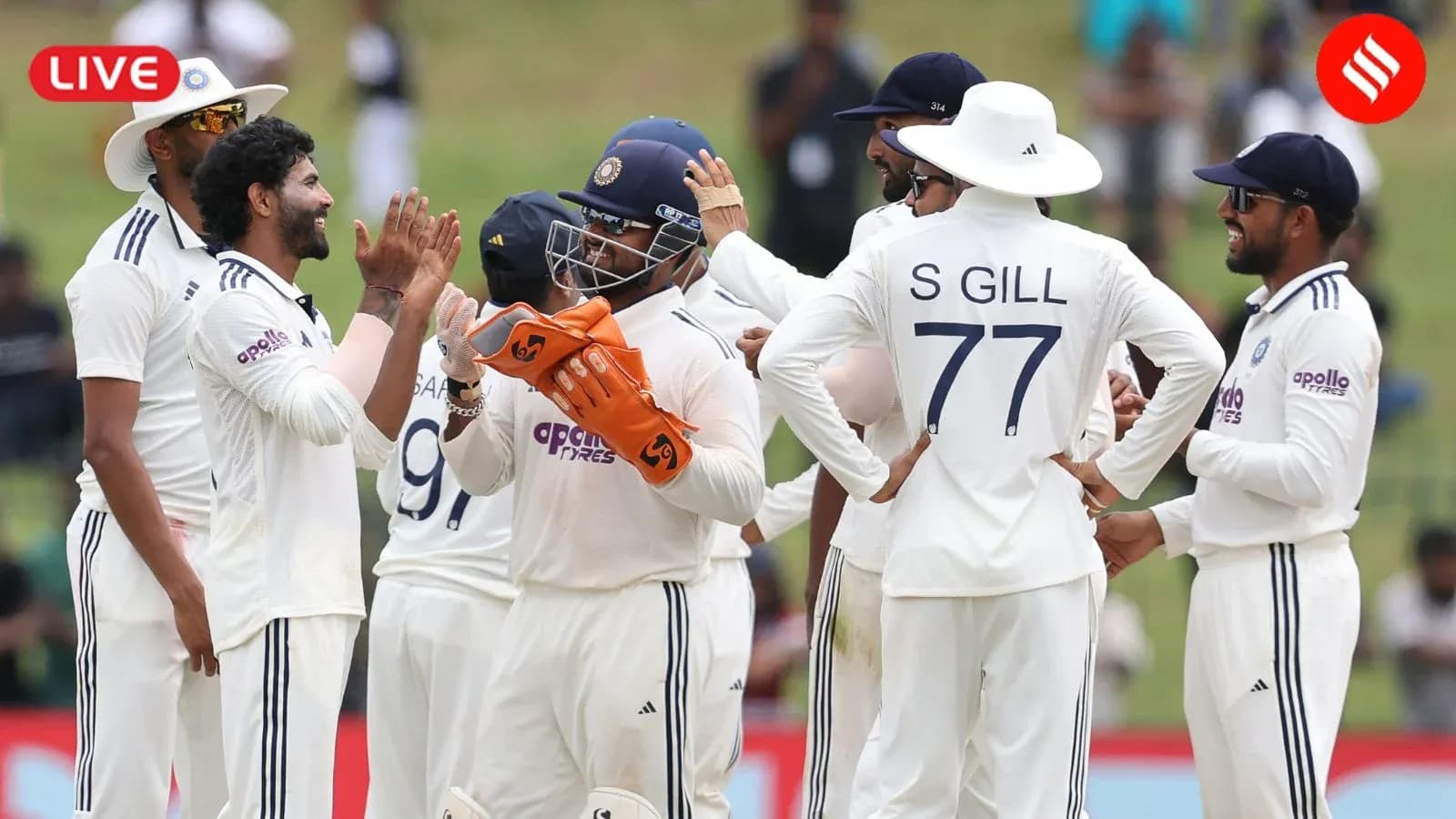
Colombo’s final day began with India eyeing a clean sweep and a fat haul of World Test Championship points. It ended with shoulders drooping, fields spread, and a young Sri Lankan allrounder standing tall amid the wreckage of a series his team has largely been outplayed in.
Sonal Dinusha did it to India once. Then twice. On Thursday, he did it again.
Batting through pain, marshalling the tail and draining the clock, the left-hander ground India down as Sri Lanka, asked to follow on, crawled from the brink of another heavy defeat to the safety of a near-certain draw in the second Test in Colombo.
By the time Sri Lanka reached 395/8 in their second innings, still following on but with 140.3 overs chewed up and a lead of 182, the contest had lost its edge. The umpires were almost down to the formalities. India, who had spent almost two full days in the field across two innings, had run out of time, ideas and, crucially, bite from the surface.
The series, though, had found its defining figure.
A Pitch That Refused to Die – or Misbehave
This was supposed to be Sri Lanka’s kind of surface. Sairaj Bahutule, India’s spin coach, had called it a “really, really good” pitch for everyone – batters, quicks, and spinners – with the familiar subcontinental twist: turn arriving late in the game, but a soft ball and damp seam dulling its menace after 30 overs.
He was right on all counts. The ball did grip from Day 2, but never savagely. It spat from the rough occasionally, not from the straight. Batters could trust their defence, play late, and leave with confidence. On a surface like that, wickets had to be earned the hard way or gifted by impatience.
For large parts of this Test, Sri Lanka’s top order chose the second option.
India, having rolled them for 290 in the first innings – Prasidh Krishna the standout with his bounce and discipline, Mohammed Siraj pounding the pitch with hostile short balls – enforced the follow-on without hesitation. With weather around, it was the only logical move. One more good session, they thought, and the game would be gone from Sri Lanka.
They got more than that. They got three-quarters of the job done. They just never quite found a way past Sonal Dinusha.
Follow-On, Then Fightback
Sri Lanka’s second innings began in familiar chaos. Lahiru Udara fell to Siraj for 10, fending a short ball straight to Saransh Jain at square leg. The openers had failed again, the new ball had struck again, and India’s quicks, despite the heavy workload, looked ready to finish the job.
Kamil Mishara briefly counter-punched but swept once too often. Ravindra Jadeja, relentless as ever around that stump-to-stump line, pinned him lbw for 29. The decision survived review on umpire’s call, a reminder of how unforgiving Jadeja can be when batters misjudge length or line.
At 83/2 at lunch on Day 4, Sri Lanka still trailed by 130. India had the game exactly where they wanted it.
Then came the first of several partnerships that would slowly twist the mood.
Pasindu Sooriyabandara and Kamindu Mendis, who had shown promise in the first innings, dug in and then expanded. They attacked Manav Suthar, they used the sweep and the pull, and they refused to let India’s spinners settle. Pasindu reached his half-century, even unfurling a no-look slog-sweep that should have been his undoing – Siraj misjudged the catch in the deep.
The risk-taking was high. The reward was a 100-run stand that dragged the deficit under 100 and forced Shubman Gill to shuffle through his bowlers, searching for a spark.
Kamindu’s half-century came with a clean six over square leg. He looked set for something bigger until Prasidh, operating with Rishabh Pant up at the stumps, lured him into one pull shot too many. Gill, backpedalling, took a fine catch. A breakthrough, but not a collapse.
Dhananjaya de Silva, elegant and compact, picked up the baton. Pasindu moved into the 90s. The pitch went to sleep. By tea, Sri Lanka were 199/3, just 14 behind, and India’s grip had loosened.
India Hit Back – Then Ran Out of Time
The final session on Day 4 belonged to India’s spinners and the weather.
Saransh Jain, on debut and searching for validation in wickets rather than just control, finally found his rhythm. Bowling in tandem with Siraj, he cramped Niroshan Dickwella, beat him on the inside edge and trapped him in front. The review showed three reds. Another wicket, another squeeze.
Earlier, Suthar had prised out Dhananjaya with a soft dismissal – inside edge onto pad, looping to Devdutt Padikkal at gully – then outfoxed Pasindu Sooriyabandara, dragging his length wider as the batter charged, allowing Pant to complete a neat stumping. The pair that had tormented India were gone.
Sri Lanka slid from 199/3 to 221/6. Dinusha walked in with the game on the line, just as he had in the first innings.
India’s quicks, especially Siraj, went hard at him. They banged it into the ribs, probing what they had identified as a weakness against the short ball in that awkward rib-cage zone. Morne Morkel, India’s bowling consultant, had spoken about using Prasidh and Siraj in “risky” phases for high reward; this was one of them.
The pressure mounted. The runs dried up. Sri Lanka’s lead, still modest, crawled. At 228/6, with the light fading and the clouds rolling in, India were almost there.
Then the rain came.
Play was halted. The drizzle turned to something heavier. Covers went on. The session, and with it India’s surge, was cut short. The forecast for the final day suddenly loomed larger than the scoreboard.
Dinusha’s Masterclass, Part Two
If Dinusha’s first-innings hundred – Sri Lanka’s 290 built almost entirely around his composure and shot selection – had kept his side from an innings defeat, his second was something even more exacting: a long, slow act of resistance that demanded skill, stamina and stubbornness.
Resuming Day 5 at 290 all out and 83/2 following on, Sri Lanka needed time more than runs. They needed someone to play the kind of innings that wears down bowlers and frays fielding plans. Dinusha was that man.
By the morning’s first drinks break, he and Keshara Nuwantha had stitched together a 50-run stand. Nuwantha, disciplined and narrow in his strokeplay, played within the stumps, leaving almost everything outside off. Dinusha swept, defended and ran with purpose. The lead crept past 50, then 100.
India tried everything. Jadeja and Jain started the day, with Suthar rotating in. Gill changed ends for his spinners, shifted fields, brought on Prasidh and Siraj with the new ball, then without it. He even flirted with the idea of part-timers later in the day as Jadeja left the field with heel discomfort.
The pitch, though, refused to misbehave. There was turn, yes, and more of it than on the first morning, but nothing that screamed inevitability. No ball with a name on it. No sudden explosion from a good length. Just hard, honest toil.
When Nuwantha finally edged Suthar to Dhruv Jurel for a sharp catch, ending a draining stand, India had their opening. Prabath Jayasuriya came in and shut the door again, facing over 20 balls with dead-bat discipline. Every minute he survived was another small victory for Sri Lanka.
By lunch, Sri Lanka were 330/6, leading by 116. They had gone wicketless through the entire morning session. India’s frustration was clear; the closest they came was a padded-out decision against Nuwantha overturned on review.
The Final Squeeze That Never Came
The afternoon session began with India still believing. One cluster of wickets, one little burst, and a chase would be on. The carrot of a last-day pursuit, perhaps even a declaration from Sri Lanka if they got far enough ahead, hovered in the background.
Instead, the game slowly bled towards stalemate.
Sonal Dinusha passed fifty again, sweeping with the same authority that had troubled India’s spinners all series. His use of the sweep – reminiscent of Ben Duckett and Tom Latham, who have similarly tormented Indian spin attacks – repeatedly upset the lengths of Jadeja, Jain and Suthar. Every time India thought they had him pinned, he’d roll a sweep into the gap, take a single, and reset.
Jayasuriya, for his part, refused to be drawn outside off. He played inside the line, trusted his pads, and forced India to aim at the stumps on a surface that still didn’t quite do enough.
When he finally fell, driving Jadeja and offering a chance, India sensed a crack. Lahiru Kumara, who had chewed up 52 deliveries in the first innings, walked in with a clear brief: survive.
He did more than that. He stonewalled.
Kumara’s first task was to blunt the new ball. He did it with a straight bat and a surprising calm. Dinusha, struggling with a back issue, often gave him the strike early in the over, trusting his partner to block out the rest. Over after over, Kumara dead-batted, left well, and soaked up time.
By tea, Sri Lanka were 383/8, leading by 170. Dinusha was stranded on 98, two runs short of what would become his third century of the series. India’s bowlers, especially the spinners, looked drained. The draw, once a distant possibility, now felt like the only realistic outcome.
When Dinusha finally reached his hundred in the final session, the applause in Colombo carried a different tone. This was not a flourish in a lost cause; it was the knock that had turned a series whitewash into a salvage job.
Gill’s Gambles, India’s Lessons
Shubman Gill’s first series as full-time Test captain in these conditions has been an education in patience and problem-solving.
He enforced the follow-on decisively. He rotated his bowlers aggressively. He backed his debutant off-spinner, Saransh Jain, through lean patches. He trusted his quicks to bowl the “donkey overs” Morkel had spoken about – long, hard spells on an unresponsive pitch – and they responded.
Yet small tactical questions will linger.
Could Jadeja have been used longer with the older ball before the new one was taken? Should slips have been in place more often for Siraj and Prasidh, rather than deep fields built primarily for the short ball? Might one of the part-time spinners, Yashasvi Jaiswal or Devdutt Padikkal, have offered a different angle once the main options ran flat?
Those are the margins that separate a ruthless finish from a drawn-out stalemate.
What India did get, though, was a deeper look at their future. Jain, described by Bahutule as “peculiar” for his side-spin, drift and flat trajectory around 80–85 kph, showed the control and temperament to survive a tough debut. Suthar, under attack at times, still found ways to strike. Prasidh underlined his growth as a bowler who can now hit a fuller length consistently, not just bang it in.
And Siraj, even on a dead pitch, kept bending his back, kept chirping, kept asking questions.
Dinusha, the New Thorn in India’s Side
Across this series, one name has repeatedly dragged Sri Lanka from embarrassment to respectability: Sonal Dinusha.
Two centuries before this Test. A third here under immense pressure. Runs scored while shepherding the tail, while nursing a sore back, while being bounced and prodded and prodded again. Add his left-arm spin, and Sri Lanka suddenly have a genuine allrounder with the temperament for long, hard days.
In Colombo, he was the difference between a 2–0 scoreline and a 1–0 result that feels, from a Sri Lankan perspective, far less brutal than it might have been.
India will leave with the series. They will leave with points. They will also leave knowing that when Australia arrive for the next home assignment, pitches like this – slow, honest, unforgiving for bowlers – will demand more creativity, more ruthlessness, and perhaps a little more luck.
As for Sri Lanka, they leave with a question of their own: if they can build a side around Dinusha’s grit and Dhananjaya’s class, and cut out the reckless strokes that littered this series, how long before days like this in Colombo are about more than just survival?