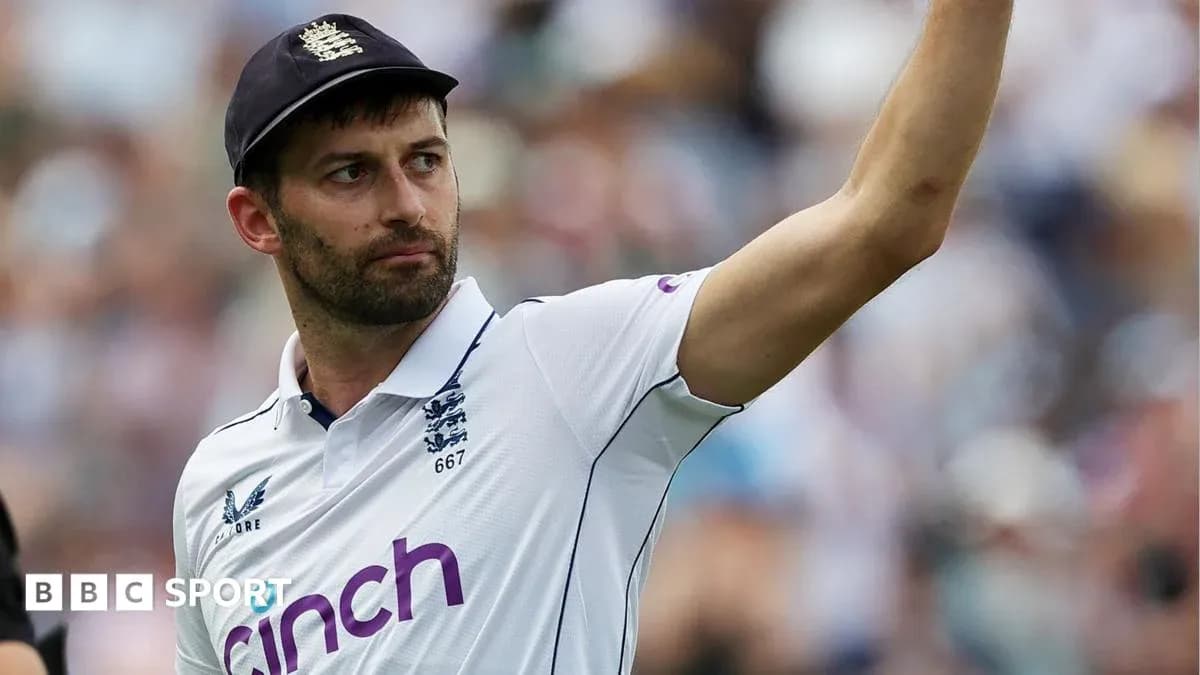
Mark Wood, one of the quickest and most compelling fast bowlers England have ever fielded, has walked away from international cricket. No farewell tour, no staged goodbye. Just a blunt, immediate full stop at 36, delivered with the same honesty that defined his career.
His body made the decision long before he did.
The Durham quick had only just dragged himself back into an England shirt for the first Ashes Test in Perth in November, ending 15 bruising months out with elbow trouble and knee surgery. He lasted 11 overs. The left knee ballooned again, the flight home followed, and he never bowled another ball for his country.
“Although this may not come as a surprise given the past year, it just feels like a natural time at the end of my contract,” Wood said in a statement on social media. He spoke of resilience, of trying to prove people wrong, of finally losing the battle. Medical advice was clear: no more Test cricket, no more 50-over cricket. The England dream, as he put it, “slowly been ground out of me over the last year.”
For a man who lived to bowl fast, that is a brutal sentence.
A career of extremes
Wood’s numbers tell one story. His body tells another.
He finishes with 119 wickets in 38 Tests, a career that began in 2015 and, in that same first summer, helped England wrench the Ashes back on home soil. Across formats he became a genuine multi-trophy player: part of the XI on that surreal day at Lord’s in 2019 when England won the 50-over World Cup, and in the squad that lifted the T20 World Cup in 2022.
In white-ball cricket, he leaves as England’s sixth-highest wicket-taker in men’s T20s, with 54 wickets from 38 matches, and 80 wickets in 70 ODIs. Those figures sit neatly in record books. They do not capture what it felt like to watch him.
Anyone who has ever tried to bowl fast understands the fantasy: hurtling in, ball fizzing, batters hopping, stumps cartwheeling. Wood lived that fantasy for real. Few in England colours – few anywhere – have operated at his speed. The run, the leap, the violent snap at the crease, often leaving him sprawled on the turf, were as much performance as skill. He bowled himself off his feet, literally and repeatedly.
Crowds loved it. Not just the pace, but the man. Wood never hid behind the role of snarling quick. He joked, he engaged, he looked like someone who hadn’t forgotten that cricket is supposed to be fun. The game, particularly in its most intense moments, needs that.
Rebuilt run-up, same thunderbolts
The price for that pace was savage. Ankle, knee, elbow – the injury list reads like a medical chart rather than a career log. By 2018, something had to change. To ease the strain, Wood lengthened his run-up, a calculated gamble to spread the load through his action.
The risk paid off. The pace stayed. The spells got longer. And when everything aligned, the results were devastating.
St Lucia in 2019 was the clearest early glimpse of the remodelled Wood. Against West Indies he tore through with a demolition job that announced a new phase of his career. This was not just raw speed; it was controlled, repeatable hostility.
He carried that into some of England’s biggest days. At Lord’s in 2019, half-crippled but unwilling to give in, he walked out to bat with Ben Stokes in the most nerve-shredding World Cup final of all. Three years later, he was part of the group that conquered the T20 world, even if a calf problem denied him a place in the closing stages of that tournament.
Ashes theatre and what might have been
The Ashes became his grandest stage and his harshest mirror.
On the wretched 2021–22 tour of Australia, when so much of England’s cricket fell apart, Wood emerged with credit. He bowled as though the scoreline didn’t matter, hammering away with unrelenting pace while others faded.
Then came the home Ashes in 2023, and the kind of entrance that sticks in a series’ folklore. Held back until the third Test at Headingley, with England 2-0 down and clinging to the contest, Wood arrived like a storm front. He bowled at near-light speed, a blur of limbs and aggression, and delivered one of the great Ashes spells.
Usman Khawaja, so serene all series, was blasted out by a 95mph thunderbolt. The crowd roared, England’s belief surged. Later, in a tense run chase, Wood was there again, this time with the bat, alongside Chris Woakes. Two players recalled mid-series, two close friends, dragging England over the line and keeping the urn within touching distance. Without them, that series would have been a procession.
That was Wood at his best: series-changing, mood-altering, a point of difference when everything else looked the same.
And yet, threaded through it all, the same question lingers. What if his body had held together? What if those long stretches in rehab had been spent on the field instead?
The end of an era
The final chapter came in Australia, but not in the way anyone imagined. After prolonged rehab on elbow and knee injuries, Wood returned for the first Ashes Test in Perth last November. England hoped for the old pace. It never truly arrived. He managed only 11 overs before the knee swelled again. Later, he admitted he felt “ashamed” by how it had gone.
That sense of unfinished business now sits alongside his medals.
Rob Key, managing director of England men’s cricket, called it “a privilege to watch the latter part of a great career” and highlighted Wood’s role as a difference-maker in Ashes wins and two World Cup triumphs, a bowler who thrilled every time he had the ball in hand. Key is right: very few players can claim to have changed games and tournaments with such frequency, across formats, at that speed.
Wood is in rare company. He is one of a small group of England players to have won both World Cups and the Ashes, having been part of the last side to regain the urn in 2015. With his retirement, Joe Root stands alone in the current Test set-up as the only player to have tasted Ashes glory.
The broader picture is stark. In less than three years, England’s Test side has waved goodbye to Stuart Broad, James Anderson, Woakes and now Wood. Add in Ben Stokes’ all-round bowling contribution effectively being lost, and that is 1,871 Test wickets gone from the attack.
An era of English pace has ended almost in a single exhale.
Wood says he hopes to continue playing cricket in some form. County shirts, franchise leagues, perhaps one last burst of that familiar, whirring run-up somewhere under lights. Whatever comes next, the sight of him charging in for England – hair back, knees pumping, body on the brink – is now filed away.
For a generation of batters, that will be a relief. For everyone else, it feels like the game has just lost one of its purest adrenaline rushes.